

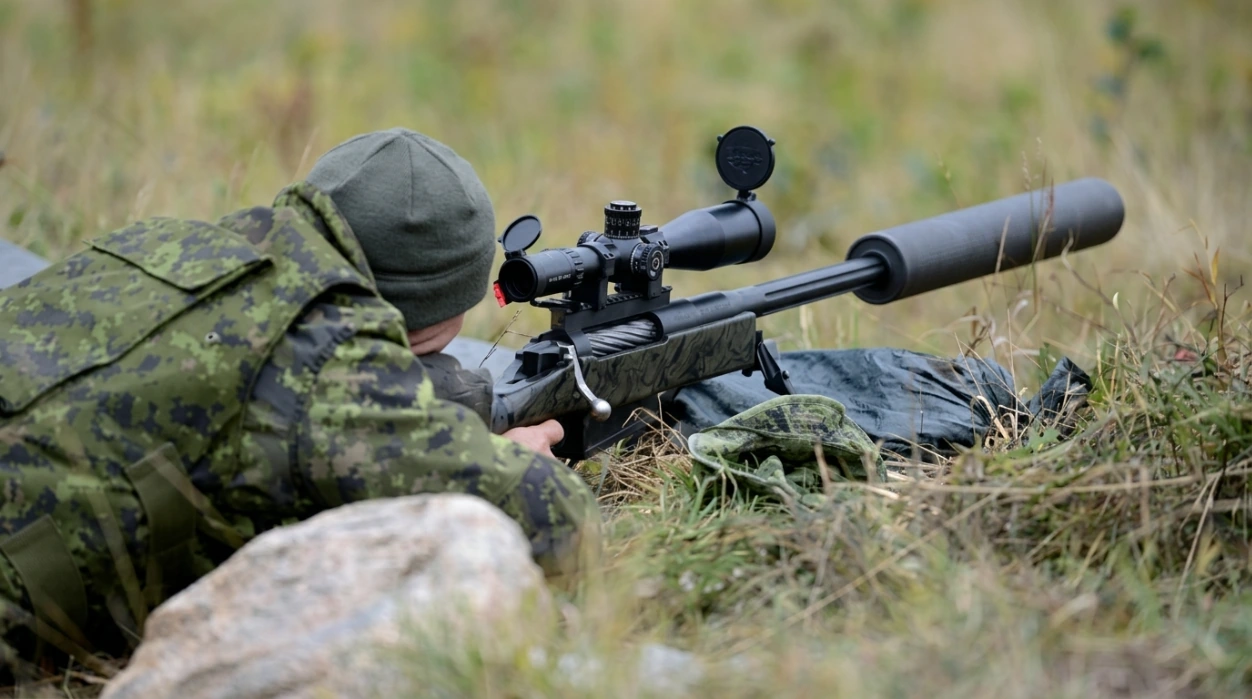
Few rifles have given the .50 BMG cartridge a reputation quite like the McMillan TAC-50. It is a large, heavy bolt-action rifle, yet its story isn’t really about size. It’s about what happens when a powerful cartridge is built around precision rather than volume of fire.
The TAC-50 emerged from McMillan’s experience with .50-caliber rifle designs and eventually found its way into military service, most notably with Canada’s C15 Long Range Sniper Weapon and the U.S. Navy’s Mk 15 Mod 0. Its reputation grew further through extraordinary long-range battlefield engagements, including a widely reported 3,540-meter shot in Iraq in 2017.
But focusing only on that record misses the bigger story.
The TAC-50 represents a particular approach to the .50 BMG: a manually operated precision rifle designed to combine extreme range with a relatively straightforward mechanical architecture. That makes it quite different from semi-automatic .50-caliber rifles such as the Barrett M82/M107.
So, how did a rifle built around such a simple concept become one of the most recognizable heavy-caliber precision weapons in modern military service?
That’s where the McMillan TAC-50 story really begins.
Read more: 5 Most Accurate Sniper Rifles in the World Ranked
What Is the McMillan TAC-50?
The McMillan TAC-50 is a heavy-caliber, bolt-action precision rifle chambered for the .50 BMG (12.7×99mm NATO) cartridge. Developed in the United States by McMillan, it was designed around a straightforward concept: combine the reach of .50 BMG with the consistency expected from a precision rifle.
Unlike semi-automatic .50-caliber rifles such as the Barrett M82/M107, the TAC-50 uses a manual bolt-action system. It feeds from a five-round detachable magazine and is built around a heavy barrel intended to support precision shooting.
The rifle is also known by different designations depending on the customer. Canada adopted it as the C15 Long Range Sniper Weapon, while the U.S. Navy SEALs used a version designated the Mk 15 Mod 0. These names can make the TAC-50 family look more complicated than it really is. They generally represent military configurations and designations of the same basic McMillan platform.
The TAC-50’s size is impossible to ignore, but that isn’t necessarily its defining characteristic. The more interesting feature is the design philosophy behind it. Rather than relying on semi-automatic fire, McMillan built the rifle around a manually operated action and a heavy-caliber cartridge capable of supporting long-range precision and anti-materiel roles.
That combination eventually made the McMillan TAC-50 one of the most recognizable .50-caliber precision rifles in military service. And its later variants would show that the original design had considerably more room to evolve than its imposing appearance might suggest.
History and Development of the McMillan TAC-50
The McMillan TAC-50 did not appear out of nowhere. Its development grew from McMillan’s earlier work with .50-caliber rifles, particularly the company’s M87 and M88 designs. That experience gave McMillan a foundation for building a rifle that could use the same powerful cartridge while placing greater emphasis on long-range precision.
The TAC-50 eventually emerged as a bolt-action .50 BMG platform, rather than following the semi-automatic approach used by rifles such as the Barrett M82. That choice shaped much of the rifle’s character. The design focused on a heavy barrel, rigid construction and a manually operated action — a fairly old-school recipe, but one that made sense for a weapon intended for deliberate long-range fire.
Canada became one of the TAC-50’s most important early military customers. Around 2000, the Canadian Armed Forces adopted the rifle as the C15 Long Range Sniper Weapon, giving the platform a formal military role and establishing its reputation beyond the commercial market. Later C15A1 and C15A2 versions introduced further modernization.
The U.S. Navy SEALs also adopted the platform, designating their version the Mk 15 Mod 0 Special Applications Sniper Rifle. That second major military adoption showed that the TAC-50 was not simply a Canadian solution. Its combination of .50 BMG capability and bolt-action precision had wider appeal.
The interesting part is that McMillan didn’t need to reinvent the .50-caliber rifle to make the TAC-50 relevant. Instead, it refined an established concept around a different priority: precision at extreme range.
That approach would eventually make the TAC-50 famous far beyond its original military requirements.
McMillan TAC-50 Specifications
The McMillan TAC-50 is a large precision rifle built around the .50 BMG cartridge, and its dimensions reflect that role. The rifle is designed for deliberate, long-range fire rather than rapid follow-up shots, with a heavy barrel and manually operated bolt-action system.
| Specification | McMillan TAC-50 |
| Origin | United States |
| Manufacturer | McMillan |
| Caliber | .50 BMG / 12.7×99mm NATO |
| Action | Manual bolt-action |
| Barrel | Approx. 29 in / 737 mm |
| Magazine | 5-round detachable |
| Overall length | Approx. 1,448 mm |
| Weight | Approx. 11.8 kg |
| Role | Long-range precision / anti-materiel rifle |
Technical references commonly list the TAC-50 with a 29-inch barrel, five-round magazine and an overall length of roughly 1.45 meters. Its weight is around 11.8 kg, although later configurations can differ depending on the stock and equipment fitted.

One figure that needs some context is range. Published references generally place the TAC-50’s effective range at around 2,000 meters, but that should not be confused with the extraordinary 3,540-meter engagement later associated with the rifle.
The distinction is important. A published effective range describes the weapon’s expected operational capability under defined conditions; a record-setting engagement represents something far outside ordinary use.
The TAC-50’s specifications also reveal its basic philosophy. There is no attempt to make the rifle compact or fast-firing. Instead, the design accepts considerable weight and size in exchange for a stable, powerful platform built around .50 BMG and long-range precision.
In that sense, the numbers tell a story of their own: this isn’t a rifle designed to do everything. It’s a specialized tool built around one demanding job.
Read more: 5 Best Sniper Rifles in the World Ranked by Performance
McMillan TAC-50 Variants
The McMillan TAC-50 has not remained frozen since its introduction. Over time, McMillan and military users have refined the platform with changes aimed at improving handling, recoil management and compatibility with modern equipment.
The TAC-50 A1 represents an updated version of the original rifle, incorporating changes to the stock and overall ergonomics. The basic formula remained familiar: a bolt-action .50 BMG rifle built around a heavy barrel and detachable magazine.
A more distinctive development was the TAC-50 A1-R2, which introduced a hydraulic recoil-mitigation system. McMillan’s documentation described the system as capable of reducing peak recoil by approximately 90 percent, spreading the recoil impulse over a longer period rather than eliminating it outright.

The TAC-50C takes the platform in a more modern direction. Instead of relying on the traditional fiberglass stock, it uses a Cadex chassis, providing greater adjustability and a more contemporary interface for accessories and optics.
Military designations add another layer to the story. Canada’s original TAC-50 became the C15 Long Range Sniper Weapon, followed by the C15A1 and C15A2 as the system was modernized. The U.S. Navy SEAL version is known as the Mk 15 Mod 0.
These names shouldn’t be mistaken for completely unrelated rifles. They reflect different configurations, customers and stages of the platform’s development.
What stands out is how conservative the evolution has been. The TAC-50 didn’t need a radically different operating system to stay relevant. Instead, modernization focused on the parts the shooter actually interacts with, such as; stock design, recoil management, adjustment and accessory integration, all while preserving the core .50 BMG bolt-action concept.
McMillan TAC-50 Military Users and Operators
The McMillan TAC-50 has developed a military footprint that is smaller than some mass-issued rifles, but its users are significant because the platform was adopted specifically for specialized long-range roles.
Canada is the most important example. The Canadian Armed Forces adopted the TAC-50 as the C15 Long Range Sniper Weapon, making it a key part of Canada’s heavy-caliber precision capability. Later C15A1 and C15A2 versions continued the platform’s service through modernization rather than immediate replacement.
The United States represents another prominent user. The U.S. Navy SEALs adopted a version as the Mk 15 Mod 0 Special Applications Sniper Rifle, giving the TAC-50 a place within American special operations.

Other documented operators have included military and specialized units in countries such as France, Turkey and South Africa, although the exact configuration and role can differ between users. This is worth emphasizing because online lists sometimes combine commercial sales, police use and military adoption into one oversized “user list.”
The Canadian and American examples are particularly useful because they show two different paths to the same platform. Canada integrated the rifle into a dedicated military C15 family, while the U.S. Navy gave its version a separate Mk 15 Mod 0 designation.
That doesn’t mean every McMillan .50-caliber rifle encountered in military service should automatically be called a TAC-50. McMillan has produced several heavy-caliber designs, and military designations can obscure those differences.
The better way to view the TAC-50’s international service is this: it found its niche among forces that valued the combination of .50 BMG capability, precision and a manually operated action rather than needing a general-purpose infantry weapon.
The McMillan TAC-50’s Record-Setting Reputation
The McMillan TAC-50 became famous for more than its .50 BMG chambering. Its reputation changed dramatically after a Canadian special operations sniper reportedly used a TAC-50-derived C15 in Iraq in 2017 to engage a target at approximately 3,540 meters.
The shot was widely reported as the longest confirmed sniper shot at the time, surpassing the previous record of about 2,475 meters, set by British sniper Craig Harrison in Afghanistan in 2009 using an Accuracy International L115A3 chambered in .338 Lapua Magnum.
That comparison is particularly interesting because the two rifles represent different approaches to extreme-range military sniping. The L115A3 uses the smaller .338 Lapua Magnum, while the TAC-50/C15 uses the substantially larger .50 BMG cartridge.

But there’s an important catch: a record-setting engagement should not be treated as the rifle’s normal effective range.
Published technical references generally place the TAC-50’s effective range at around 2,000 meters, while the 3,540-meter event occurred under highly specific battlefield conditions. Extraordinary shots depend on far more than the rifle itself, including ammunition, optics, environmental conditions and the skill of the sniper team.
That’s what makes the record interesting from a defense-technology perspective. It wasn’t simply proof that the TAC-50 could “shoot farther.” It demonstrated how a combination of heavy-caliber ammunition, precision rifle design and a sophisticated sniper system could push the boundaries of what was considered achievable at extreme range.
The record gave the TAC-50 a legendary reputation. But its real military significance goes beyond one remarkable shot.
McMillan TAC-50 in Modern Military Service
The McMillan TAC-50 has continued to evolve rather than simply remaining frozen in its original configuration. That matters because modern military precision rifles are expected to work alongside increasingly sophisticated optics, observation equipment and accessory systems.
One of the clearest developments is the TAC-50C, which moves away from the traditional fiberglass-stock approach toward a modern chassis configuration. The change gives users greater adjustability and a more contemporary interface for optics and other equipment while retaining the core bolt-action .50 BMG architecture.

Canada’s C15 family also demonstrates how the platform has been maintained through successive upgrades. The original C15 designation was followed by the C15A1 and C15A2, reflecting an effort to keep the system relevant rather than immediately replacing it with an entirely different rifle.
Recoil management has been another area of development. The TAC-50 A1-R2, for example, introduced a hydraulic system designed to reduce the rifle’s perceived recoil impulse. That kind of improvement illustrates an important reality of heavy-caliber rifles: making the cartridge more capable is only half the challenge. The rifle also has to remain manageable for the person carrying and operating it.
Modern military sniping has increasingly become a system rather than a single weapon. Better optics, rangefinding equipment, observation tools and other supporting technologies can influence overall capability just as much as changes to the rifle itself.
The TAC-50 therefore occupies an interesting position today. It isn’t the newest .50-caliber precision rifle, nor does it need to be. Its continued development shows that the basic combination of bolt-action precision, .50 BMG capability and modular modernization remains useful for specialized military roles.
Why the McMillan TAC-50 Still Matters
The McMillan TAC-50 remains significant because it demonstrated that the .50 BMG cartridge could be built into a rifle where precision was just as important as raw reach. Instead of relying on semi-automatic fire, the TAC-50 uses a deliberate bolt-action design that puts the emphasis on consistency and long-range capability.
Its military legacy is equally important. Canada’s C15 and the U.S. Navy’s Mk 15 Mod 0 showed that the platform could meet demanding requirements for specialized forces. Later C15 upgrades and TAC-50 variants demonstrated that the basic design could continue evolving without abandoning its original concept.

The rifle’s record-setting reputation certainly helped make it famous, but that is only one part of the story. The more lasting contribution is the niche the TAC-50 occupies between a conventional precision rifle and a much heavier anti-materiel system.
Its continued development also says something about military procurement. A weapon doesn’t necessarily need to be replaced simply because newer technology exists. If the underlying combination of range, precision, ammunition capability and reliability still answers a specific requirement, modernization can make more sense than starting over.
That is essentially the TAC-50’s story.
It began as a specialized .50 BMG bolt-action rifle, became a major military precision platform and later evolved through improved stocks, recoil management and modern chassis systems.
More than its impressive size or famous long-range records, the TAC-50’s real legacy is the idea behind it: a heavy-caliber rifle doesn’t have to be built around volume of fire. It can instead be engineered as a carefully refined precision instrument and that concept has kept the TAC-50 relevant for decades.
