

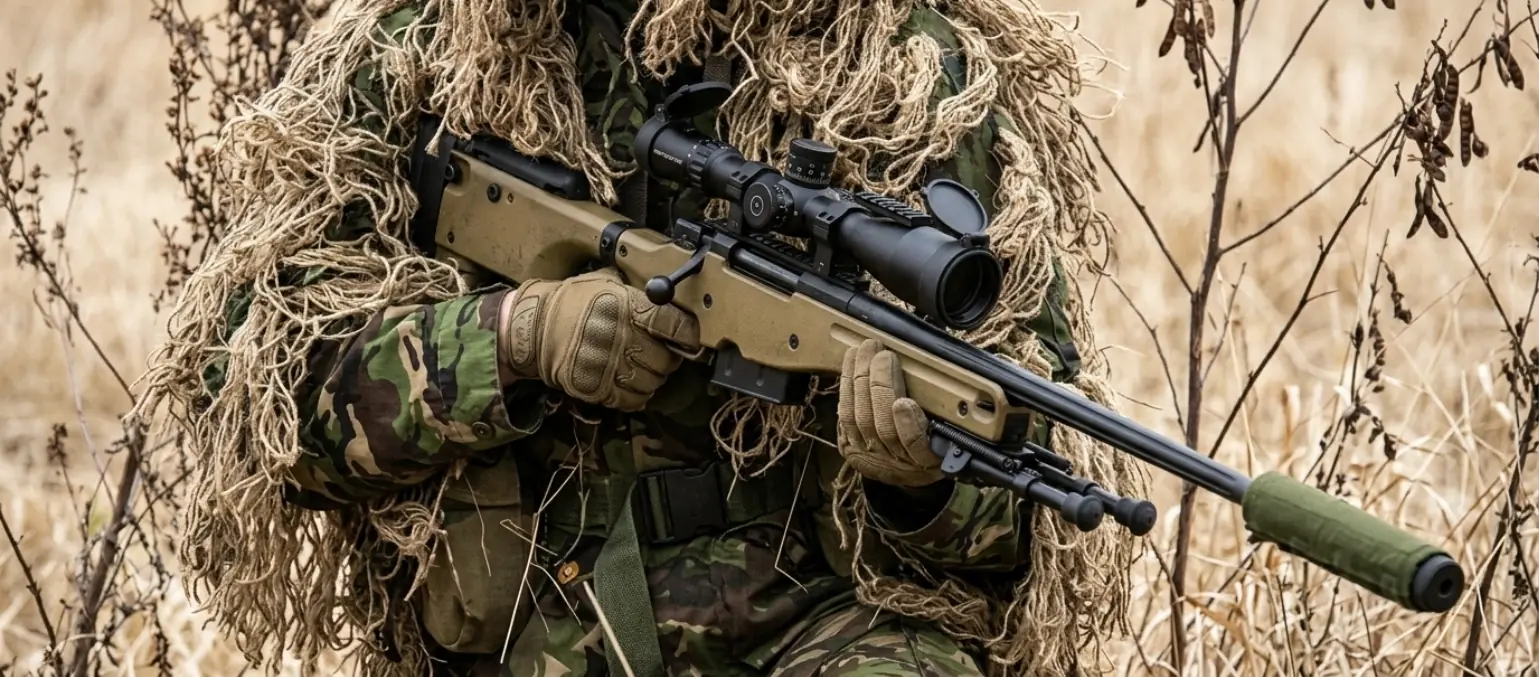
The Accuracy International AWM has earned a reputation for extreme-range military sniping, but its story didn’t begin with the famous .338 Lapua Magnum. It grew from the company’s earlier Arctic Warfare rifle family, with Accuracy International adapting the established design to accommodate longer, more powerful Magnum cartridges.
That evolution produced configurations chambered for .300 Winchester Magnum and .338 Lapua Magnum, giving the AWM a different role from conventional 7.62mm precision rifles.
The rifle became particularly famous through Britain’s L115 series. The L115A3, a .338 Lapua Magnum configuration, is listed by the British Army with a 6.8 kg weight, 1,300 mm length and an effective range of more than 1,100 meters.
But the numbers only tell part of the story.
The more interesting question is how a British bolt-action rifle evolved from the Arctic Warfare family into one of the most recognizable Magnum-class military precision rifles in service.
And that story starts with understanding exactly what the AWM was designed to be.
What Is the Accuracy International AWM?
The Accuracy International AWM, short for Arctic Warfare Magnum, is a British bolt-action precision rifle developed from Accuracy International’s Arctic Warfare family. Rather than being a completely new design, the AWM adapted the established platform to handle longer and more powerful Magnum cartridges.
The rifle is best known in .338 Lapua Magnum, although AWM configurations have also been produced in .300 Winchester Magnum. Both cartridges required a longer action than the standard Arctic Warfare rifles, allowing the platform to accommodate their larger dimensions.
The AWM uses a manual bolt-action system and a detachable five-round magazine. That may sound fairly conventional, but the rifle’s significance comes from how Accuracy International combined this traditional action with a highly rigid chassis-style architecture designed for military precision work.
Terminology can get confusing, too. AWM, AWM-F and AWSM are related configurations within the broader Arctic Warfare family, while military users often give their rifles completely different designations. Britain’s L115A1 and L115A3, for example, belong to the AWM family but represent specific military configurations rather than simply alternative names for every AWM.
Germany provides another useful example. Its G22 is based on the AWM-F configuration and uses .300 Winchester Magnum, showing that different militaries made different choices even when adopting rifles from the same family.
So, rather than thinking of the AWM as one fixed rifle, it’s better understood as the Magnum branch of Accuracy International’s Arctic Warfare platform, a design that took an established precision-rifle concept and stretched it into a more demanding class of military cartridges.
Read more: 5 Best Sniper Rifles in the World Ranked by Performance
History and Development of the Accuracy International AWM
The Accuracy International AWM makes more sense when viewed as the next chapter in a much longer story. Before the Magnum rifle appeared, Accuracy International had already established its reputation with the PM/L96 and Arctic Warfare family.
The company’s Arctic Warfare design was influenced by requirements from Sweden, where military testing placed particular emphasis on reliable operation in extremely cold conditions. Those lessons helped shape the distinctive architecture that later became the foundation for the AWM.
The next challenge was ammunition. Traditional military precision rifles commonly relied on 7.62mm cartridges, but the growing interest in Magnum-class ammunition offered greater reach without moving all the way to much heavier .50-caliber systems.
Accuracy International adapted the Arctic Warfare design to accommodate cartridges such as .300 Winchester Magnum and .338 Lapua Magnum. The result was the Arctic Warfare Magnum, or AWM. It wasn’t a clean-sheet rifle; it was an evolution of an architecture that had already proven itself.
Britain eventually became one of its most important military customers. The .338 Lapua Magnum configuration entered British service as the L115A1, replacing the older L96A1 in the long-range sniper role. It was later followed by the L115A3, developed as part of Britain’s Sniper System Improvement Programme. The British Army currently identifies the L115A3 as a long-range sniper rifle with an effective range of more than 1,100 meters.
That progression is important. The AWM wasn’t created simply because engineers wanted a rifle firing a larger cartridge. It was the result of an existing precision-rifle design being adapted to changing military expectations about range, ammunition and battlefield capability.
And that evolution explains why the AWM became much more than another member of the Arctic Warfare family.
Accuracy International AWM Specifications
The Accuracy International AWM is a precision rifle where configuration matters. The .300 Winchester Magnum and .338 Lapua Magnum versions share the same basic family architecture, but barrel, stock and equipment choices can change the final dimensions and weight.
| Specification | AWM / .338 Configuration |
| Origin | United Kingdom |
| Manufacturer | Accuracy International |
| Action | Bolt-action |
| Caliber | .338 Lapua Magnum / .300 Winchester Magnum |
| Magazine | 5-round detachable |
| Barrel | Approx. 660–686 mm, depending on configuration |
| Stock | Fixed or folding, depending on variant |
| Operating system | Manual bolt action |
| Role | Military precision/sniper rifle |
The L115A3, Britain’s .338 Lapua Magnum configuration of the AWM family, provides a useful reference point. The British Army lists it at 6.8 kg, with an overall length of 1,300 mm, a five-round magazine and a muzzle velocity of 936 m/s. Its listed effective range is more than 1,100 meters.

Those numbers shouldn’t be treated as universal AWM specifications, though. A rifle configured in .300 Winchester Magnum can have different dimensions and performance characteristics from a .338 Lapua Magnum military variant.
The distinction is important because the AWM is a family of configurations, not one frozen specification sheet. Military versions can also differ in their stocks, optics, suppressors and other equipment.
Perhaps the most significant specification isn’t a number at all. The AWM’s ability to accommodate Magnum cartridges is what separates it from the standard Arctic Warfare rifles and explains its reputation as a long-range military precision platform.
Read also: 5 Most Accurate Sniper Rifles in the World Ranked
In other words, the AWM’s specifications make more sense when viewed as a package: a relatively portable bolt-action rifle built around cartridges that pushed military precision shooting beyond the traditional 7.62mm class.
Accuracy International AWM Variants
The Accuracy International AWM evolved into several configurations as different militaries and users looked for different combinations of cartridge, portability and equipment. The names can be confusing, but they generally describe variations within the same broader Arctic Warfare family.
The standard AWM was offered in .300 Winchester Magnum and .338 Lapua Magnum, providing the basic Magnum configuration. The larger .338 version became particularly well known because of its later British military adoption.
The AWM-F added a folding stock, reducing the rifle’s footprint when transported. Germany adopted an AWM-F configuration as the G22, chambered in .300 Winchester Magnum. This is a useful example of how the same basic platform could be tailored to a different national requirement rather than simply copied.

The .338 Lapua Magnum configuration is also commonly associated with the AWSM designation. Terminology varies between sources and periods, so it’s better to treat AWSM as part of the Magnum branch rather than an entirely separate rifle.
Britain gave the platform some of its most recognizable military designations. The L115A1 represented the earlier British .338 configuration, while the L115A3 introduced a more modern package with a folding stock and updated day and night sighting equipment. The British Army lists the L115A3 with a five-round magazine and identifies it as a long-range sniper rifle.
The later L115A4 continues that modernization story rather than representing a completely unrelated weapon.
Taken together, these variants show the AWM’s real strength: one precision-rifle architecture could be adapted around different cartridges, stocks and military requirements without losing its basic identity.
Accuracy International AWM Military Users and Operators
The Accuracy International AWM has earned a place with military and specialist units well beyond its British origins. But rather than judging its success by a long list of countries, it is more useful to look at how different forces adapted the same basic platform to their own requirements.
The United Kingdom is the most prominent example. The .338 Lapua Magnum AWM became the L115A1, followed by the upgraded L115A3. The British Army identifies the L115A3 as a long-range sniper rifle and lists an effective range of 1,100+ meters, making it a central part of Britain’s modern sniper system.

Germany took a different route. The Bundeswehr adopted the folding-stock AWM-F in .300 Winchester Magnum as the G22, demonstrating that the platform wasn’t tied exclusively to .338 Lapua Magnum.
The Netherlands also became an important .338 Lapua Magnum user. Dutch forces adopted the AWM-F in the 1990s, with the rifle used by specialist units as well as long-range marksmen within several Army formations.
Other confirmed operators and users have included countries such as Ireland, Italy, Norway, Poland and Indonesia, although the exact model, caliber and military role differ between users. The wider Arctic Warfare family has been adopted by numerous armed forces, making it important not to automatically classify every Accuracy International rifle in service as an AWM.
That distinction matters. The AWM’s international success isn’t simply about how many flags appear beside its name. Its real strength was flexibility: one established rifle architecture could be configured around different Magnum cartridges and adapted to very different military requirements.
Accuracy International AWM in Modern Military Service
The Accuracy International AWM has evolved into something larger than a rifle. In modern military service, the weapon is part of a broader precision system that includes advanced optics, observation equipment, rangefinding technology and other supporting equipment.
Britain’s L115A3 illustrates this shift particularly well. The British Army describes the system as including day and night sights, spotting scopes, laser rangefinders and tripods, rather than treating the rifle as a standalone capability. The L115A3 itself weighs 6.8 kg and is listed with an effective range of more than 1,100 meters.
That matters because modern military sniping is increasingly about the information surrounding the shot, not simply the rifle. Better optics and observation equipment can be just as important to a sniper team as changes to the rifle itself.

The AWM’s influence can also be seen in Accuracy International’s newer designs. Platforms such as the AX and AXSR continue the company’s emphasis on modular precision rifles while offering more contemporary configurations and broader caliber options. Accuracy International’s testing program for newer rifles includes demanding environmental and endurance tests covering conditions such as extreme cold, heat, mud and sand.
This doesn’t mean the AWM suddenly became obsolete. Instead, it sits within a gradual evolution of the same design philosophy.
The original Arctic Warfare concept was built around reliability and adaptability. The AWM extended that idea into Magnum cartridges, while newer Accuracy International rifles push the architecture further.
That’s perhaps the clearest way to understand the AWM today: not as the final word in military precision rifles, but as an important bridge between the classic Arctic Warfare generation and the highly modular sniper systems that followed.
Why the Accuracy International AWM Still Matters
The Accuracy International AWM matters because it helped define an important transition in military precision rifles. Before Magnum-class systems became more common, many military sniper rifles were centered around the familiar 7.62mm family. The AWM pushed the Arctic Warfare concept into a different category without turning the rifle into a much heavier .50-caliber system.
The .338 Lapua Magnum became central to that evolution. It offered militaries a cartridge positioned between traditional 7.62mm precision systems and much larger heavy rifles. Britain’s adoption of the AWM-derived L115 series demonstrated how that capability could be integrated into a complete military sniper system.
But the Accuracy International AWM’s legacy isn’t just about range.

Its importance also comes from the way Accuracy International developed the platform. The company retained the fundamental Arctic Warfare architecture while adapting stocks, optics, barrels and other components to changing requirements. That philosophy eventually influenced newer Accuracy International platforms such as the AX and AXSR.
The rifle’s Arctic Warfare heritage is another part of the story. What began as a design shaped by demanding cold-weather requirements eventually became a platform used by militaries in very different environments and operational roles.
More than anything, the AWM demonstrates that military rifle development is rarely about finding one perfect weapon. It’s about finding a balance between range, weight, portability, reliability and the equipment surrounding the shooter.
That’s why the Accuracy International AWM remains significant.
It wasn’t simply a British sniper rifle chambered for a bigger cartridge. It helped establish the Magnum precision rifle as a practical middle ground between conventional 7.62mm systems and heavier long-range weapons, and that idea continues to influence military sniper systems today.
