

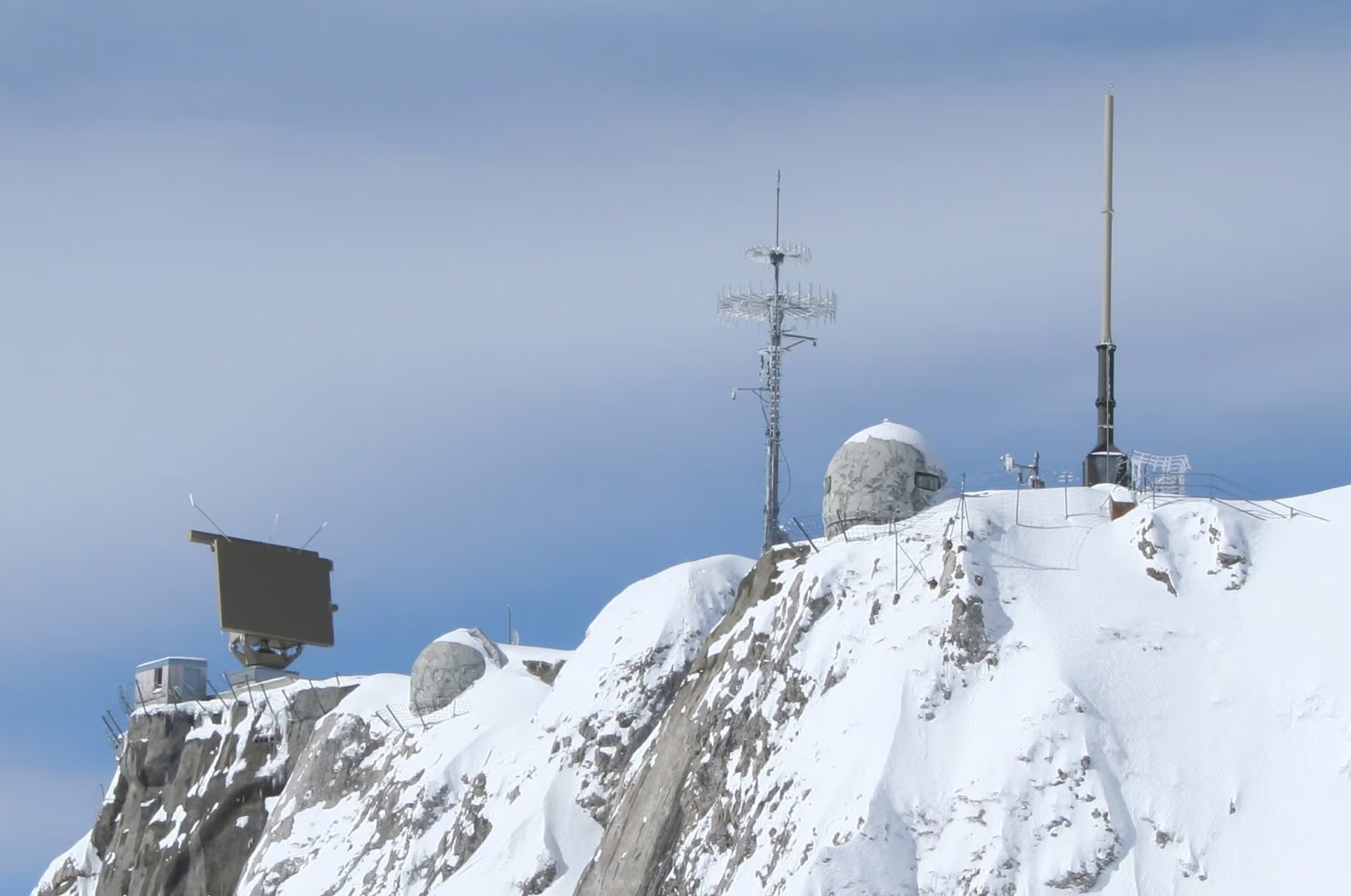

Plans are afoot to deepen the interoperability between Switzerland’s FLORAKO integrated air defence system and neighbouring air defence architectures.
Switzerland’s FLORAKO Integrated Air Defence System (IADS) was activated in 2004. The FLORAKO acronym translates from German as Florida Radarersatz Radarluftlagesystem Kommunikationssystem (Florida Radar Replacement and Air Situation Communications System). Florida was the name of the previous IADS which was developed and implemented by Hughes. Legend has it that Hughes employed internal project codenames which started with the initials FL. The Florida moniker emerged and was eventually employed as the system’s name.
Although Switzerland remains neutral, the country’s location at the heart of Europe makes it essential that the Swiss Air Force cooperates with neighbouring nations to ensure the country’s air space, and air approaches, are protected. Swiss air defenders advise their Austrian, German, French and Italian counterparts of potential air threats, and vice versa. Switzerland’s mountainous topography places a premium on radar to ensure that air targets cannot exploit valleys to hide from surveillance. Swiss air defenders routinely share Recognised Air Picture (RAP), track and other tactical data with neighbouring air defenders. A simplified and unclassified version of Switzerland’s national RAP is also shared with the North Atlantic Treaty Organisation (NATO). Armada understands that this RAP is sent to the alliance’s Combined Air Operations Centre (CAOC) at Uedem airbase, Western Germany. Uedem is responsible for the protection of European NATO airspace, and air approaches, north of the Alps. The federated RAP of this area is developed using the alliance’s Air Command and Control System (ACCS). ACCS is a scalable IADS hardware and software.
Connectivity enhancements
Armada has learnt that the Armasuisse, Switzerland’s defence procurement agency, has embarked on an initiative to improve the connectivity between FLORAKO and the country’s neighbouring national IADS, and NATO’s ACCS. The decision to enhance this connectivity was taken by the Swiss government given the tense strategic situation in Europe, following Russia’s second invasion of Ukraine in February 2022. The connectivity improvements will have no bearing on Switzerland’s neutrality. Nonetheless, the enhancements will help improve coordination between these respective IADS.
Strategically, it is all but impossible to contemplate a situation in which Switzerland would not be affected by a major European conflict involving Russia and NATO. Moreover, as the Ukraine conflict underscores, the air domain now hosts a multiplicity of threats including Uninhabited Aerial Vehicles (UAVs), hypersonic air-to-surface and surface-to-surface missiles, and conventional/nuclear short- and medium-range ballistic missiles. These threats were arguably less of a concern when FLORAKO entered service earlier this century. Regarding the latter two threats, the velocities of these weapons, and their ranges, mean that European nations will have no choice but to work together to find, fix, engage and assess these targets.
ASTERIX and the Gauls
A key motivation for the cooperative air defence arrangement between Switzerland and her neighbours is the detection, identification, tracking and distribution (henceforth known as processing) of tracks associated with unidentified and/or uncooperative targets. Track information is shared with neighbouring countries like France using the ASTERIX (All-Purpose Structured Eurocontrol Surveillance Information Exchange) protocol. Tactical data can also be shared in the form of J-Series messages. The J-Series protocol is at the heart of NATO’s Link-16 secure tactical datalink. Switzerland has access to Link-16 as a NATO Partnership for Peace member. Track and tactical information are shared across telecommunications links between Switzerland and these neighbouring IADS, and with NATO.
Armasuisse is enhancing the ability to share these data digitally via the introduction of a Data Exchange Hub. The hub will be a unified hardware and software ensemble where RAPs, tracks and tactical data will be exchanged with Switzerland’s neighbours and NATO. The architecture will also be the conduit via which Swiss air defenders receive similar information from these actors. Beyond the Data Exchange Hub, Switzerland has plans to expand the sharing the space surveillance data between her neighbours and NATO. The performance of today’s ground-based air surveillance radars means that space targets like satellites in Low Earth Orbit (LEO) can be processed by such systems. LEO spacecraft orbit at altitudes below 800 kilometres (432 nautical miles) above Earth. Regional and NATO cooperation concerning space targets will be especially important considering ballistic missile threats.
Current plans call for the Data Exchange Hub to be operational by 2028, Armada understands. The air threats faced by Europe show no immediate sign of dissipating. Switzerland’s IADS has a long tradition of working with neighbouring, and NATO, air defenders. The advent of the Digital Exchange Hub and improvements in sharing space threat information builds on this heritage. The improvements come at an opportune moment for European security.
by Dr. Thomas Wihtington
