

With the war in Ukraine now grinding into its fifth year, the Republic of Moldova has moved from the margins of the European security debate to a far more strategically exposed frontline partner of the West. Traditionally viewed as a forgotten ‘frozen conflict’ of a state undergoing a slow and painful post-Soviet transition, Moldova has become increasingly understood in Brussels and NATO capitals as another ‘test’ for Europe’s ability to stabilise fragile Western-leaning democracies under Russian pressure. Moldova’s current trajectory holds implications way beyond its capital city, Chişinău, and now include issues such as Black Sea security and wider EU enlargement debates.
At the heart of Moldova’s security dilemma is an obvious contradiction. Politically, the country is seeking closer ties with the European Union under President Maia Sandu and the governing Party of Action and Solidarity (PAS). Militarily, however, Moldova remains exposed: constitutionally neutral, dependent on fragile institutions, economically constrained, and compromised territorially by the unresolved issue of Transdniestria, a pro-Russian separatist enclave along Moldova’s border with Ukraine that broke away after a brief 1992 war. Although internationally recognised as part of Moldova, it has operated for decades outside Chişinău’s control under Russian protection.
This delicate balancing act has become considerably more difficult since Russia’s full-scale invasion of Ukraine. What was once seen by many observers as a ‘manageable’ frozen conflict has increasingly turned into part of the broader confrontation between Russia and the West.
Geography explains much of Moldova’s significance. Wedged between Ukraine and Romania, the country occupies a critical position in the Black Sea region and adjoining NATO territory. Any internal destabilisation risks spilling externally into Romania — a neighbouring NATO member and now crucial logistical hub for Allied operations in support of Ukraine. At the same time, sustained internal instability would weaken the EU’s wider eastern policy just when Brussels is trying to prove that a combination of enlargement and security integration are still credible tools at their disposal.
However, unlike Ukraine, Moldova lacks any meaningful military strength. Moldova’s Armed Forces are small, lightly equipped, and traditionally oriented towards internal security rather than territorial defence. Soviet-era equipment dominates the current inventory, and although Western military assistance has accelerated since 2022, the scale and scope are limited. European support is focused primarily on mobility, communications, air surveillance, logistics, cyber defence, and counter-drone capabilities rather than offensive systems.
This shift nevertheless marks an important strategic change. For years now, Moldova’s neutrality constrained meaningful security cooperation with Western partners, though Chişinău now cooperates more intensively with the EU, NATO, and individual European states in areas such as intelligence sharing, resilience planning, border management, and hybrid threat mitigation. Significantly, this does not mean concrete advances towards NATO membership — a topic that remains politically divisive domestically — but a pragmatic effort instead to increase the state’s survivability under external pressure.
The European Union is now the country’s primary external anchor for this policy. Moldova’s EU accession negotiations formally opened against the backdrop of the war in Ukraine, transforming enlargement from a purely technocratic process into a geopolitical tool. Brussels now sees Moldova not only as a reform candidate, but as part of a wider strategic buffer zone whose stability directly affects European security, much as it does with Ukraine.
However, the country’s internal fragility complicates this path. Russian influence continues to be deeply entrenched within parts of society, particularly through certain media outlets, oligarchic networks, energy leverage, and political proxies. And since Moscow’s strategy in Moldova does not necessarily require overt military escalation, the Kremlin benefits from fuelling uncertainty, fragmentation, and economic vulnerability in a way that is enough to slow European integration and weaken public confidence in the western path.
External pressure from the east is nothing new in this region, but it has become particularly visible through repeated allegations of electoral interference, disinformation campaigns, cyber-attacks, and organised protests linked to pro-Russian actors. Moldovan authorities frame these ‘activities’ as constituent parts of a coordinated hybrid warfare strategy designed to destabilise the state from within. The concern in Chişinău is the gradual weakening of institutional resilience through persistent pressure.
Transnistria lies at the centre of this wider security question. This narrow separatist territory along Moldova’s eastern border has existed outside Chişinău’s control since the brief but violent conflict of 1992. Supported by Russia politically, economically, and militarily, the self-proclaimed Pridnestrovian Moldavian Republic still hosts approximately 1,500 Russian troops, officially described by Moscow as peacekeepers and guards for the Soviet- era ammunition depot at Cobasna.
For three decades, Transnistria has functioned as a relatively dormant frozen conflict, though the war in Ukraine has altered the strategic environment. During the early phases of Russia’s invasion, concerns emerged that Moscow could attempt to establish a land corridor from occupied southern Ukraine toward Transnistria, effectively encircling Moldova and threatening Odesa at the same time. Although Russia’s inability to secure southern Ukraine thwarted this scenario, the possibility changed Western threat perceptions regarding Moldova.
In practice, Transnistria represents less an imminent military launchpad than a persistent destabilisation mechanism. Russian forces stationed there are limited in capability, geographically isolated, and heavily constrained by Ukraine’s control of the surrounding border space. Nonetheless, the unresolved status of Transnistria allows Russia to maintain political influence inside Moldova while complicating Chişinău’s path toward closer Euro-Atlantic integration.
The economic domain further reinforces this complexity. Despite its political separation, Transnistria remains economically intertwined with both Moldova and the European Union. Much of its industrial production ultimately depends on access to EU markets facilitated indirectly through Moldova’s trade arrangements with Brussels. This has produced a paradoxical situation in which a Russian-backed separatist entity increasingly relies economically on the very European structures Moscow opposes.
For Moldova, the challenge therefore is not resolving Transnistria quickly — an outcome currently unrealistic in any case — but in containing any destabilising potential while advancing with state integration elsewhere. Chişinău increasingly appears to be focused on a longer-term strategic approach: one that sees it deepen its EU integration efforts, strengthening institutional resilience, and reducing, albeit gradually, dependence on Russian energy and political influence without triggering or provoking direct escalation.
In today’s reality on the European continent, energy security has become especially significant. Historically dependent on Russian gas supplies, Moldova has experienced severe pressure during the wider European energy crisis, triggered by the war in Ukraine. Since then, substantial efforts have been made to diversify supply routes through Romania and broader European energy networks. Although vulnerabilities remain, particularly regarding electricity generation linked to Transnistrian infrastructure, Moldova’s overall exposure to Russian energy coercion has declined compared to the pre-2022 period.
Romania’s role in Moldova’s security architecture has simultaneously grown more important. Beyond historical and cultural ties, Bucharest increasingly functions as Moldova’s gateway into European political, economic, and infrastructural systems. Romanian support has expanded across energy interconnections, transport infrastructure, institutional assistance, and defence cooperation. For NATO, Romania also serves as the critical geographic bridge through which any wider regional stabilisation efforts involving Moldova would likely operate.
The broader Black Sea context further elevates Moldova’s importance. Russia’s militarisation of Crimea since 2014, combined with the war against Ukraine, has transformed the Black Sea into one of Europe’s most strategically contested regions. Although Moldova itself lacks direct maritime access beyond the small Danube-linked port of Giurgiulești, its stability remains connected to the wider balance of power around the north-western Black Sea littoral. From a European perspective, Moldova increasingly represents a broader strategic question: whether states operating under sustained Russian pressure can successfully integrate into European structures without triggering uncontrolled escalation. The answer carries implications not only for Moldova itself, but also for Georgia, the Western Balkans, and future EU enlargement credibility more generally.
Stalled Mediation Efforts
A further complication in Moldova’s near neighbourhood is that the diplomatic framework put in place in the early 1990s to manage the Transnistrian conflict has itself largely stagnated. For years, negotiations were conducted under the so-called “5+2” mediation framework; this brought together Moldova and Transnistria as the two ‘parties’, alongside Russia, Ukraine, and the OSCE as mediators, with the European Union and United States participating as observers. The OSCE in particular has long played a central role in conflict monitoring, implementing or supporting confidence and security-building measures (CSBMs), and seeking to maintain a dialogue between Chişinău and Tiraspol through its field mission based in Moldova (with a field presence in Transnistria). Yet, despite helping prevent renewed violence since the 1990s, the framework has produced little meaningful political progress even before 2022. The war in Ukraine has effectively paralysed it further. Ukraine’s direct conflict with Russia has rendered the idea of Moscow and Kyiv jointly mediating another regional dispute completely unrealistic, while relations between Russia and the West have deteriorated to levels not seen since the Cold War.
As a result, the Transnistrian question exists in a kind of diplomatic limbo. There is no realistic settlement process currently visible, but neither is there any serious appetite among external actors for escalation. This leaves the OSCE in yet another difficult position, of attempting to preserve basic communication mechanisms and regional stability, without the leverage necessary to push for a comprehensive political solution. Increasingly, Western policymakers appear less focused on resolving the conflict outright and more concerned with ensuring that Transnistria does not evolve into an active crisis capable of destabilising Moldova or the wider Black Sea region.
This stalemate reflects a deeper reality confronting European security planners. Moldova is no longer viewed simply through the narrow prism of a post-Soviet separatist dispute, but rather as part of the wider contest over Europe’s eastern order. The country’s resilience is therefore becoming measured less by whether Transnistria is formally reintegrated, and more by whether Moldova itself can continue functioning as a stable, democratic, and outward-looking state despite sustained external pressure.
For now, President Sandu and PAS remain politically dominant and broadly aligned with the European path. Yet Moldova’s domestic political balance remains fragile. Inflation, economic stagnation, emigration, and public fatigue with prolonged insecurity all create fertile ground for pro-Russian or more Moscow-accommodating political forces. The Kremlin does not necessarily need to install a fully loyal government in Chişinău to achieve its objectives; merely slowing EU integration, weakening sanctions alignment, or reviving ambiguity over Moldova’s geopolitical orientation could already represent a strategic success from Moscow’s perspective.
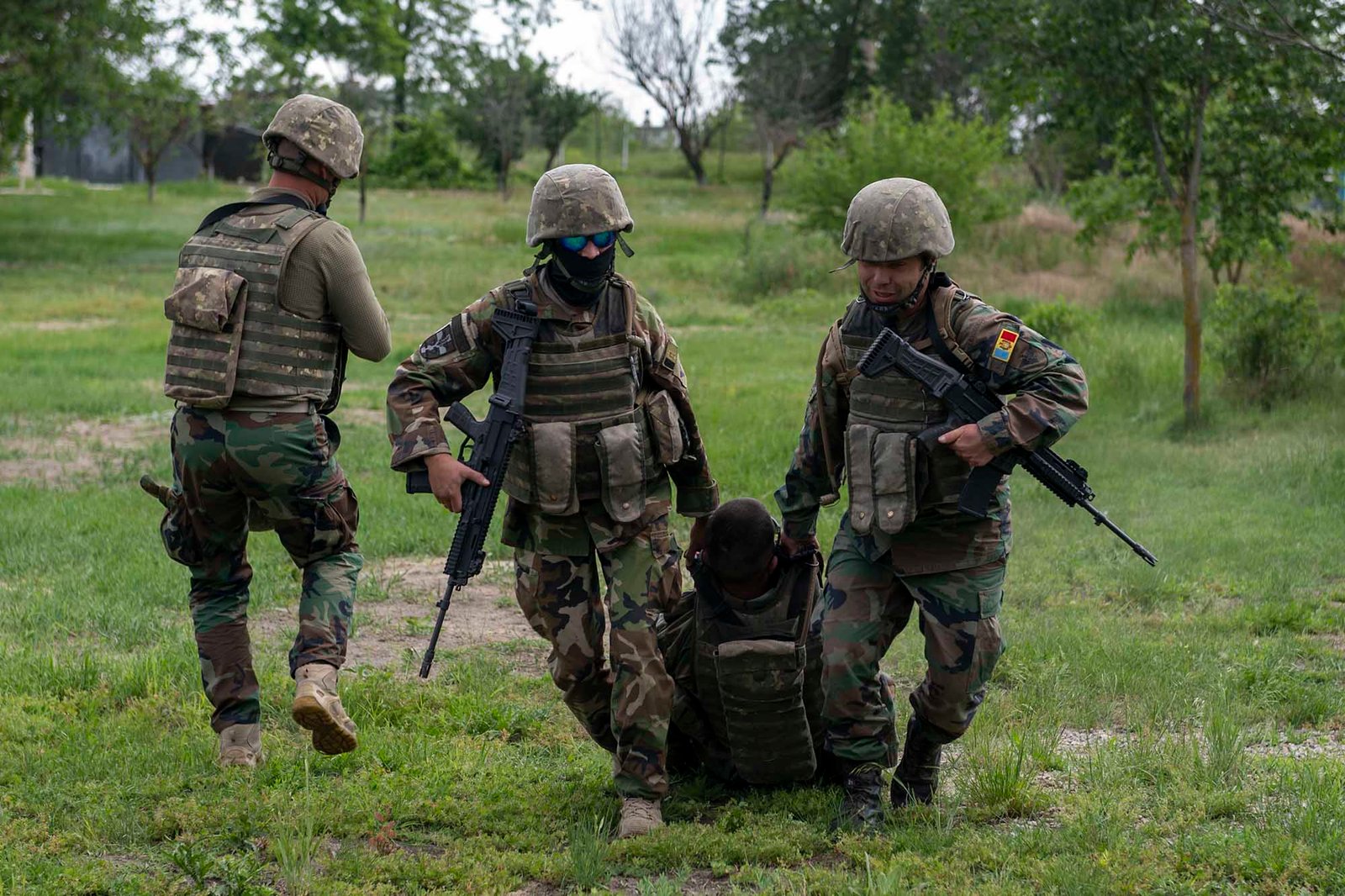
![Moldovan and Slovenian military personnel conduct riot control training in an exercise at the Hohenfels Training Area, Joint Multinational Readiness Center, Germany, prior to participation in a peacekeeping mission in Kosovo. [Image: US Army]](https://euro-sd.com/wp-content/uploads/2026/08/Riot-Control-Kopie.jpg)
This raises a longer-term question for both Brussels and NATO capitals. Much of the current Western approach toward Moldova is heavily personalised around Sandu’s reformist leadership and the assumption of continued pro-European governance. A future electoral victory by pro-Russian parties, or even a fragmented coalition less committed to European integration, could significantly alter Moldova’s strategic trajectory. Such an outcome would likely complicate EU accession efforts, weaken security cooperation with Western partners, and potentially reopen space for greater Russian political and economic leverage inside the country.
For Europe, therefore, the challenge is becoming increasingly structural rather than electoral. Western support for Moldova can no longer rely solely on favourable political cycles in Chişinău. The longer-term objective increasingly appears to be embedding Moldova so deeply within European economic, infrastructural, and institutional systems that any future government would find it politically and economically difficult to reverse course entirely. Whether this strategy succeeds may ultimately determine if Moldova consolidates itself as part of Europe’s emerging eastern security architecture — or instead remains permanently suspended between competing geopolitical spheres.
Ultimately, Moldova’s significance lies less in its conventional military power than in its strategic position. The country sits directly on the fault line between competing European security orders. And whether it succeeds in consolidating itself as a stable, European- oriented democracy under sustained external pressure will shape not only Moldova’s future, but also the credibility of Europe’s broader eastern strategy in an era of renewed geopolitical confrontation.
Author: Richard Passmore, Freelance Editor
Click here to read the latest issue of ESD.
