

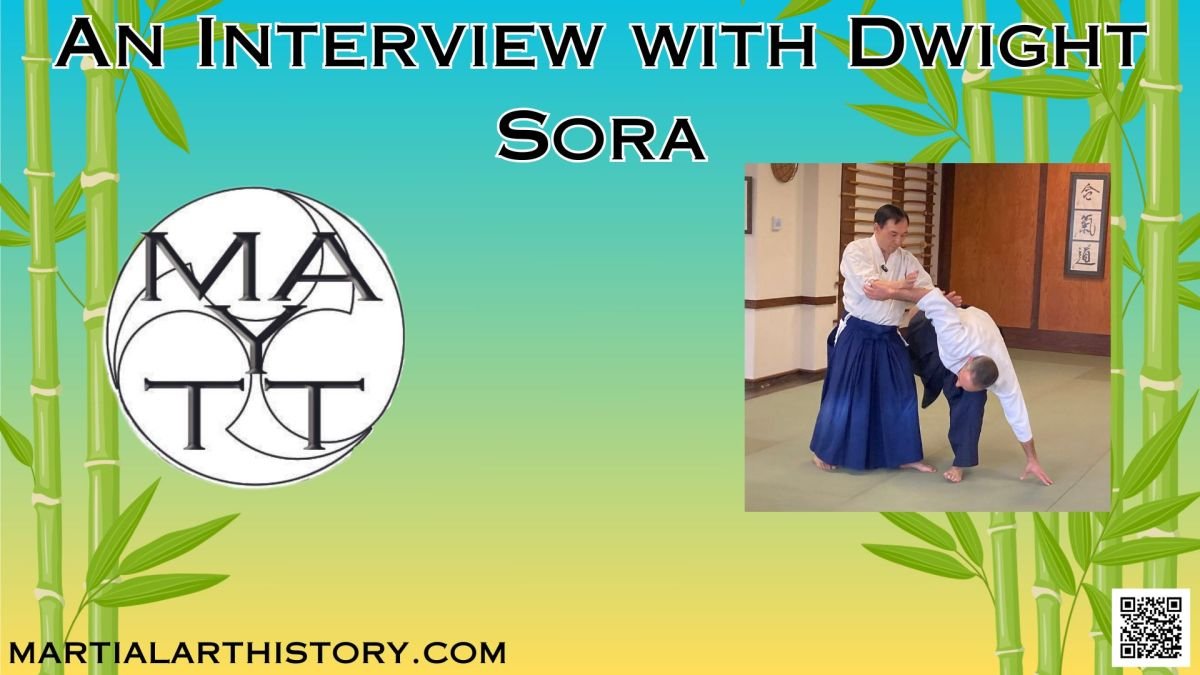
Combined with the recent move of Chicago Aikikai and a former student finding dojo boxes in his storage, Dwight Sora found a window into Chicago’s Aikido past. Some were archival footage of the school’s early days as Illinois Aikido Club with Koichi Tohei, others were newsletters and seminar posters of years and decades past. Today, Sora reflects upon the complexities of historical memory, the cultural tensions between Japanese instructors and Japanese American students, and the challenges of preserving martial traditions in a modern context. All images provided by Dwight Sora.
MAYTT: It is kind of a philosophical debate of the morality of learning and propagating something that had a far-right wing influence.
DS: Tying that into talking about the future, I do think that, as a matter of personal conduct, I generally do not engage in heavy-duty probing discussions with people from Japan, especially older teachers. I just don’t think anything good is going to come from it. Other people may disagree with me or criticize me for taking that stance, but I’ll stick by it. On the flip side, for myself and for other younger practitioners – particularly those of us here in America – I think we do have to think about these issues. Future generations, especially now that we have the internet, are going to be very probing people.
It’s the same thing as having to explain questions like: Why do we wear hakama? Why do we grab wrists? Why do we do this and not that? We are better off promoting Aikido if we have explanations for these things. Likewise, I think those of us looking toward the future need to have tangible answers for some of the more difficult historical questions as well. The earlier generations could often get away with simply saying, “Shut up and train.” I don’t think I could get away with that. And, honestly, I think I would become visibly uncomfortable if I tried.
So, I think there’s a balancing act. On one hand, I don’t think it’s necessarily productive to aggressively interrogate older teachers about difficult historical topics. On the other hand, I do think that people of my generation and younger have a responsibility to think seriously about these questions and be prepared to answer them, because future students are going to ask. They’re going to want explanations, context, and honesty. And I think, if we want Aikido to continue into the future, we need to be ready for that. As I get older, I’m becoming more accepting of the fact that human beings are just messy. Organizations are messy too. The thing is, we’re social creatures. The scientific evidence is pretty clear that we’re not designed to be lone wolves.
I think that’s interesting because I’ve known lots of people who have left Aikido through what I’d call a hard divorce – completely disillusioned. I’ve known some people who left because they hit a wall in their training or because their training simply wasn’t satisfying them anymore. But I’ve also met people who became completely fed up, or even outright disgusted, by organizational politics. For some people, it really is a hard divorce: “I’m out the door, never looking back, never talking to you guys again.” My first hiatus from Chicago Aikikai was kind of a mini version of that. I left in a huff. In retrospect, I was younger, and I wish I had just taken a vacation instead. But because I went through that experience, I’m more understanding now as a senior person. I don’t think you can really get away from these issues. If you’re going to be part of any human endeavor involving other people – including something as fundamental as raising a family – you’re going to deal with mess, and it’s not always going to be pleasant.
I don’t think that invalidates Aikido any more than bad Christians invalidate Christianity. I’m not a churchgoer, but I still believe in it. The problems are human nature more than anything else, and human nature has a lot of bad history attached to it. That’s at least how I address it and rationalize it. There are weird moments where I think about the fact that I’m half Korean, and it isn’t inconceivable that someone related to one side of my family may have been harmed by someone related to the other side. History is messy. People are messy. And I think coming to terms with that messiness is just part of getting older.
MAYTT: One of the points you made with some of the older Aikidoka, is that the past is not affecting them right now and they are just moving forward regardless.
DS: I will say that doing this research has actually made me a lot more sympathetic to Akira Tohei Sensei. I joined Chicago Aikikai after coming back from Japan to finish my last year near Chicago in 1994–95. I joined the University of Chicago Aikido Club, met Don Levine, and he introduced me to Chicago Aikikai. Other than two breaks, I’ve basically been with ASU and the Aikikai ever since. Because of that, the narrative I received mostly came from secondhand information from Choate Sensei and direct information from Takahara Sensei about how that split happened. That version of the story generally made it sound like Akira Tohei was this old-fashioned Japanese guy who wanted to run everything, while the Japanese Americans who founded the dojo felt, “We own the dojo, we should run the business, and you’re the guy in charge of the mat.” I’m not saying anything they said was factually or emotionally untrue. But going through these materials and hearing stories from people involved in other Japanese martial arts in Chicago has made me realize that a lot of those early transplanted instructors from Japan really didn’t know what they were getting into.
What I mean is that they didn’t know what it was going to mean to deal with Japanese Americans. Japanese Americans are kind of strange in that regard. We look like we should know better when dealing with Japanese people, but a lot of the time we don’t. We’re Americans. Many of us don’t speak the language, and that particular generation – people like Takahara Sensei and Lester Katsura, the founders of Illinois Aikido Club – had all lived through World War II and the internment experience. They grew up with Japanese traditions, but within the context of living in the United States. At the same time, they wanted to be American and had also seen firsthand the dangers of being identified as an alien during World War II. So, I think they had a very complicated relationship with Japanese culture and authority. If you talk to Takahara Sensei, he’s very conscious about respect for teachers, propriety, and certain rules that need to be followed. But I always found it funny because I think, “Aren’t you also part of the group that essentially kicked out a shihan?” Which sounds insane on paper. But I think that’s the tension. They’re Americans too. They may not even have been consciously aware of that tension. They just knew what they were uncomfortable with. And I think the unfortunate thing is that I don’t think Tohei Sensei had anyone who could effectively serve as a go-between and smooth things over. He arrived in 1972, and the split happened in 1975. In my opinion, that simply wasn’t enough time to adjust. And he was busy. He founded the Midwest Aikido Federation, hosted Doshu, and had all kinds of responsibilities.
I also talked to a friend who did kendo in Chicago. We were exchanging war stories, and he described how one Japanese instructor simply did not know how to deal with all these sansei and nisei students. He told me about one instructor getting so angry that he chased someone out onto a fire escape with a shinai. Another student apparently wrestled somebody to the ground. I remember saying, “He wrestled a guy during kendo?” And my friend was like, “Yeah!” I think those early teachers found the experience incredibly frustrating.
Again, I don’t want to invalidate what the nisei generation went through, but I do think that in another world, if there had been people capable of effectively smoothing over those cultural differences, things might have gone differently. There were a lot of communication hurdles and cultural hurdles. Maybe it still wouldn’t have worked out. Obviously, history unfolded the way it did. But I also find it interesting that someone told me many of the people who sided with Tohei Sensei were younger students, including younger Japanese Americans. And I thought, well, that makes sense. The younger Japanese Americans didn’t necessarily have the same wartime hangover. They were already moving into a period where they could afford to be a little more romantic about Japanese culture. That’s one of my theories, anyway.
MAYTT: It is culture in general. How we embody our culture is different from others with different upbringings. Having a space with three different and distinct cultures vying for room in a singular space can create tension.
DS: I don’t know, maybe it was a decade ago, but (Seishiro) Endo Sensei—he’s a very noted instructor in Japan. Lisa Tomoleoni Sensei and her dojo hosted him for a seminar in the western suburbs. A bunch of us from Chicago Aikikai went. The seminar was held in a park district building because her dojo wasn’t large enough, so she rented the space and brought in mats. I remember arriving and seeing Lisa Sensei. She immediately told everyone, “Make sure you’re on the mat when the clock strikes the start of class, because Endo Sensei is really strict about that.” So, I thought, say no more. I went to the locker room, changed, got on the mat, sat down in seiza, and waited. Endo Sensei came out. He didn’t speak English, so he had an interpreter. He looked over all of us lined up, and then he started talking. The interpreter suddenly pointed and said, “You! You over there! Why are you late?” I realized someone way behind me was walking onto the mat after the official start of class. I remember sitting there thinking, I really hope that’s not one of our guys, because that would be very embarrassing. So, Endo Sensei spent several minutes berating the person. “You are inconveniencing all these people!” and so on. Then class started.
Afterwards, I was riding back into the city with some friends from Chicago Aikikai, and one of my friends, who wasn’t Japanese or Japanese American, was really annoyed by the whole thing. He said, “Why do we all have to be punished for one guy’s mistake? That doesn’t make any sense at all. Why were we all inconvenienced?” And I said, “Listen, from his point of view, for the duration of this seminar, we are not in a park district building where he is a guest. We are in his dojo. He is an elder teacher from Japan, and we should act accordingly.” My friend said, “No, no, no. He’s in America. He should adapt.” And I was like, “No, no, no; come on.”
That’s exactly where the tension lies. There are different assumptions operating simultaneously. From one perspective, the seminar is a service being provided in America and the instructor is the guest. From another perspective, the instructor is temporarily establishing his dojo and its norms, and the students are expected to enter that space respectfully. Neither side necessarily thinks they’re being unreasonable. They’re simply operating from different cultural frameworks. And I think that’s one of the recurring themes you see in the history of Japanese martial arts in America: these moments where expectations don’t quite line up, where people are looking at the same situation but interpreting it through very different lenses.
MAYTT: To that point, I remember talking to Aaron Ward and he cited Terry Dobson, saying, “Remember you are practicing the Japanese martial art of Aikido, but also remember you are in the sticks of Vermont.” It brings up the topic of culture and how much each of us embody our own culture.
DS: That’s a tough one. Depending on who you talk to – especially people from Japan – there’s often this sense that you’re not really doing Aikido unless it’s the whole package. You’re bowing at exactly the right times in exactly the right way, sitting in the proper manner, cleaning the mats correctly – every little detail has to fall into place. And I’ve yet to see signs that this can be implemented quite that strictly in America. I mean, some dojos manage it. I’m under the impression that Midwest, for a long time when Tohei Sensei was alive, was a very tight ship. If your dojo is thriving and being run that way, fine. Great for you. That’s terrific. But I don’t think it works for everyone.
I think even Choate Sensei had some of that tension going on. He had a naturally goofy sense of humor, but in his formative years he trained under Shigeru Suzuki Sensei, who, from everything I’ve been told, was very drill-sergeant-like. And Saotome Sensei too. You know, Hiroshi Ikeda Sensei and others – I know the modern versions of them as somewhat affable elder teachers, but anecdotally I’ve heard that things were quite different back in the day. Those were Choate Sensei’s formative years, and I feel like there was a part of him that wanted to recreate that atmosphere. There was this side of him that wanted everyone to be quiet, pay attention, and train seriously. But then there was also the side of him that wanted to joke around, drink beers with his buddies after class, and treat us like regular guys. So, it’s hard. It’s much harder than I ever thought.
Anyone who thinks running a dojo in America is simply a matter of putting down mats, running class, bowing in and out, doing techniques, and maintaining a high level of training, I would say, no, it’s so much harder than that. It’s also interesting watching how other people run their dojos. I’m friends with Doug Tono, who runs one of the big judo schools in Chicago. His father was a judo instructor as well. They run a serious competitive judo program, with Olympians and high-level competitors. I’ve been in his dojo when his students didn’t clean the mats properly, and he just became a demon. I mean, he would absolutely explode. He’d yell, “Oh my God, you guys! What are you doing? You’re worse than the kids’ class! I’ll just rip these mats out and hire janitors!” And you could see all the students immediately straighten up because he can really raise his voice.
Part of me watches that and thinks, wow, sometimes I wish we could get our guys to clean like that. But I also know none of us would ever act that way. And honestly, if we tried to do that now, nobody would take us seriously (at Chicago Aikikai). That’s part of the interesting tension of teaching martial arts in America. You inherit traditions and expectations from Japan, but you also have to deal with the reality of American culture, modern students, and changing expectations. Trying to navigate those different worlds is much more complicated than I think people realize.
MAYTT: Getting the archival footage, you found them while you were going these boxes Chicago Aikikai had in storage?
DS: So, the film footage actually came to us last year. A former dojo member’s wife told him, “Hey, there’s this box of junk in the basement, get rid of it.” He looked through it and found these reels of film and a projector. Then he remembered that during one of the many dojo moves, he’d been asked to hold onto them and had completely forgotten about them. So, he called me and said, “Hey, Dwight, do you want these?” I looked at them, got Marsha Turner Sensei’s permission to have them digitized through the Chicago Film Archives, and then we put them online.
MAYTT: With the archival footage, looking at them from a modern perspective, what do these videos demonstrate to or for modern Aikidoka?
DS: I think one of the things you get from seeing this footage is an appreciation for how much they were doing back then that we’re still doing now, often in exactly the same way. At the same time, you notice differences too, and I think you should appreciate those differences. I’ve seen comments on the YouTube uploads where people say things like, “Man, what they’re doing with the jo is weird.” And I’m like, well, weird to you, you know? That’s your observation. One of our current students saw all these old photos and films and said, “Oh my God, this made me realize that twenty years from now, I could be the person people are talking about in old footage.” And I was like, yeah, exactly. You get this real sense of history. For me, it was also fascinating because I’ve heard criticisms of Koichi Tohei Sensei forever. I’m never going to meet him, but it was interesting to see how he wanted to present himself in the footage from Japan that features him. That was genuinely fascinating.
Another big thing for me is that I actually like being reminded that I don’t own Aikido, and neither does my dojo. I think sometimes people can start acting that way a little bit. I don’t think they do it for malicious reasons; I think it just kind of happens. And while it’s not as if Japanese instructors never do this, I do think it’s a particularly American tendency in many cases. Americans are big on wanting to put their own stamp on things.So, I think it’s good to have a reminder that you’re part of a much larger continuum. Whether you like those people or not, whether you like the way they did things or not, you’re standing on their shoulders.
Personally, I’m not a fan of Ki Society Aikido, but in no way would I ever say that nobody has a right to do that, or that Koichi Tohei Sensei was wrong. He’s there in the history. He helped bring Aikido to the United States. He helped start a lot of dojo, and he influenced many of our instructors. He’s part of our formation. There are probably things we do that came from him that we don’t even realize we’re doing. It’s in the DNA of what we do. So, at least for me, I think that’s the healthiest attitude to take, and probably the most useful attitude to take.
MAYTT: What is different about Ki Aikido practice to your current training?
DS: I have had three main opportunities to be exposed to Ki Aikido, or at least, Koichi Tohei’s approach to Aikido (which we’ll presume is ki based, even if from before the organizational split). One was John Eley came to guest teach a class or two at University of Chicago Aikido Club when I was an undergrad (and prior to joining Chicago Aikikai). The second was Joe Takehara’s regular incorporation of exercises from Koichi Tohei in his classes at the Aikikai in the 1990s to early 2000s. The last is visits to the Ki Aikido club at University Chicago led by Kagan Arik.
I don’t want to say anything that comes across as too critical, as I do have the greatest respect for all of the above teachers. And I don’t think those experiences necessarily give me a full picture of all of Ki Aikido. Even in the case of Takahara Sensei; he might have been exposed to Tohei in the 1960s, but he’d also been practicing and training outside of that for more than twenty years by the time I met him.

There does seem to be a very strong emphasis on relaxation and flowing body movements, which are both things we try to achieve in Aikikai Aikido (for lack of a better word). However, there seems to be less of a concern about martial validity, or putting some intensity or weight behind attacks. The former observation may come across as pretentious on my part, as I’ve hardly spent the last thirty-three years trying to win real fights (In fact, I’ve never been in a physical fight in my entire life). But I do feel that even when practicing slowly or trying to do “soft” technique, there’s always a sense among ASU teachers and students that you should be maintaining the same body position and awareness as with an actual hostile opponent. And even if attacking slowly for practice, there should be a sense of direction and genuine intent.
All that being said, I personally don’t care if there are folks practicing Aikido strictly as a form of movement or exercise. In fact, I feel that way about all martial arts. The key thing is that those teachers and students should always be honest, aware and explicit in explaining the intentions behind how they practice.
MAYTT: With Koichi Tohei, he is a very prominent figure in these archival footage. He is an influential figure in early Aikido history; at what point did you think he became “unimportant” to the Aikidoka of Chicago?
DS: When I talk to older folks – people like Takahara Sensei, Cheryl Matrasko, who runs a dojo in Skokie, or Deborah Mamura-Belter, the daughter of Mike Mamura, who founded Milwaukee Aikido Club – they all speak very highly of Koichi Tohei Sensei. They have very strong memories of him, and he clearly left a deep impression on them. When Chicago Aikikai was on Lincoln Avenue, Takahara Sensei taught every Monday and Friday night. He didn’t necessarily mention Koichi Tohei Sensei by name all the time, but later, when I saw footage of Tohei Sensei, I realized that many of Takahara Sensei’s regular exercises were actually Koichi Tohei exercises. But I think when the split happened, there was, in a very Japanese way, this feeling of, “Well, we don’t really talk about that.”
Certainly, from Akira Tohei Sensei’s side, since he was directly tied to Hombu, I’m pretty sure there was a very firm attitude (of not mentioning Koichi Tohei). There was this sense of, “He’s no longer part of our group. We’re not publicly interested in him.” At the same time, I’ve read anecdotes suggesting that even in Japan, some instructors maintained cordial relationships with him privately, because ultimately it was also a political decision. But it definitely had an impact. Unless you dig up old books or historical materials, you really don’t find Aikikai people talking about Koichi Tohei very much. Some people genuinely do not care for his approach to Aikido, and, well, that’s whatever – you can’t please everyone.
I do find that a little disappointing, though. Part of me thinks, aren’t we supposed to be all harmonious? Even if he broke away, can’t we still be good sports about it? But I also know what Japanese culture can be like. They generally don’t look favorably upon people quitting or leaving the group. That’s why, when I recorded the introductory video for our Koichi Tohei footage series, I actually included a disclaimer. I explicitly said that, as a member of an Aikikai dojo, I wanted to apologize to my seniors for speaking at length about Koichi Tohei Sensei. I said that I was not disagreeing with their teachings or opinions, I was simply trying to present history. I was very self-conscious about that, just in case someone became upset with me. You do have to be aware of these things.
MAYTT: Using the footage as a starting point, how have you seen Aikido practice change over time, and do you think that change has been for its benefit?
DS: I’m not going to speak for everyone, but in the ASU dojos I’ve visited, and at the seminars and camps I’ve attended, and with my own instructors here at home, I see a lot of people who are willing to experiment. They’re willing to incorporate things they’ve learned from dance, Pilates, and other disciplines, and they don’t seem self-conscious or afraid to bring those ideas up. I like that. I think things are more interesting that way. I think it’s a good thing, and I do think it helps keep Aikido alive. Bringing in these new ideas also gives you more vocabulary to talk about. One of the big questions for the future is: how do we talk about Aikido to a modern audience? Sometimes it’s good to get outside your own box, because if all you do is spend time with other Aikido people who practice exactly the way you do, you’re probably not learning many new ideas. So it is good to step outside your comfort zone. Overall, I do think experimentation is healthy, but it’s always going to be a balancing act. We don’t want to stray too far, and I think that’s a potential peril down the line. In the same way that, in your own individual practice, you can fall into habits and ruts without realizing it.
For me, I’m very conscious of that because, since becoming a dad and because of other factors, I don’t really have the time or money to travel the way I did when I was younger. So, my primary training is with the same group of people in my own dojo. One thing that happens is that you start to habituate to each other. Even if you don’t mean to, you have to stay alert and ask yourself: am I just going through the motions? If I’m working with another senior person, are we earnestly challenging each other at least some of the time? Are we pressure-testing our technique, or are we simply cooperating because we know each other so well? You have to think about those things. In that same way, when introducing new ideas, you also have to make sure you’re maintaining your foundation. The equivalent in music would be: sure, go ahead and do crazy experimental stuff, but also remember to practice your scales. Keep working on the basics, because they’re always useful and always helpful.
It’s funny because I know people who get bored practicing basic technique or working with newer students. I actually love doing basic technique, and I enjoy working with beginners. I even think there’s value in occasionally practicing what you might call old-fashioned Aikido. When I visited Hombu Dojo on vacation two years ago, I would argue that the class I took felt almost exactly like it did when I was a college student. And I liked that. I didn’t think, “Ugh, this is old hat.” I thought, “No, this is great.” Sometimes you need to refresh yourself by going back to the old well. Ideally, you should keep your hands in both worlds; a little bit of the new and a little bit of the old. Maintain both, because you don’t want to fall into a rut in either direction.
I remember some instructor once telling me that whether you’re doing very standard, basic forms or more flowy, experimental Aikido, if you don’t have solid form, then the floaty stuff just becomes muddy and loses meaning. But if you only ever do rigid basics and never practice the relaxed, exploratory side of things, then your technique can become stiff and inflexible. So, you have to strike a balance, and trust your teachers to help guide you through that process. And honestly, I think that’s very hard.
MAYTT: It is difficult especially when you are trying to maintain your training at a certain level but sort of stuck with the tools that you do have at your disposal.
DS: Dwight Sora: I can’t really speak for other martial arts, but I feel like Aikido is one of the hardest arts to strike that balance with. Maybe part of it is because we don’t have tournaments. It’s not that we have no proving ground – our regular practice is supposed to be our proving ground – but without competition, it doesn’t have that same external incentive to win or constantly measure yourself against others. Because of that, I think one of the challenges in Aikido is that you have to constantly fight complacency, especially among senior practitioners. It’s very easy to become comfortable, to settle into habits, and to keep doing things simply because that’s the way they’ve always been done. So I think maintaining that balance – between tradition and experimentation, between preserving the art and continuing to question and refine it – is particularly difficult in Aikido. It requires constant self-awareness and a willingness to keep examining what you’re doing and why you’re doing it.
MAYTT: Complacency is a real issue.
DS: At the March Midwest Aikido Bridge seminar, I taught a class where, for most of it, I showed some semi-experimental material that I thought would be fun and interesting. But at the very end, I finished with shomen uchi ikkyo, which is probably one of the most basic techniques you can imagine. One of my pet peeves is when people go to seminars and a teacher shows something like shomen uchi ikkyo, and then later in the locker room – or even under their breath while training – they say, “Oh my God, I paid $150 or $200, drove all this way, and we’re doing ikkyo? I wanted to learn something special.” And, to be fair, I’ve been that person too when I was younger. I don’t want to pretend I’m innocent in that respect. But now that I’m older, I’ve come to realize something different.

When you go to a seminar, if a teacher is showing the most basic thing, you’re not necessarily there because the technique itself is new. You’re there to see them do it. Maybe they have a different perspective on it. Maybe they have a subtle detail or a new feeling that changes your understanding. And if they do it exactly the same way you do, then maybe that’s confirmation that you’re on the right path. Because I have friends who say, “Oh, I already know this.” And my response is always, “Do you? Really?”
I told the class about something that has become a sort of running mantra for me. My wife and I enjoy watching cooking shows, and I remember one host saying that the real measure of a chef isn’t the fanciest dish they can make. The real test is whether they can prepare the most basic dish with care, attention, and detail. A grilled cheese sandwich can be amazing. So I demonstrated shomen uchi ikkyo and then said, “Alright everyone, enjoy your grilled cheese sandwich.”
MAYTT: The basics are important. Everyone needs a foundation to work from.
DS: I don’t know if you were ever a teenage musician, or had friends who tried to start a rock band. You know, you get kids saying, “I’m gonna be like Keith Moon!” and it’s like, okay… maybe you should first learn how to keep a basic beat. Learn how to do this first.
MAYTT: Would you like to say anything else before we wrap up?
DS: No, thank you. Honestly, thank you, because there really aren’t a lot of people I can have conversations this far-ranging with. It may not feel that way to you, but even on my home front – and this is absolutely not a slam against the people I train with – a significant number of people practice Aikido for entirely good reasons. They’re like, “I show up, I take classes, I clean up the mats, I come to events, I help out, I buy supplies,” and that’s it. And honestly, that’s perfectly fine. Those are the basic requirements of being a good dojo member. A lot of people don’t sit around thinking about history, culture, or these broader questions, and there’s absolutely nothing wrong with that. It’s just that I happen to be interested in those things, so it’s nice to have the opportunity to talk about them. I do hope, though, that I haven’t exceeded my bounds. I want that clearly stated somewhere – repeat that quote if you have to. I humbly offer my opinions, but I sincerely hope I haven’t overstepped. Because, yeah, I’m very mindful of that aspect of things. There are people out there who are much more important than me, people with much more experience and authority. I’m aware of that, and I try to keep it in mind whenever I talk about these subjects.
MAYTT: This was a great conversation! Thank you for joining!
DS: It was great!

