

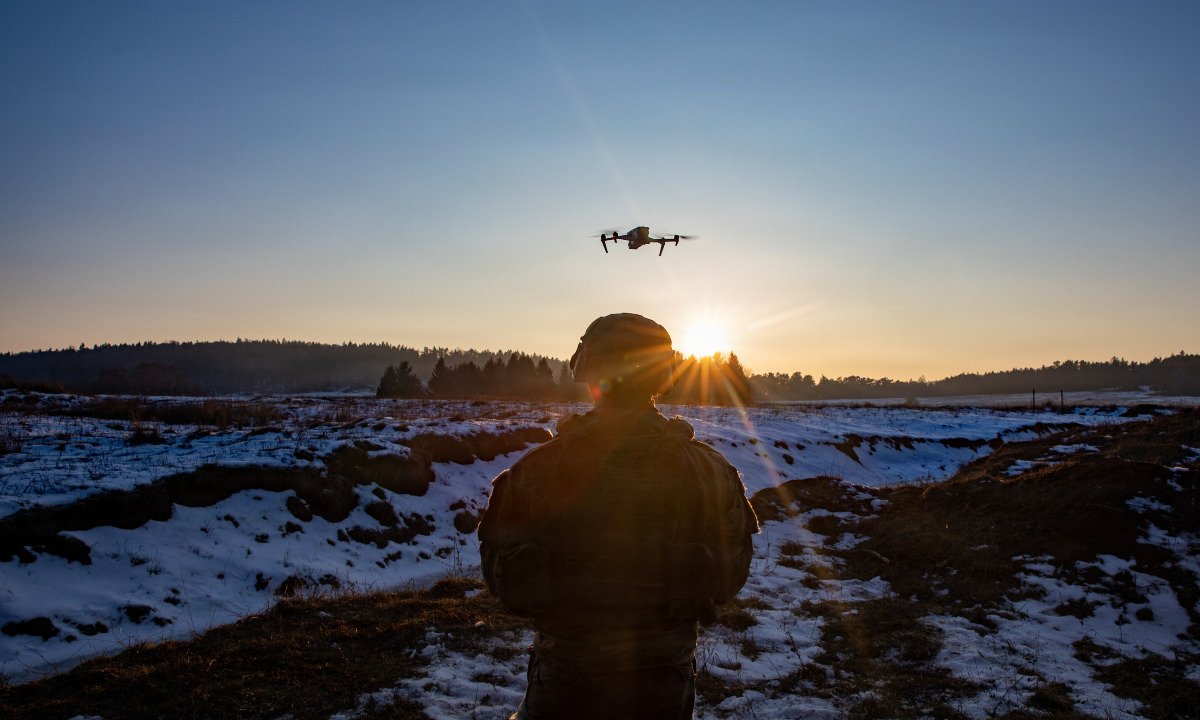
The battlefield in Ukraine is becoming increasingly transparent, increasingly lethal, and increasingly difficult to command. Unmanned aircraft systems watch movement far beyond the forward line. First-person-view drones turn fleeting observation into immediate attack. Electronic warfare contests communications and navigation. Digital networks push intelligence, imagery, targeting information, and orders across formations at speeds that would have been inconceivable even a few short years ago. Russia and Ukraine have consequently been forced into a continuous cycle of tactical and technological adaptation.
This has understandably concentrated Western attention on technology. Yet one of the most consequential lessons from Ukraine is less technological. Drones have changed what commanders can see. Networks have changed how quickly they can communicate. Precision weapons have changed how rapidly information can be converted into destructive effect. None of these has removed the fundamental problem of command: turning higher intent into effective action by real military units operating under fear, exhaustion, uncertainty, interrupted communications, incomplete information, and enemy action.
The US Army recognizes this problem in its doctrine on mission command. Army Doctrine Publication 6-0, Command and Control stresses subordinate decision-making and decentralized execution precisely because combat does not permit a headquarters to control every important action. Ukraine is demonstrating why that principle remains essential.
But the problem is much older than the technology now exposing it.
Almost a century ago, Russian military theorist Aleksandr Svechin described the regimental commander as the man who must translate the plans of high command into the “language of life.” In his account of commanding the 6th Finnish Rifle Regiment during World War I, he emphasized the enormous distance between a written order and setting the thoughts, feelings, bones, and muscles of soldiers into motion. That insight lies at the heart of The Art of Regimental Command: Lessons from World War I, which I recently edited and translated.
The weapons in Svechin’s war belonged to another age. His command problem did not.
Svechin was interested in what might be called the last mile of command: the space between an order being issued and its execution by actual troops. That space contained everything operational maps and headquarters returns tended to conceal: exhausted soldiers, inexperienced replacement officers, unreliable communications, broken formations, ammunition shortages, fear, poor morale, inaccurate reporting, the personalities of subordinate commanders, and the physical condition of the troops.
He had experienced both sides of this divide. Before taking command of the 6th Finnish Rifle Regiment in August 1915, Svechin had worked at Russian General Headquarters. He became increasingly dissatisfied with the distance between headquarters assumptions and the condition of forces actually fighting the war. When he reached the front, the picture changed dramatically. The troops looked entirely different from the army imagined at headquarters. He concluded that an abyss had opened between the aspirations of the high command and the objective capabilities of the forces expected to fulfill them.
His conclusion was not that higher command was unnecessary. It was that command only worked when somebody converted abstraction into reality.
That remains true on the modern battlefield. A contemporary headquarters possesses vastly better means of observing its forces than its World War I predecessor. But better observation does not eliminate the difference between a unit represented digitally and the same unit as a functioning human organization.
A blue icon can show where a company is. It cannot necessarily tell a commander whether its leader has slept in forty-eight hours, whether two platoons have lost their most experienced noncommissioned officers, whether the soldiers trust newly arrived replacements, whether the unit has adequate electronic warfare protection to move, or whether its remaining combat power is sufficient for the task appearing on the common operational picture.
The battlefield can become more transparent without becoming more understandable.
That distinction matters because greater visibility creates another danger: the illusion of control. MWI has already highlighted the possibility that modern command-and-control systems can produce shared data without necessarily creating shared understanding. The more a higher commander can see, however, the more tempting it also becomes to intervene.
A brigade commander watching live drone imagery can now observe events that in previous wars would have been visible only to a battalion, company, or platoon commander on the ground. Digital communications make it possible to transmit instructions almost instantaneously. This looks like improved command. It can also become technologically enabled micromanagement.
Svechin encountered a primitive version of the same problem in August 1915. During operations around Buividy, his regiment was operating amid shifting boundaries, confused subordination arrangements, disrupted communications, and German pressure. Higher headquarters instructed him to remain forward and support the flank of another corps. By the time the instruction reached him, however, the tactical situation had already changed and his withdrawal had been underway for hours. Division headquarters nevertheless sent him what amounted to a reprimand for failing to execute the earlier instruction. Svechin’s objection was strikingly modern: Headquarters was refusing to recognize the changed situation and the actual conditions under which the subordinate commander had to act. The order arrived too late but treated the battlefield as though it had remained static.
The episode became more revealing when Svechin confronted his division commander. He discovered that the commander actually approved of his actions. The written rebuke had largely been produced to protect the headquarters bureaucratically in its dealings with another formation. Here was the pathology Svechin feared: command becoming the formal transmission of orders and the protection of institutional responsibility rather than the achievement of the mission. Modern communications can reduce the time required to transmit an instruction. They cannot guarantee that the instruction reflects the current situation. Indeed, they may worsen the problem if greater connectivity persuades senior commanders that they possess a sufficiently complete picture to dictate tactical action from above.
Svechin regarded a sense of responsibility as the first prerequisite for successful command. Crucially, he did not mean responsibility only to a superior officer. He meant accepting responsibility for the outcome. That distinction separated command from bureaucratic compliance. A commander who formally executed an unsuitable instruction, preserved good relations with his superiors, and subsequently explained why failure belonged to somebody else had not commanded effectively.
This has direct relevance to high-intensity warfare today. Communications will fail. Units will become isolated. Electronic warfare will interrupt networks. Headquarters will displace. Information will arrive late. Subordinate formations will sometimes possess a clearer picture of their immediate circumstances than their superiors.
The answer cannot be to make military formations progressively more dependent on uninterrupted connectivity. One of the most revealing episodes in Svechin’s account occurred during the night withdrawal of August 29–30, 1915. The division was in a confused situation, higher headquarters lacked a clear overall picture, communications had been disrupted, and Svechin’s regiment was ordered to withdraw to another line. What followed was not a demonstration of centralized control. Svechin records that his battalion commanders organized the withdrawal so effectively that he was able to leave its execution largely in their hands, observing rather than directing their actions himself. The regiment disengaged, moved its equipment, and reached the new position in good order.
That is decentralized command in practice.
It does not mean abandoning subordinates to make arbitrary decisions. It means developing subordinate commanders capable of intelligent action once detailed direction can no longer be continuously supplied. Decentralization without competence produces disorder. Centralization without subordinate initiative produces paralysis when the network fails. Effective command requires trained subordinates who understand intent, possess sufficient professional judgment to interpret changing conditions, and are trusted to act—a fundamental truth from Svechin’s time that endures in the drone age.
Svechin’s account also highlights another enduring problem that technological discussions can obscure: the human condition of the force itself. When he assumed command of the 6th Finnish Rifle Regiment, he inherited a formation that had suffered heavily during the Russian retreat of 1915. It contained remnants of experienced personnel, reinforcements of uneven quality, shortages, organizational disruption, and soldiers who had already endured intense operations. Svechin refused to treat combat effectiveness as something that could simply be read from an establishment table. He spent considerable time among his companies, speaking with soldiers and examining how they were actually functioning. His concern with morale, discipline, leadership, exhaustion, training, and the relationship between officers and men was not peripheral to tactics. It was part of tactics.
The same point is easy to lose on today’s highly instrumented battlefield. Modern militaries can measure the number of drones available to a brigade, artillery range, communications bandwidth, ammunition consumption, vehicle availability, sensor coverage, and target-processing time. All are important. None is enough to tell a commander whether a formation can perform its next task. Ukraine also demonstrates that technological adaptation does not automatically produce equivalent adaptation in command. Russian forces have substantially altered their employment of unmanned systems, electronic warfare, reconnaissance, fires, and strike mechanisms. Yet improving the means of finding and attacking targets is not the same as solving weaknesses in leadership, initiative, training, force employment, or organizational culture.
An army can become better at using drones while remaining weak at command. It can shorten a sensor-to-shooter cycle while retaining rigid decision-making. It can improve reconnaissance while commanders misunderstand the condition of their own troops. It can generate enormous quantities of battlefield information while distorting that information as it travels through headquarters.
Svechin saw comparable dysfunction in 1915. Reports could be exaggerated and failures obscured, headquarters could lose contact with subordinate formations, and units could receive tasks bearing little relationship to their actual condition. Technology changes the means by which such problems manifest themselves. It does not abolish them. The implication for Western militaries is not to slow technological modernization. It is to ensure that modernization serves command rather than progressively reshaping command around the network.
Drones, artificial intelligence, resilient communications, automated data processing, electronic warfare, precision fires, and distributed sensors will be indispensable in future warfare. But they should be judged partly by whether they improve a commander’s capacity to exercise judgment. Does a new system help a commander identify what matters, or simply provide more information? Does greater connectivity strengthen subordinate initiative, or give senior headquarters greater opportunity to intervene in decisions that should be made below? Can formations continue operating when the network is degraded? Can subordinate commanders interpret intent when detailed instructions stop arriving? Do exercises test what happens when communications collapse, headquarters lose situational awareness, units become exhausted, and reports from the front contradict the digital picture?
These are not secondary leadership questions. They are combat-system requirements. The force that wins the information contest but cannot translate information into sound decentralized action has not achieved decision advantage. It has merely accumulated data. Svechin’s battlefield contained horses, field telephones, rifles, machine guns, artillery, and paper maps. Ukraine’s contains fiber-optic drones, electronic warfare systems, digital networks, satellite-derived information, precision strike, and rapidly developing applications of artificial intelligence. The difference is enormous.
Yet the commander at the tactical edge still confronts Svechin’s last mile. An order has to become action. An abstraction has to become a task that tired people can actually perform. Information has to become understanding. Intent has to survive interrupted communications. And when reality diverges from the plan, somebody has to accept responsibility for deciding what to do next.
Drones have changed the battlefield. They have not solved the command problem.
Roger N. McDermott, FRHistS, is a specialist in Russian military strategy, military thought, doctrine, and operational developments. He is the editor and translator of Aleksandr Svechin’s The Art of Regimental Command: Lessons from World War I, published by McFarland & Company.
The views expressed are those of the author and do not reflect the official position of the United States Military Academy, Department of the Army, or Department of Defense.
Image credit: Spc. Adrian Greenwood, US Army
