

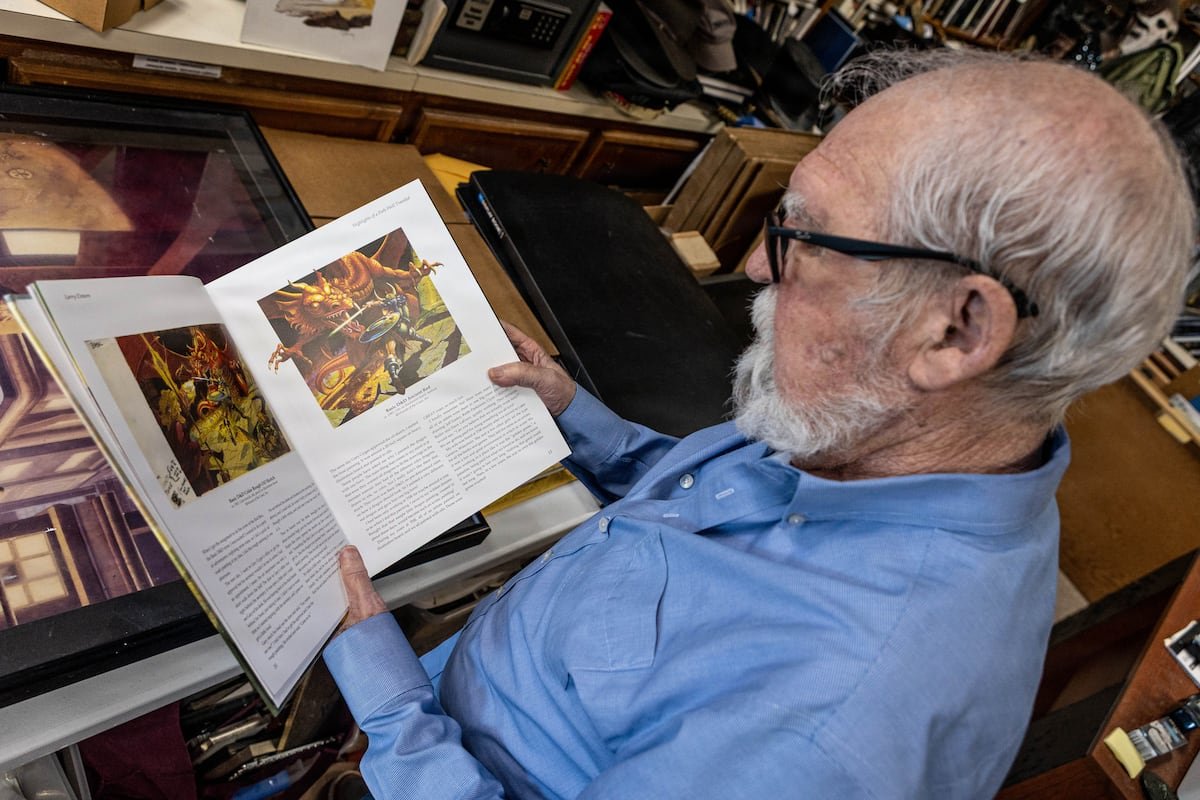
Before Larry Elmore became one of the artists behind Dungeons & Dragons’ popular imagery, he was drawing tanks and rifles for the U.S. Army.
Elmore has been drawing for as long as he can remember, but growing up in a family with limited means meant his family had to ration paper, he said in a conversation with Fort Knox Public Affairs Office reporter Savannah Baird.
When Elmore was drafted into the Army after graduating with a fine arts degree from Western Kentucky University, the service gave him the resources to hone his craft, he told Baird.
“Once I got assigned, the Army saw my portfolio and realized I could draw just about anything from memory, so they put me on illustration work,” Elmore said in the release.
The Army changed the look of its field manuals in the 1970s to include more illustrations, and Elmore’s talents were put to use. After studying objects, Elmore could retain their images and draw them from memory, including tanks and rifles, he told Baird.
“It was a God-given gift and I used it,” he said.
Elmore went to basic training and was stationed at Fort Knox. During his time there, he developed skills he had not learned in college.
“Illustrations in the ’70s were just line work, pure ink — white and black, no grays — and they didn’t teach you that in college. I developed those skills at Fort Knox,” he said in the release.
After completing his two-year obligation, Elmore decided to stay on as a contractor, Baird reported. Around that time, a new employee joined the staff and introduced the team to Dungeons & Dragons, changing Elmore’s life.
Despite his initial hesitation, he began playing the game with his coworkers and quickly became hooked, calling it “the king of all games.”
Dungeons & Dragons was relatively new at the time, and its art was elementary, Elmore told Baird. He recalled that a fellow artist said he was going to submit his artwork to Tactical Studies Rules, or TSR, the company behind Dungeons & Dragons, because “our art is much better than this.”
Elmore then decided to submit his own portfolio to TSR, which included drawings he had produced for the Army. Soon after, TSR offered to double his salary, hire his wife and move them to Wisconsin, the release stated.
Elmore said he immediately shook the company representative’s hand and told him, “you just bought yourself an artist.”
He went on to create one of the most recognizable images in the game’s history: the cover art for the famous “Red Box” set, which featured a warrior in combat with a red dragon.
After six years at TSR, Elmore decided to move back to Central Kentucky and pursue freelance work for another 40 years, according to the Army’s release.
He recognizes the impact the Army had on his career as an artist.
“I was very lucky,” he said in the release. “Sometimes, I think to be successful you have to be good, but you got to have some of those weird breaks in life — and I got two or three.”
