

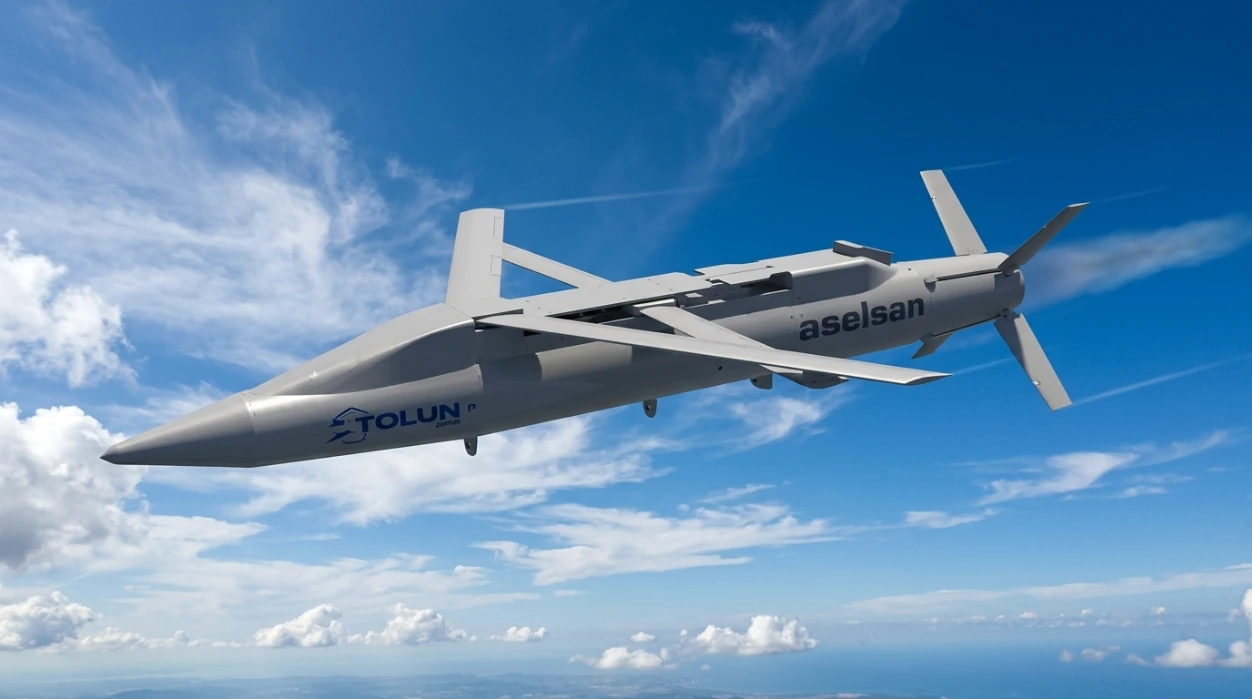
Defense Feeds, Ankara – ASELSAN TOLUN-P Expands Türkiye’s Precision Strike CapabilityASELSAN TOLUN-P Expands Türkiye’s Precision Strike Capability, following a successful firing test from Baykar’s Bayraktar AKINCI unmanned combat aircraft.
The test, announced by ASELSAN on August 7, 2026, demonstrated the ability of the domestically developed munition to engage hardened targets while being carried by a long-endurance unmanned platform.
More importantly, the event demonstrated how Türkiye is connecting its aircraft, weapons, guidance technologies and smart carriage systems into a common combat-air ecosystem rather than developing isolated defense products. That approach could give Ankara greater control over the development and modernization of its future precision-strike capabilities.
ASELSAN TOLUN-P Precision Penetrator Expands Türkiye’s Airstrike Capability
The latest test in which ASELSAN TOLUN-P precision penetrator expands Türkiye’s airstrike capability involved a direct hit during a live firing from the Bayraktar AKINCI. ASELSAN describes TOLUN-P as a precision-guided penetrator designed for hardened targets, including armored targets and structures protected by reinforced concrete.
The munition has a published weight of 136 kilograms, including a 105-kilogram penetration warhead. It measures approximately 1.8 meters in length and has a diameter of 164 millimeters. ASELSAN states that the weapon can penetrate up to one meter of reinforced concrete, although real-world penetration performance depends on target construction, impact conditions and other factors.
That makes TOLUN-P different from a conventional general-purpose guided bomb. Its design is centered specifically around combining precision navigation with a penetrator configuration capable of delivering effects against protected structures.

Precision Matters More in Contested Airspace
One of the more important aspects of TOLUN-P is its navigation architecture. The weapon combines INS/GPS guidance with a four-channel CRPA anti-jam antenna and software designed to resist spoofing. ASELSAN also lists a formal accuracy specification of less than 10 meters circular error probable (CEP).
This is significant because satellite navigation cannot simply be assumed to operate without interference in a modern battlefield. Electronic warfare can degrade or manipulate navigation signals, making resilience an increasingly important characteristic for precision-guided weapons.
The anti-jam and anti-spoof features do not make TOLUN-P immune to electronic warfare. Instead, they are intended to make navigation more resilient when satellite signals are being disrupted or manipulated. That distinction matters because precision under contested electromagnetic conditions is becoming increasingly important for modern air operations.
AKINCI Turns TOLUN-P Into a Larger Strike Architecture
The integration with Bayraktar AKINCI gives the weapon another important dimension. TOLUN-P can be carried using ASELSAN’s SADAK-4T smart pneumatic quad rack, allowing up to four weapons to be carried and released against one or multiple targets during a mission.
This changes how the capability should be evaluated. The important factor is not simply the destructive potential of an individual munition but the number of independently targetable precision effects that an aircraft can carry during a single sortie.
ASELSAN publishes a maximum range of up to 102 kilometers when launched from fighters and up to 57 kilometers from UAVs. The difference illustrates an important characteristic of unpowered glide weapons: range depends heavily on the launch platform’s altitude, speed and release conditions rather than being a single fixed figure.
For AKINCI, this means a long-endurance unmanned aircraft can carry a hardened-target precision weapon without requiring a crewed fighter to perform every strike mission.
TOLUN-P Is Part of a Wider Turkish Weapons Ecosystem
Another important development is that TOLUN-P is not restricted to AKINCI. ASELSAN identifies the F-16, AKINCI, ANKA-III, Bayraktar TB3 and KIZILELMA among the platforms associated with the TOLUN family, including configurations compatible with internal weapons bays.
This creates a much broader architecture. Türkiye is effectively developing a common precision-weapon family that can potentially be distributed across fourth-generation fighters, high-endurance UCAVs, carrier-capable unmanned aircraft and emerging jet-powered combat drones.
The wider TOLUN family includes variants with different guidance and payload concepts, including laser-guided and imaging-infrared configurations as well as electronic-warfare and surface-launched versions. This suggests an approach focused on creating a family of adaptable precision effects rather than a single standalone munition.
That flexibility could become particularly valuable as Türkiye expands its inventory of indigenous combat aircraft and unmanned systems.
