

Key Points
- Ukraine’s 302nd Anti-Aircraft Missile Brigade publicly displayed a truck-mounted STASH air defense system for the first time in an official video.
- STASH combines AGM-114L Longbow Hellfire missiles with a RADA radar, giving it a maximum range of about 10 kilometers (6.2 miles) against drones.
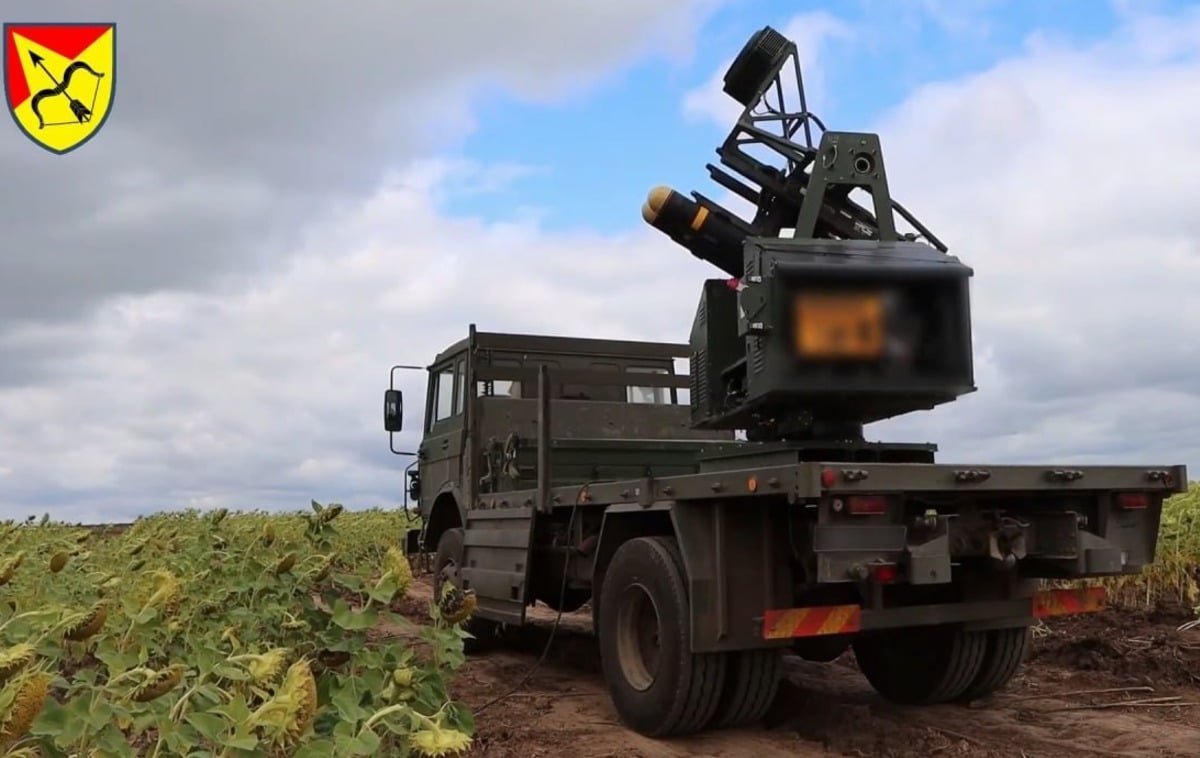
Ukraine’s military has shown a homemade air defense system built by bolting American anti-tank missiles onto a Rada radar and welding the whole thing to a Dutch army truck.
Ukraine’s 302nd Anti-Aircraft Missile Brigade publicly displayed a new mobile variant of the STASH short-range air defense system in an official video, mounting the launcher on a DAF YA 4442, a Dutch-made military transport truck long supplied to Ukraine’s armed forces. Versions of STASH have appeared in leaked or unofficial combat footage before, but this marks the first time Ukrainian forces have formally presented the system rather than letting its existence circulate purely through social media leaks and open-source tracking.
STASH is an improvised counter-drone system built around the AGM-114L Longbow Hellfire, an American air-to-ground missile originally designed to destroy tanks and armored vehicles from helicopters and aircraft, repurposed here to intercept airborne threats instead. What makes the Longbow variant specifically useful for this mission is its guidance system, a millimeter-wave active radar seeker that lets the missile find and lock onto a target on its own after launch, giving the weapon genuine fire-and-forget capability rather than requiring a laser designator to keep tracking the target throughout the engagement, a critical advantage when trying to hit a small, fast-moving drone under time pressure. STASH pairs that missile with a radar system from RADA, an Israeli defense electronics company whose Multi-Mission Hemispheric Radar family uses active electronically scanned array technology specifically built to detect and track low-signature aerial targets, the kind of small, hard-to-spot threats that conventional air defense radar often misses.
– ADVERTISEMENT – CONTINUE READING BELOW –
The physics behind the Hellfire missile itself define exactly what kind of threat STASH can and cannot handle. The AGM-114 Hellfire’s maximum range tops out around 10 kilometers (6.2 miles), placing STASH firmly in the short-range air defense category, a class of weapon built to protect a relatively small area around a specific point rather than covering broad swaths of airspace the way longer-range systems like Patriot do. That short range makes STASH well suited for exactly the mission it appears designed for, knocking down slow-moving drones before they reach a protected target. The missile’s own flight speed, roughly 425 meters per second (1,394 ft/s or 951 mph), reinforces that narrow role, since a missile moving at that pace, while plenty fast against a propeller-driven drone, simply cannot catch or intercept the far faster cruise missiles or ballistic missiles Russia has also used extensively against Ukrainian targets throughout the war.
Traditional surface-to-air missile systems like Patriot cost millions of dollars per interceptor, an unsustainable exchange rate against Shahed and Geran-series attack drones that typically cost Russia only tens of thousands of dollars to build and launch by the hundreds in a single overnight assault. STASH represents Ukraine’s answer to that math problem, repurposing anti-tank missiles that were never originally designed for this mission but happen to be cheaper and more readily available than dedicated air defense interceptors, paired with a radar system compact enough to mount on ordinary military trucks rather than requiring the elaborate fixed installations traditional air defense batteries typically need.
STASH is not an entirely new invention built from scratch. The system shares its core missile and radar architecture with an earlier platform called Tempest, a self-propelled counter-drone system developed by American defense contractor V2X and reportedly already operating within Ukraine’s Air Force before footage of Tempest missions during nighttime Shahed interceptions surfaced publicly in January 2026. STASH appears to strip down that same Tempest concept, replacing its more elaborate buggy-style chassis with a simpler towable or truck-mounted launcher better suited for defending fixed infrastructure rather than accompanying maneuvering ground forces, a modification that reduces fuel consumption and maintenance complexity while sacrificing some of the mobility a dedicated combat vehicle chassis would offer.
Earlier sightings had already shown STASH mounted on a simple trailer and, more recently, on a Ford F-350 pickup truck chassis, variants that circulated through social media and open-source intelligence channels well before this latest, officially released video.

The shift to a Dutch military truck chassis for this 302nd Brigade unveiling suggests Ukrainian forces continue experimenting with different vehicle platforms to find the right balance of mobility, durability, and ease of production as the system moves from an improvised field expedient toward something closer to a standardized, repeatable design.
