

On 23 July, Singaporean defence firm ST Engineering reported that its counter-unmanned aerial systems (C-UAS) had secured deployments in Asia in the past few months.
Emanating from ST Engineering’s Digital Systems business unit, these C-UAS systems are performing both defence and critical infrastructure applications, the company shared. It elaborated, “These include an air defence deployment and another for the protection of multiple critical infrastructure sites against evolving drone threats.”
ST Engineering did not divulge which Asian countries had procured these systems, but it did laud the “versatility, operational maturity and effectiveness” of its counter-drone solutions.
Low Jin Phang, Chief Operating Officer for Defence & Public Security, and President for Digital Systems at ST Engineering, said, “Counter-drone capabilities have become an increasingly important part of modern defence and security operations.”
He continued, “These deployments underscore the growing demand for integrated solutions against evolving drone threats and validate our ability to deliver operationally proven counter-drone capabilities.”
ST Engineering’s C-UAS products combine sensors, artificial intelligence (AI)-based command and control based on the company’s proprietary Agil, and a choice of soft-kill and hard-kill effectors. These combine to detect, track, identify and neutralise drone threats.
Its solution is also modular, enabling customers to deploy them as needed for defence, public security or critical infrastructure protection tasks.
Underlining the threat, ST Engineering claims that 80% of drone-related hostility incidents during recent global conflicts have been undertaken by commercially available, off-the-shelf, small and micro-drones.
The suite includes a detection radar, choice of radio frequency (RF) sensors, electro-optic/infrared camera, RF jammers and a new laser effector.

Indeed, ST Engineering unveiled its S1000 RF drone decoder at IMDEX 2025, which has an enhanced 1km range compared to the existing 300m-ranged S300. Whereas many C-UAS systems rely on libraries and databases of different UAV types, the S300 and S1000 combine AI and machine learning.
This means the system learns on the fly when it encounters unknown UAV threats. It examines data packets shared between UAVs and operators, and ascertains any hostile intent.
At the same exhibition in Singapore, ST Engineering also showed its associated J1000 RF jammer with 1km range for the first time. These C-UAS systems can be ground-, vehicle- or ship-mounted.
Later, at Singapore Airshow 2026 in February, ST Engineering exhibited a laser, drone and high-powered microwave as additions to existing C-UAS jammers and RF sensors.
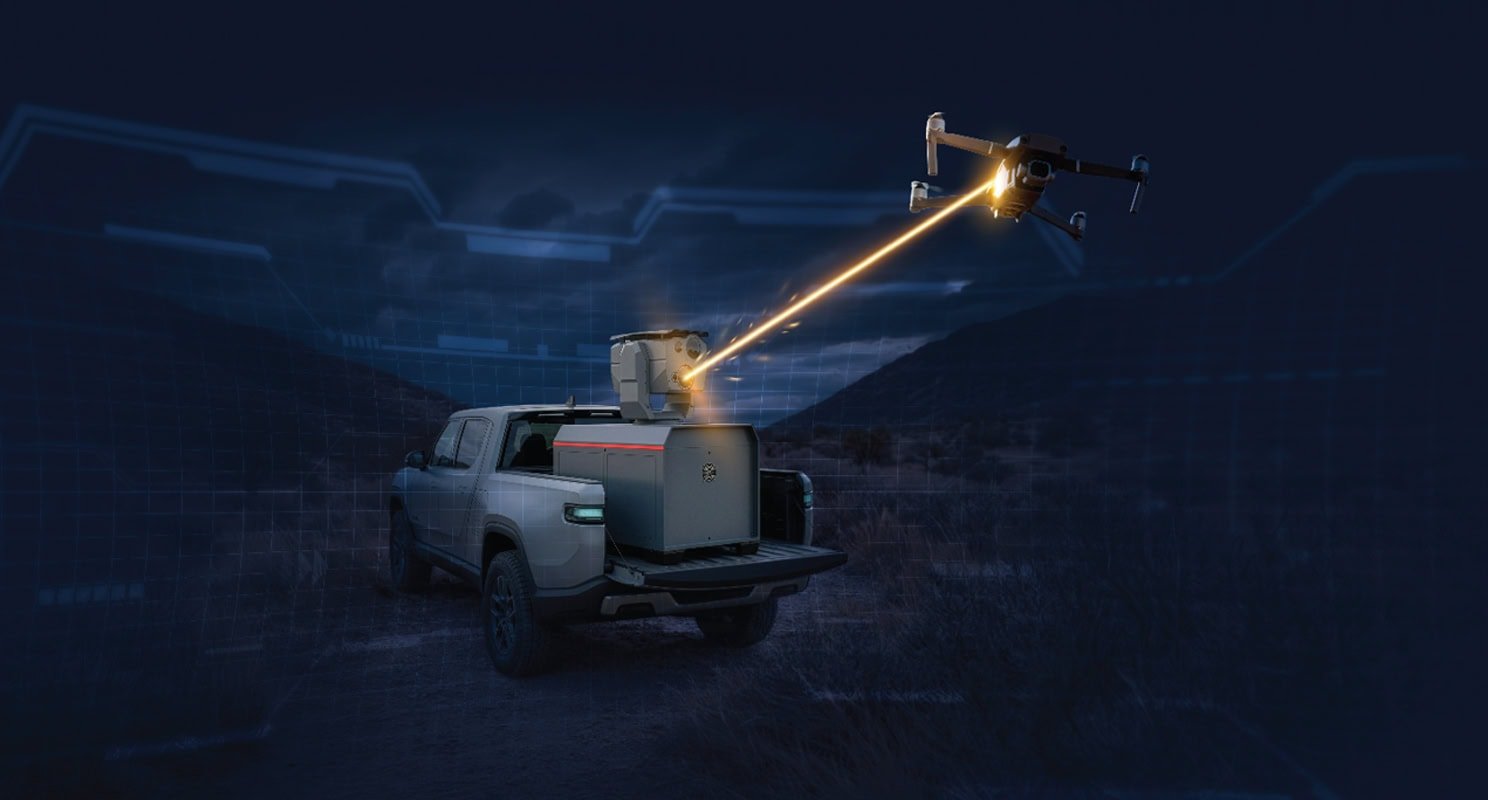
If jamming fails, the 5kW Counter-Drone Laser Effector (CDLE) has a 1km range and takes around five seconds to disable a flying drone by targeting its rotors. The next layer of defence comes from a pair of airborne drones – one carrying a radar and the other a hit-to-kill kinetic effector in the form of a small drone.
Meanwhile, the high-power microwave forms the last line of defence against hostile drones. It has a 300-500m range and is particularly suited to targeting drone swarms. At the time, this microwave weapon was still at the prototype stage.
by Gordon Arthur
