

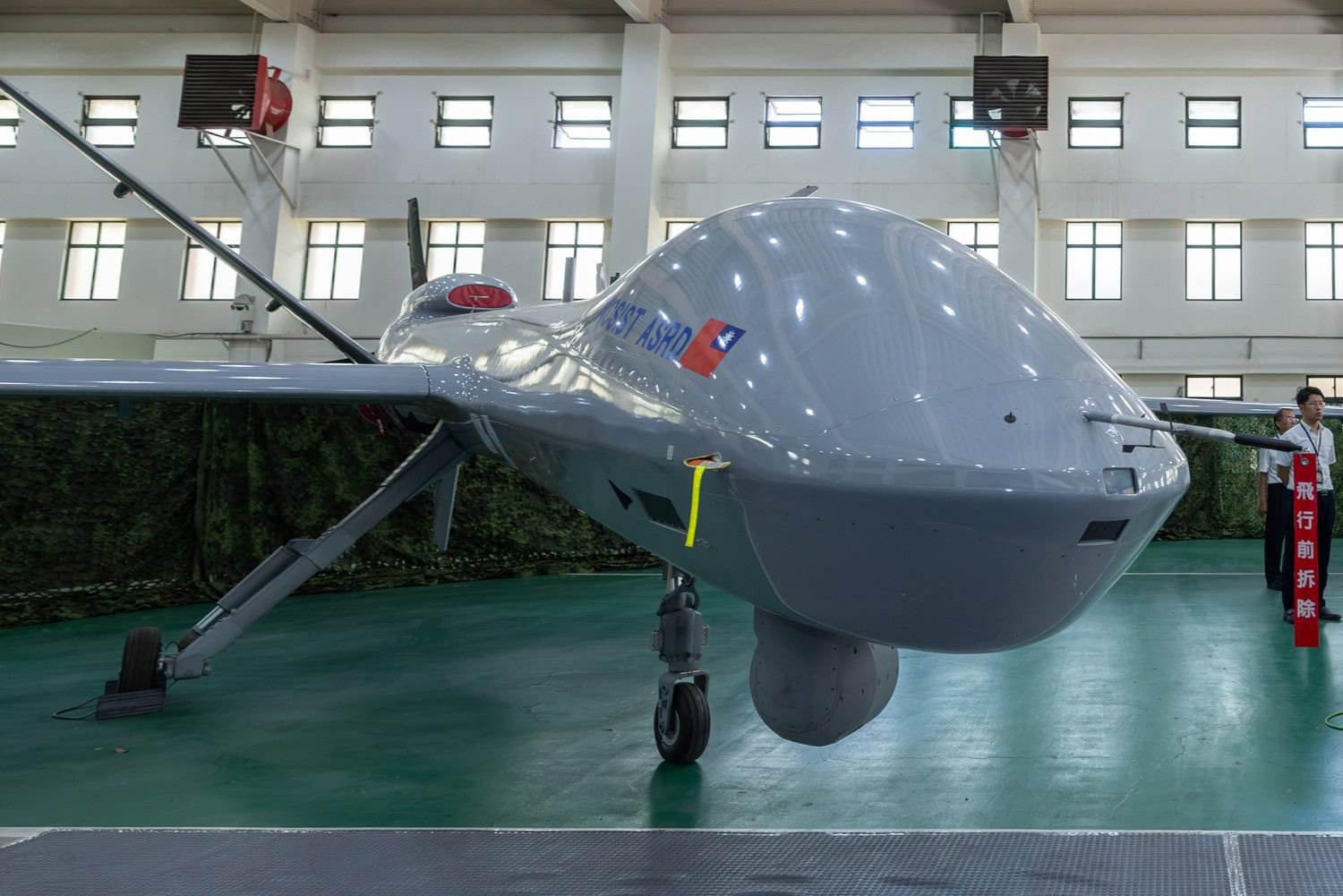
Taiwan is signalling renewed interest in the domestically developed Teng Yun (Cloud Rider) unmanned aerial vehicle (UAV). This medium-altitude, long-endurance (MALE) UAV has been refined into a second-generation variant known as the Teng Yun II.
One example of the UAV, developed by the National Chung-Shan Institute of Science and Technology (NCSIST), was on display during President Lai Ching-te’s visit to its Aeronautical System Research Division facility in Taichung on 17 July.
During the visit, Lai urged continued investment in Taiwan’s drone programmes, highlighting their increasingly important role in the island’s defence and on the modern battlefield.
Lai’s visit followed that of a group of legislators just a week earlier, during which a Teng Yun II was also on display.
Local media reports indicated that the Republic of China Air Force (ROCAF) is considering acquiring the Teng Yun II, with the platform potentially operating as part of a high-low mix alongside the General Atomics MQ-9B SkyGuardian.
Under such a force mix, a relatively small number of mature, highly capable MQ-9Bs would be complemented by a larger fleet of Teng Yuns to undertake intelligence, surveillance and reconnaissance, and potentially strike missions.
The ROCAF is in the process of taking delivery of the four MQ-9Bs it ordered, with the first two aircraft having already arrived in Taiwan.
In addition, reports state that an electronic-warfare capability for the Teng Yun II is under development.
NCSIST began developing the Teng Yun in 2009, resulting in the construction of two first-generation prototypes by the mid-2010s. In response to shortcomings in payload capacity, endurance and overall flight performance, a second-generation variant was subsequently developed, with a further two prototypes built.
Resembling the MQ-9, the Teng Yun II incorporates a redesigned airframe, larger wings and a more prominent engine intake. It is powered by a Honeywell TPE331 turboprop, replacing the Rotax 914F used in the original model to address the platform’s thrust limitations.
Extensive flight trials supporting development testing of the Teng Yun began at Chihhang Air Base in Taitung in late 2020, and subsequently from Chiashan Air Base in Hualien. During a trial on 18 February 2021, a first-generation Teng Yun prototype encountered difficulties and crashed while on approach to Chihhang.
Operational testing of the platform began in March 2023 and continued for one year.

However, orders for the Teng Yun from Taiwan’s Ministry of National Defense have not materialised, with media reports citing budget constraints as a contributing factor.
A similar situation has affected NCSIST’s Rui Yuan II (Albatross II) medium UAV, which has completed testing but is yet to receive orders. Its predecessor, the Rui Yuan, has been in service with the Republic of China Navy for nearly 15 years.
While Taiwan looks to pursue a “hellscape” strategy centred on uncrewed systems to conduct saturation and precision attacks against an invading Chinese force, the survivability of MALE UAVs like the Teng Yun in contested environments remains questionable.
This vulnerability is illustrated by reports that nearly 30 US MQ-9s were lost during the recent Operation Epic Fury, despite Iran’s degraded air defence capabilities.
by Roy Choo
