

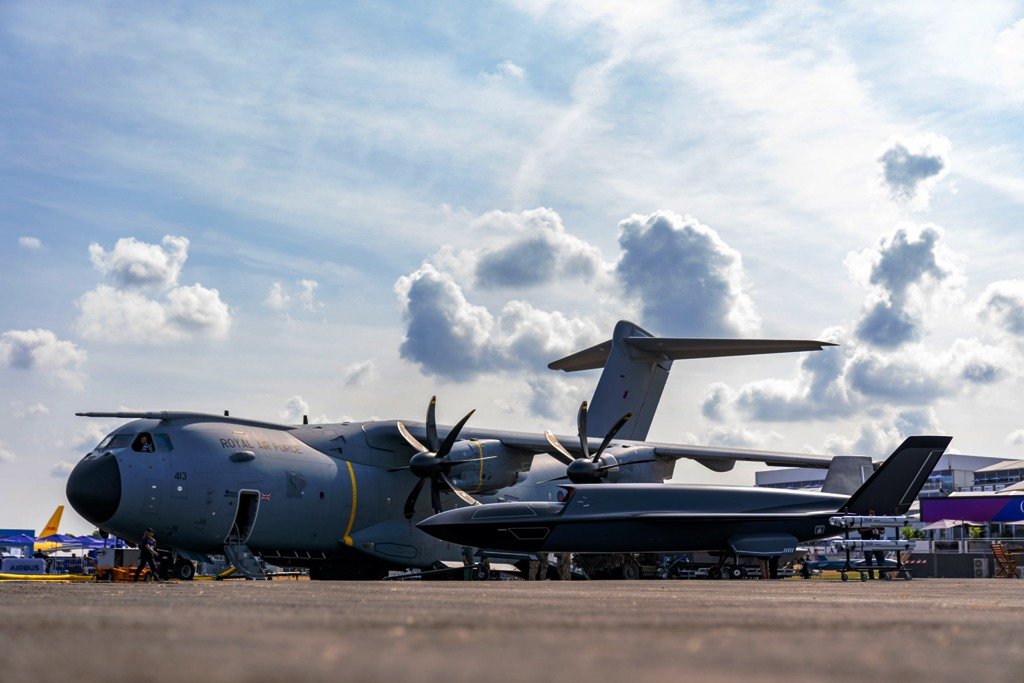
At a media event held in London during the Farnborough Airshow, Airbus CEO Guillaume Faury said that there had been a record intake for Airbus Defence & Space in 2025 amounting to € 1.3 billion
The drone sector is growing along with AI and cyber defence. Airbus has agreed to acquire the UK cybersecurity firm Ultra Cyber from Cobham. The deal is expected to be finalized in the second half of 2026 for an undisclosed sum. Autonomy is being addressed with Combat Collaborative Aircraft (CCAs) based on what was learned from the Barracuda jet powered unmanned aerial vehicle technology demonstrator and Airbus Defence & Space is working with the German drone manufacturer Quantum. Faury said that “we want hardware with software.”
2025 was also a record year for the company’s helicopter sector which seen new missions being undertaken by rotary-wing platforms, particularly for the H145 range of Airbus Helicopters. Faury told EDROn-Line that after its protracted development and entry into service there has been a surge of demand for the Airbus A400M, and with production currently running at eight aircraft per year, he admitted was not enough.
On the subject of the failure of the FCAS programme, he said “we tried to make it work with Dassault”but he said that he was “not happy with the result, but now we have to look forward, we have to write a new page”. Asked if Airbus would consider joining the GCAP programme, he would only say that this is to be determined.
The FCAS was no longer valid as designed but he said its other pillars, combat cloud, remote carrier, and engine development, are progressing despite the programme being cancelled.
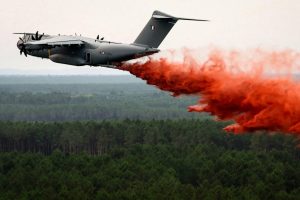
It was left to Jean-Brice Dumont, Airbus Defence and Space Head of Air Power, and soon to be chief executive of MBDA, to flesh out some of the company’s successful programmes the following day. The A400M has racked up 178 sales from nine customers, and new roles are being offered including a platform for dropping drones, missiles and pallets, and for fighting fires it is capable of dropping 20 tonnes of retardant. The A400M is already being used for the first time to fight the catastrophic wildfires that are sweeping across France.

Sixty eight A330 MRTTs have been delivered of 91 ordered and the MRTT+ is now in production. This has Rolls-Royce Trent 7000 engines, optimised aerodynamics and wing-tips. They can deliver up to 8% lower fuel burn and reduced noise and with an increased maximum take-off weight of 242 tonnes further extends range, increases fuel offload capacity. The Royal Thai Air Force has ordered an A330 MRTT+ equipped with both the hose-and-drogue, and a boom, as refuelling systems.
Developments regarding the Eurofighter include it being able to operate with CCAs by 2029. Airbus Defence and Space has Europe’s largest drone portfolio, including the Bird of Prey, and updates on Uncrewed Collaborative Combat Aircraft (UCCA) solutions, Ravenstorm and Valkyrie.
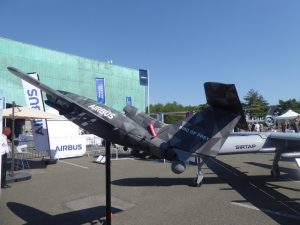
The Bird of Prey is an uncrewed interceptor drone based on a modified Airbus Do-DT25, designed to autonomously detect and neutralize kamikaze drones using low-cost Mark I air-to-air missiles developed with Frankenburg Technologies. The U760 Ravenstorm is a new UCCAintended to enter service by 2032 and operate with crewed fighters in air-to-air combat, air-to-ground strike missions, and electronic warfare. Developed in co-operation with Kratos, andequipped with Airbus’ Multiplatform Autonomous Reconfigurable and Secure (MARS) Mission System, the U740 Valkyrie aims to deliver an operational, sovereign UCCA to the German Air Force by 2029. It integrates the MARS (Multiplatform Autonomous Reconfigurable and Secure)AI-supported software core to enable platform autonomy.
Eurodrone, the four-nation programme of Germany, France, Italy and Spain, which Dumont admitted has been a long time in development, recently received a fillip when Kawasaki Heavy Industries signed a memorandum of understanding (MoU) with Airbus Defence and Space to analyse opportunities to work on a Japanese anti-submarine warfare variant of the medium-altitude long-endurance (MALE) UAV. Asked why the Eurodrone is powered by two turbo-prop engines, Dumont said that more single-engine MALE UAVs had been lost by engine failure than any other reason. Two engines is a safety feature and one engine could be shut down during the transit phase of its patrol saving fuel to increase its endurance.
The overall message from the Airbus executive is that Airbus Defence and Space is playing an increasing important part in the company’s growth.
Photos courtesy Airbus and D. Oliver
