

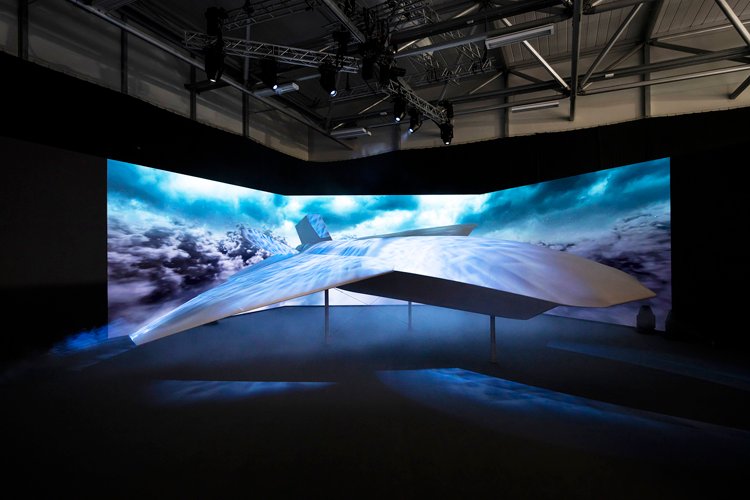
BAE Systems has unveiled the UK’s first uncrewed, autonomous Collaborative Combat Aircraft (CCA) at the Farnborough International Airshow. The system was designed to augment the combat power of the armed forces by complementing existing and future crewed aircraft, delivering additional frontline capability at a lower cost, the company stated in a press release.
The “Brontanax” Prototype
The first-of-its-class aircraft is named Brontanax and was designed and built by engineers at BAE Systems in Warton (Lancashire). To date, more than 500 BAE Systems employees alongside over 75 large companies and SMEs from across the UK aerospace sector have been involved in its development.
Brontanax is roughly similar in size to a BAE Systems Hawk jet (approx. 12.4 meters in length, with a wingspan of approx. 10 meters). Key characteristics include a stealth-optimized delta wing design (Low Observable) with canted tail fins, as well as a chin intake beneath the nose section for its single engine. At less than 25 percent of the cost, the CCA is projected to achieve 70 to 80 percent of the capability of a modern combat aircraft. Insiders estimate the target price at around 25 million US dollars (equivalent to approximately 22 million euros).

The CCA is intended for electronic warfare roles as well as precision strikes against air and ground targets. It is designed to operate alongside combat aircraft such as the Eurofighter Typhoon, allowing a Typhoon pilot or mission commander to operate the drone remotely. Thanks to an open system architecture and a modular design, the system can be adapted quickly to evolving threats. Flight testing is scheduled for next year, with entry into service planned before the end of the decade.
Strategic Significance and Project Quotes
Defence Secretary Wesley Streeting emphasized that Brontanax demonstrates the strength of the sovereign defence industry. Through the Storm Fighter program, the government is investing 300 million pounds (equivalent to approximately 350 million euros) to support the UK’s ambition to become Europe’s first 6th-generation air force.
Chief of the Air Staff Air Marshal Sir Harv Smyth stated that the RAF is determined to drive innovation forward. The Storm Fighter program plays a pivotal role in transforming future capabilities and achieving 6th-generation air power.
Simon Barnes (BAE Systems Air sector) highlighted that the drone extends the reach of crewed aircraft while keeping pilots out of harm’s way. The project builds on significant self-funded company investment and strengthens the British defence ecosystem as well as domestic suppliers.
Brontanax is currently being prepared in Warton for ground testing, followed by flight tests within UK airspace. The maiden flight is expected in 2027, with entry into service scheduled for 2030.
Gerhard Heiming
