

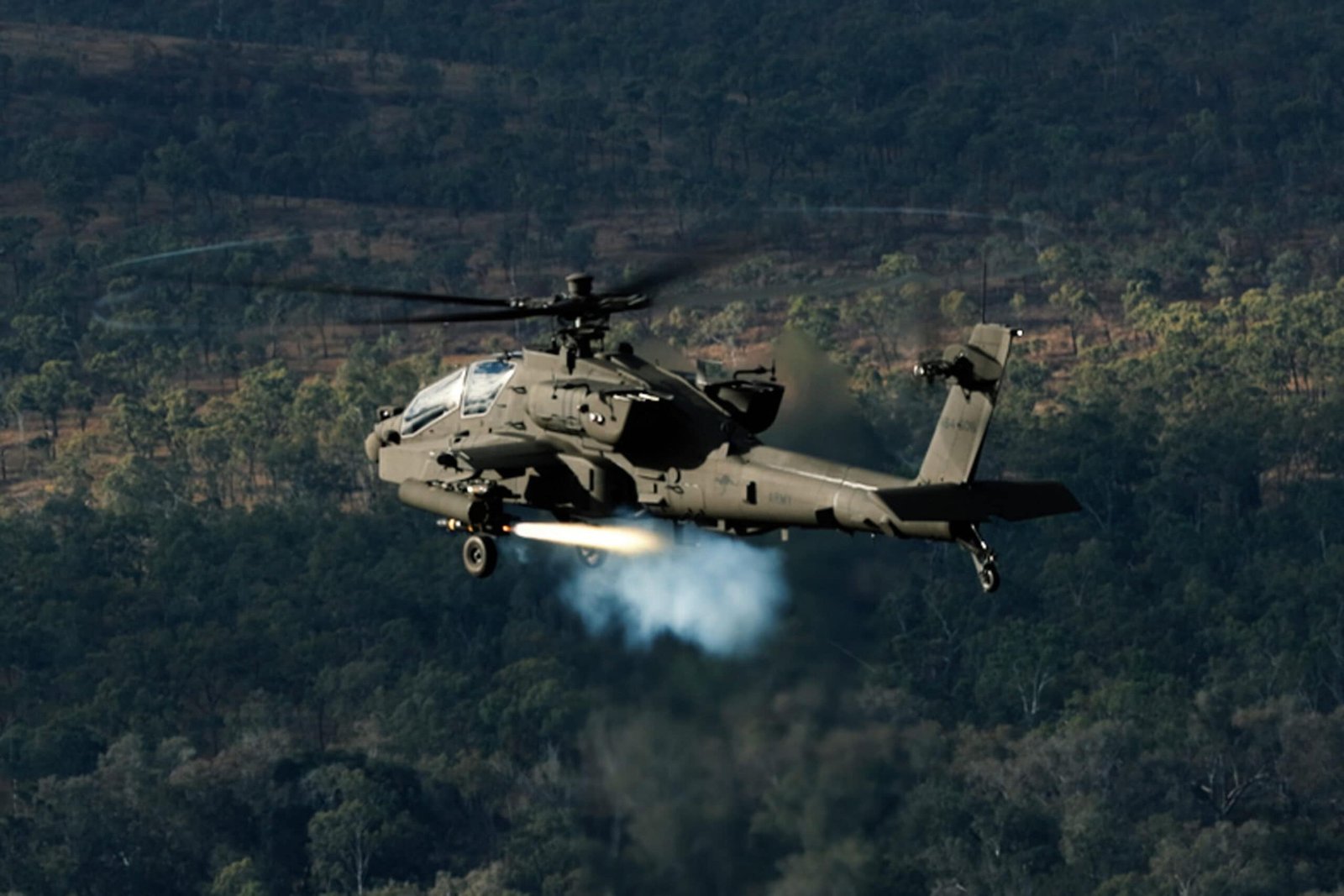
In mid-July, Boeing AH-64E Apache attack helicopters of the Australian Army fired live ordnance for the first time ever during Exercise Possum Guns at the Townsville Field Training Area.
The Apache platform fired its 30mm chain gun, as well as launching 70mm rockets and Hellfire missiles, against simulated targets.
Major General David Hafner, Commander of Australian Army Aviation, remarked, “This is a significant milestone for Army Aviation. Conducting our first live-fire in Australia demonstrates that we’re building a capable, safe and sustainable attack helicopter capability.”
Hafner added, “Our aircrew, maintainers and support personnel will now conduct routine live-fire training and continue to integrate the Apache’s advanced capabilities into joint force operations.”
Army personnel earlier conducted Exercise Possum Walk in May, which saw ground crew loading inert ordnance onto AH-64Es in various scenarios, including at night. This was an important work-up towards Possum Guns.
The Department of Defence said Apaches “are a key element of army’s transformation into a force optimised for littoral manoeuvre and with a long-range strike capability”. It added that the AH-64E will “provide critical attack aviation effects, including reconnaissance, communications and networking, firepower and offensive support to the integrated force”.
The Townsville-based 1st Aviation Regiment has received six Apaches so far, with the latest two arriving in May. Another pair will arrive before the end of 2026.

Lieutenant Colonel Jason Perrins, Commanding Officer of the 1st Aviation Regiment, recently spoke to Asian Military Review about the Apache’s capabilities. “Having operated it now, I think the benefit that Apache brings over any of the other type is just the connectivity and the situational awareness that you can give to the crew. By using those data systems when you’re connected across the battlespace, we can enable the rest of the joint force with a bunch of situational awareness.”
He noted “the sensors bring in so much information, and we can pass that out quickly to other assets that we’re supporting. I don’t think there’s anything else out there that’s doing that level of integration for an attack platform right now.”
The 1st Aviation Regiment is transitioning from the Airbus Tiger armed reconnaissance helicopter to the Apache, plus it is simultaneously relocating from Darwin to Townsville. Slightly more than 50% of the regiment’s 240 personnel have already transitioned to the Apache.
The Townsville-based 161 Reconnaissance Squadron is now operating Apaches, while 162 Reconnaissance Squadron in Darwin will relinquish its Tigers by the end of 2026. Perrins said one troop of Tigers is still flying. Canberra has not revealed the fate of the Tiger fleet yet, with some voices encouraging their sale to Ukraine.
Dr. Malcolm Davis, Senior Analyst at the Australian Strategic Policy Institute, commented, “Many say that attack helicopters can’t survive over the modern battlespace, and thus question acquisition of platforms like the AH-64E Apache Guardian, which the Australian Army is in the process of acquiring.
“I’d argue that the traditional concept for employing attack helicopters dating back to the Cold War is probably over. But seeing attack helicopters as the controlling node for autonomous systems, like the new Anduril Thunder…reinforces to me that there’s new life for crewed attack helicopters. The ability for crewed-autonomous teaming adds new mission flexibility and survivability, even in complex and highly contested environments.”

AMR did ask Perrins about the army’s manned-unmanned teaming (MUM-T) ambitions. “The Apache has obviously got a bunch of good capabilities for manned-unmanned teaming. We’re getting all of that, and so we have a plan to integrate that into how we operate.”
He said the regiment is trained on MUM-T through simulators. “We’ll get the MUM-T equipment in time, and work out how we’re going to do that. There’s definitely a plan that’ll be a key part of what the Apache brings to the Australian Defence Force.”
The Brisbane-based 20th Regiment, Royal Australian Artillery operates Insitu Integrator unmanned aerial systems (UAS), so this will be an early candidate for MUM-T operations.
However, Perrins pointed out, “The benefit of the Apache MUM-T system is it can work with anything. If the unmanned system has the ability to operate on the frequency that the antenna for the Apache does – which most of them do – it’s about just setting the systems up to talk to any of those UAS.”
Perrins believes attack helicopters still have a vital role to perform for the foreseeable future. “I don’t think we’ve got unmanned systems to the point yet where we’re saying that one has replaced the other; they’re certainly complementary.”
Exercise Talisman Sabre 2027 will be the first major activity integrating Apaches, and it will be a key step towards declaring an initial operating capability in the latter half of next year.
Altogether, Australia will field a fleet of 29 Apaches, with all due for delivery by 2029.
by Gordon Arthur
