

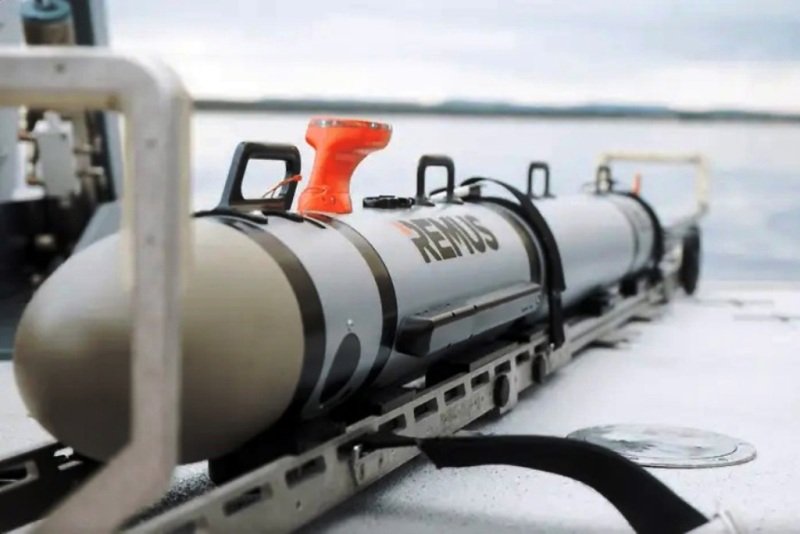
HII (Huntington Ingalls Industries), America’s largest shipbuilder and producer of the Romulus Unmanned Surface Vessel (USV) and the Remus Unmanned Underwater Vehicle (UUV), hosted a media briefing on July 20, 2026, discussing its Odyssey Autonomous Control System and recent developments
Odyssey Autonomous Control System (ACS): Overview
The Odyssey Autonomous Control System (ACS) is a modular, open-architecture software system capable of integrating with USVs, UUVs, UGVs (Unmanned Ground Vehicles), UAVs (Unmanned Aerial Vehicles) or any manned platform in any domain. Once integrated, the system offers varying oversight options depending on the user’s needs, from semi-autonomous operations to fully autonomous, with multi-system collaboration possible.
Additionally, the Odyssey ACS can be licensed and integrated separately from the Remus and Romulus systems and can be tailored to the user, according to Jeremy Shattuck, HII’s Unmanned Systems Chief Technology Officer. Odyssey ACS can integrate relevant forces’ operational behaviours/mission approaches, ensuring that the autonomous systems act exactly as a crewed or semi-autonomous system would.
In the briefing, Shattuck provided some insight into how the communications process works through an autonomous operation, explaining how, for mine countermeasure operations, the Romulus USV acts as a communications gateway, enabling line of sight (LOS) communications with the UUVs responsible for the detection of mines; the UUVs are capable of autonomously calculating the best depth, speed and manoeuvres to optimise mission success. Following the detection of a mine, a secondary UUV will be called in to the target’s location to identify and classify the mine, enabling the first UUV to continue the detection process. Once detected and classified, a Romulus USV can neutralise the threat autonomously, or semi-autonomously with the operator in the loop, confirming the decision before action, dependent on the end user’s preferences.
The ACS is functional in limited or no bandwidth environments, and fully compliant with the International Regulations for Preventing Collisions at Sea (COLREGS), a key component given the autonomous nature of the systems. Currently, the control system is integrated into its Remus and Romulus platforms in 30 countries, including the US Navy, Royal Navy, and NATO forces.
Shattuck discussed how HII’s Odyssey Sim provides an in-depth simulation of environments, enabling users to simulate operations before launch and ensuring systems start with an optimised mission plan and the greatest chance of success in the most time-effective manner.
Romulus variants
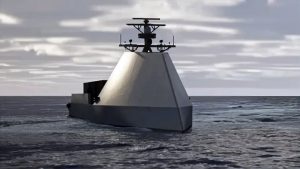
HII’s Romulus USV family currently consists of three variants: the Romulus 7, a 7-foot man-portable USV; the Romulus 151, a 151-foot vessel (there are Reportedly 5 under construction); and the flagship Romulus 190, a 190-foot vessel, capable of achieving speeds of 25+ knots and a reported endurance of 2500 nautical miles when loaded. The vessel was built with other industry leaders, including Breaux Brothers, Beier Integrated Systems, and Incat Crowther. The Romulus 190 is capable of conducting ISR (intelligence, surveillance, and reconnaissance) and targeting operations, counter-UAS and force protection, and strike missions in addition to multi-domain operations, including the launch and recovery of UUVs, UAVs and smaller Romulus USVs. Since its conception, Romulus has expanded its “autonomy, object classification, and lifecycle sustainment” capabilities through collaboration with Shield AI, Applied Intuition, and C3 AI.
Romulus variants are compatible with the US Navy’s Modular Attack Surface Craft (MASC), the US Marine Corps’ Long Range Unmanned Surface Vessel (LRUSV), and next-generation naval unmanned programs, which seek to fulfil the US Navy’s goal of a dominant, hybrid fleet by 2027. In June 2026, it was announced that the Romulus USV had been selected to progress to the evaluation phase of the US Navy’s Medium Unmanned Surface Vessel (MUSV) program.
Remus variants
HII’s other Odyssey-powered systems include the Remus UUV family, which currently consists of four variants. According to Duane Fotheringham, President of the Unmanned Systems group in HII’s Mission Technologies Division, the REMUS variants are “one of the most mature, scalable and flexible undersea platforms in service today,” and HII has delivered over 750 UUVs to 30 countries, with 90% in service over the last 25 years.
Tech Profile: Remus variants
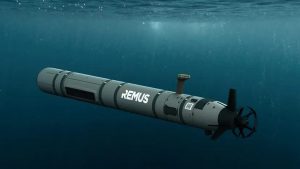
The smallest variant, the Remus 130, has a depth rating of 100 metres and a range of 55 kilometres with an endurance life of up to 10 hours; additionally, the system is two-man portable. The REMUS 300, HII’s second smallest Remus variant, is similarly two-man portable, but the depth rating is raised to 305 metres, with a range of 165 kilometres and endurance life of 30 hours. The other Remus variants, the Remus 620 and Remus 6000, are both non-man portable; however, they provide much greater depth and range capabilities. The Remus 620 has a depth rating of 600 metres, a range of 500 kilometres and an endurance life of 100 hours, whilst the Remus 6000 has a depth rating of 6,000 metres and an endurance life of 25 hours. It is stated that the system can “access 98% of the world’s oceans” according to HII.
The Remus 130 and Remus 300 are both designed to conduct mine countermeasures operations, search and rescue operations, rapid environmental assessment, marine archaeology, and offshore oil and gas exploration.
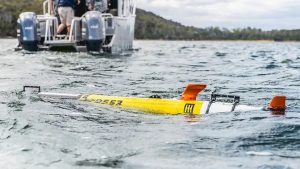
The Remus 620 is designed to carry out mine countermeasure operations, hydrographic surveys, intelligence collection, surveillance, and electromagnetic warfare. The Remus 620 can be deployed from submarines, small manned or unmanned boats, amphibious ships, surface combatants, and helicopters. Moreover, in October 2025 it was announced that in collaboration with the US Navy’s Naval Undersea Warfare Centre Division Newport (NUWC Division Newport), HII had successfully carried out the first recovery of the Remus 620 into a Virginia-class submarine torpedo tube during tests at Seneca Lake in New York. Finally, the Remus 6000 is designed for a variety of deep-sea operations, including search and recovery, hydrography, geothermal vent research, tectonic plate studies, deep-sea mineral exploration, marine research, fisheries research, environmental monitoring, oil and gas infrastructure inspection, and marine geology.
NATO’s future
As it stands, Remus variants have been delivered to 14 NATO countries, primarily for mine countermeasures operations, with Fotheringham revealing that, as expected, there has been a recent uptick in spending from European partners. In September 2025, it was announced that Babcock and HII had signed a memorandum of understanding to combine HII’s Remus UUV variants and Babcock’s Weapon Handling and Launch Systems (WHLS). The collaboration aims to deliver UUV torpedo tube launch and recovery capabilities to the Royal Navy and allied forces.
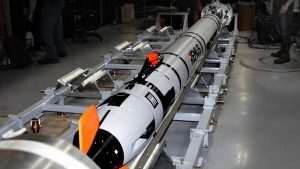
Fotheringham also discussed the December 2025 announcement, covering the further collaboration between Babcock and HII, ARMOR Force (Autonomous and Remote, Maritime Operational Response Force). ARMOR Force aims to use medium or large USVs in conjunction with the Royal Navy’s new Type 31 frigates, which are currently under construction, to extend their reach in contested environments, exercising manned/unmanned teaming capabilities to remove the frigate from the weapons engagement zone, allowing the frigate to function as a “quarterback”, or Common Command Vessel (CCV), coordinating forces of autonomous UUVs and USVs.
The importance of hybrid fleets is likely to increase across NATO, as members face budget constraints and personnel limitations. By pairing crewed vessels with autonomous systems, hybrid fleets offer a more affordable alternative to maritime security, improving efficiency, reducing risk to crewed vessels, and enabling operators to extend their reach into contested environments.
Images and photos courtesy HII
