

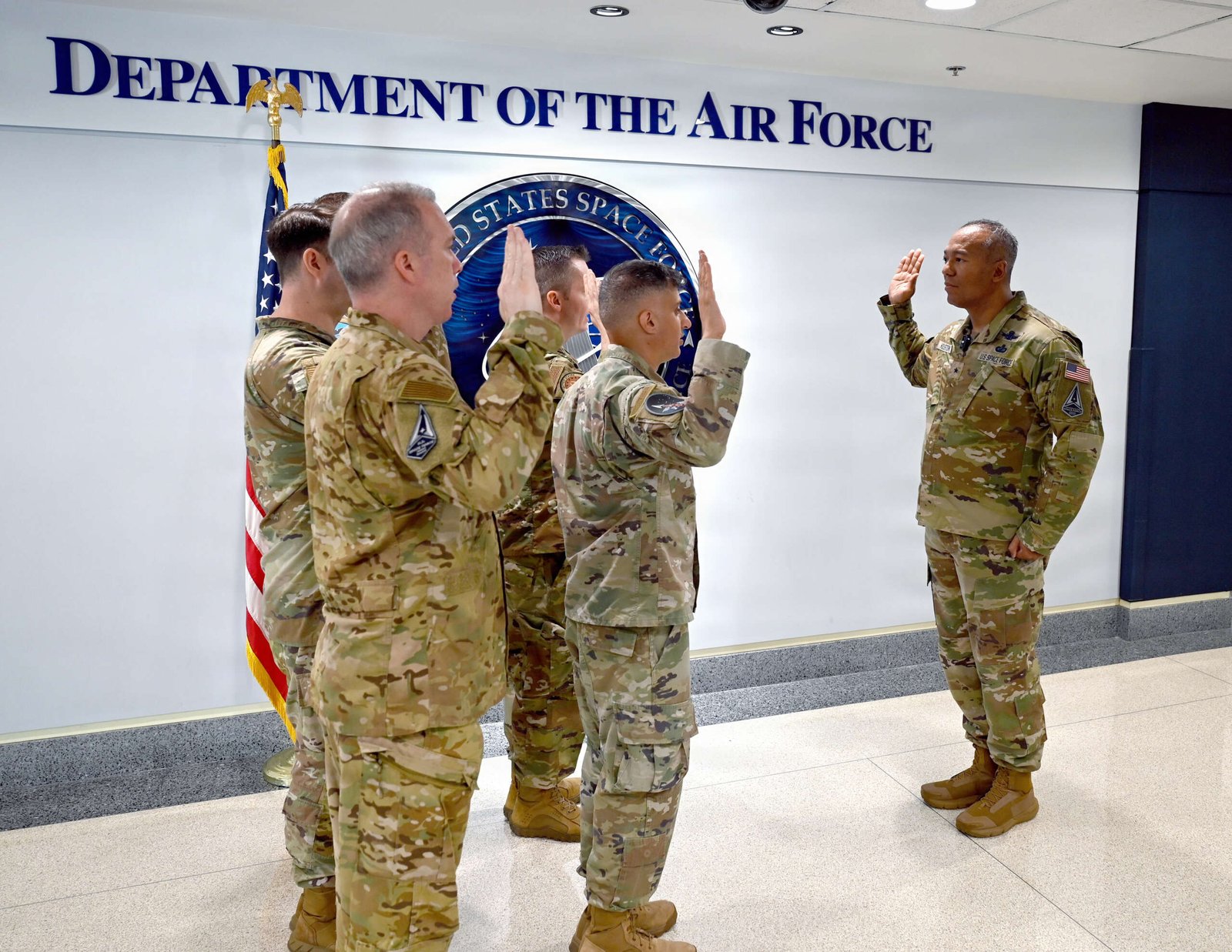
Eighteen Air Force Reservists became the Space Force’s first part-time troops, as the service debuts a more flexible way to serve.
The Space Force welcomed its first part-time troops on Wednesday, bringing in 18 Air Force Reservists as the service rolls out a more flexible personnel model designed to help recruit and retain experienced staff.
The Space Force is the first military branch to let troops move between full-time and part-time work without transferring to the National Guard or Reserves, instead keeping both under a single chain of command. The new approach will test how far military service can go to accommodate members’ needs without compromising critical national security missions.
Part-timers will serve in a new status dubbed “nonsustained duty” — an option that allows them to hold a private-sector job or care for ailing family, for instance. The Space Force said those guardians will keep the same pay, benefits and retirement options they would get in the Air Force Reserve.
Federal law requires that the part-timers serve for at least 14 days each year, as well as participate in at least 48 scheduled drills or training periods. Alternatively, they can switch to a typical active-duty role for training for up to 30 days.
“The model allows for more efficient management of the military force, improved quality of life and retention, and the ability for the Space Force to capitalize on critical skill sets developed outside of military service,” the service said in a release Friday.
The service did not answer whether full-time guardians now have the option to go part-time as well.
“Now there’s just one component … where there’s a common organizational structure, common culture for the guardians that are serving in that,” Brig. Gen. Matthew Holston, who oversees the technical effort to combine the components, said in a video.
More than 220 Guard and Reserve airmen will transfer in over the next few months. The service ultimately plans to bring on about 1,800 Air Force Reservists and Guardsmen, about two-thirds of whom would come from the Reserve, according to the Government Accountability Office.
The Space Force spun off from the Air Force in 2019 with a promise to break the mold created by the other armed forces and adapt military service to the needs of modern Americans.
Under the typical three-component system, the active-duty, Guard and Reserve each have their own set of leaders, personnel, bases, equipment, and IT systems. While Guardsmen and Reservists can temporarily join active-duty units to fill staffing gaps, it’s more complicated to permanently move between components.
That’s why the nascent Space Force built something different.
Chief Master Sgt. of the Space Force John Bentivegna said in 2024 he believes people will gravitate toward a service that recognizes that “life happens.”
“A lot of our part-timers will probably be in their normal job … in the space industry somewhere, or the cyber industry or the intelligence agencies,” he added. “How do we keep leveraging that and bring them back and forth in a way that makes sense?”
The unorthodox approach has rankled proponents of a separate Space National Guard and Space Force Reserve that would mirror the other armed forces and give a greater voice — and more resources — to part-time guardians. They worry that combining the components will make it difficult for governors to call on their state’s space units for missions like wildfire tracking and cut into more global roles like missile warning.
Adding part-timers is one piece of the service’s push to grow from 10,400 troops this year to 13,200 troops in 2027. But joining the Space Force from the Guard or Reserve isn’t as simple as slapping a new patch on a uniform.
Lt. Gen. Doug Schiess, the nominee to lead the Space Force, told senators in written testimony this week that the military’s outdated human resources systems are keeping the service from scaling up its part-time workforce.
“Current Air Force systems are disparate across active and reserve components, requiring extensive manual interventions which drive inefficiencies and constrain the seamless management of guardians moving between full- and part-time statuses,” he said.
Those workarounds are “not practical or sustainable,” Schiess added, calling for continued investment in modern, automated HR software.
Copyright
© 2026 Federal News Network. All rights reserved. This website is not intended for users located within the European Economic Area.
