

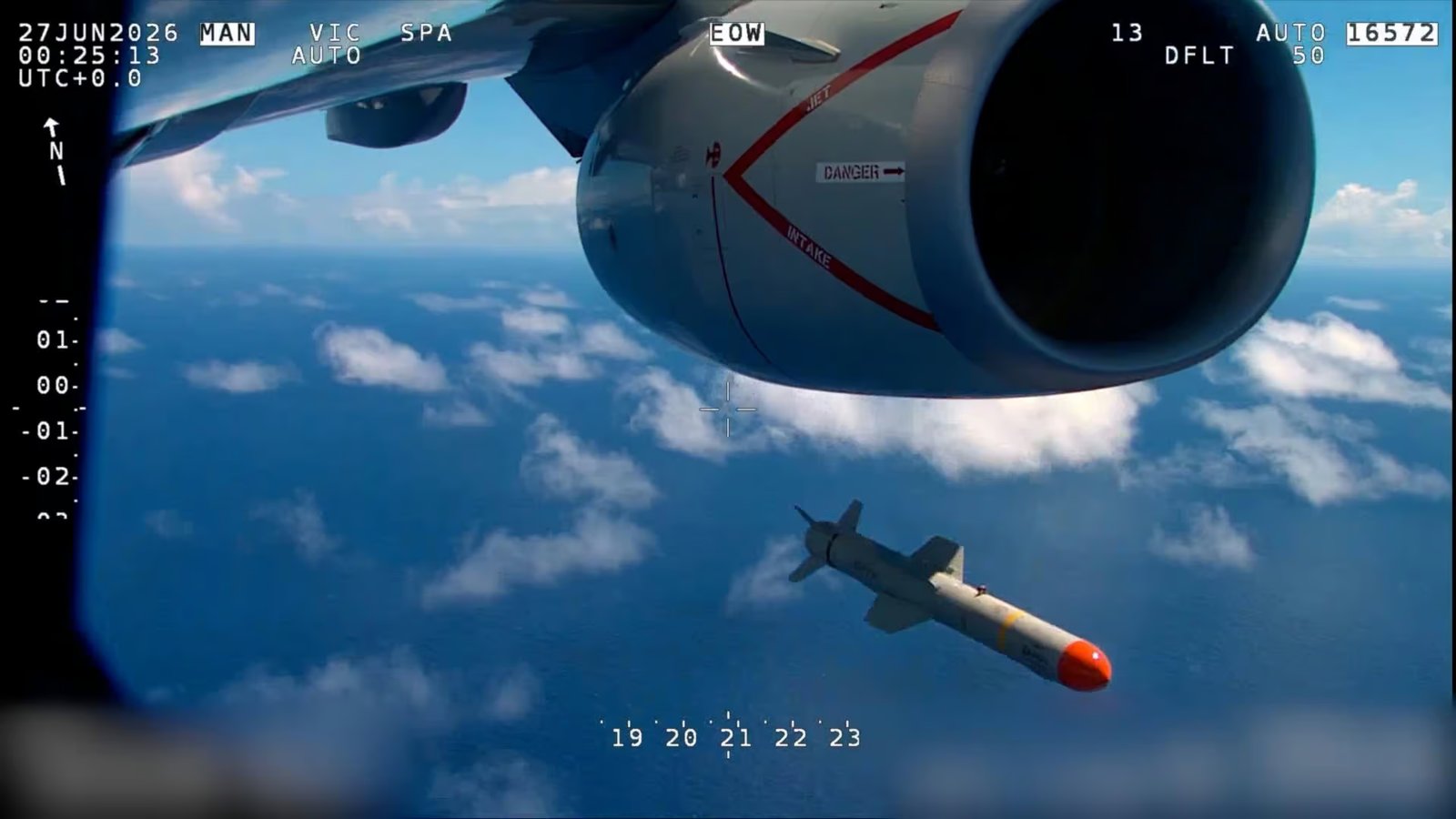
A Boeing P-8A Poseidon of the Royal New Zealand Air Force (RNZAF) launched two AGM-84 Harpoon missiles on 27 June. This event was significant, since it was the first time the RNZAF platform had fired this type of missile.
The drill occurred in waters off Guam during the multilateral Exercise Valiant Shield, held from 22 June till 1 July. The pair of missiles, actually supplied by Australia, hit the decommissioned ship target USS Juneau.
The Kiwi aircraft performed the sinking exercise in conjunction with an Australian and two US Navy P-8s. The RNZAF aircraft from No. 5 Squadron successfully detected, identified and fired at the target. Meanwhile, surface vessels and submarines also fired at the target during the drill.
Squadron Leader Michael Craies, the Poseidon captain, said, “When the time came for our firing, the professionalism of all three P-8A crews involved meant that we were able to rapidly acquire the target and fire four Harpoons in total.”
Air Commodore Andy Scott, Air Component Commander, said this milestone “marked a significant step forward for the RNZAF with the first successful launch of air-to-surface missiles by our P-8A”.
He continued, “These activities are critical to the New Zealand Defence Force’s readiness to be able to meet the challenges of a deteriorating strategic environment, and we’re incredibly grateful for the support of partners to assist us in regenerating the ability to rapidly strike targets at distance.”

The ability to fire Harpoons is even more important when one considers that the Royal New Zealand Navy’s two Anzac-class frigates have no anti-ship strike capability, apart from SH-2G(I) Super Seasprite helicopter carrying relatively obsolete Penguin anti-ship missiles.
This was the first time an RNZAF Poseidon had taken part in Valiant Shield, which has now completed its eleventh iteration. The exercise also rehearsed anti-submarine warfare skills, and the Kiwi P-8A operated within a task force to find, track and conduct simulated MK54 torpedo attacks against multiple submarines.
As well as Australian, NZ and American P-8As, Exercise Valiant Shield 2026 involved the Canadian frigate HMCS Charlottetown, the Japanese ships JS Kaga and JS Fuyuzuki, and the US Navy’s George Washington Carrier Strike Group.
The RNZAF received its quartet of P-8As from December 2022 till July 2023, and Squadron Leader Philip Zeisler, Executive Officer of No. 5 Squadron, told Asian Military Review that the whole transition process has “gone really well, largely due to great support from the Americans and Australians in terms of our training pipelines”.

Speaking to AMR last year, Zeisler noted that P-8 training was still in a transition stage because a simulator and training devices are not yet commissioned. However, after delivery in April 2025, the Ohakea-based simulator system should begin operations this year.
New Zealand replaced six P-3K2 Orions with four P-8s, with the simulator and training devices allowing a reduction in aircraft numbers. Asked about this downsizing, Zeisler said, “It’s absolutely working out for us. Whilst no aircraft is perfect, we find that we have some really good availability out of the aircraft.”
Crewmembers that AMR spoke to at Exercise Talisman Sabre 2025 said the P-8’s sensors were “relatively similar” to the Orion’s, as the P-3K2s had undergone upgrades during their lifetimes. However, the P-8 brings advancements in data sharing, speed to station and its interoperability with partners.
by Gordon Arthur
