

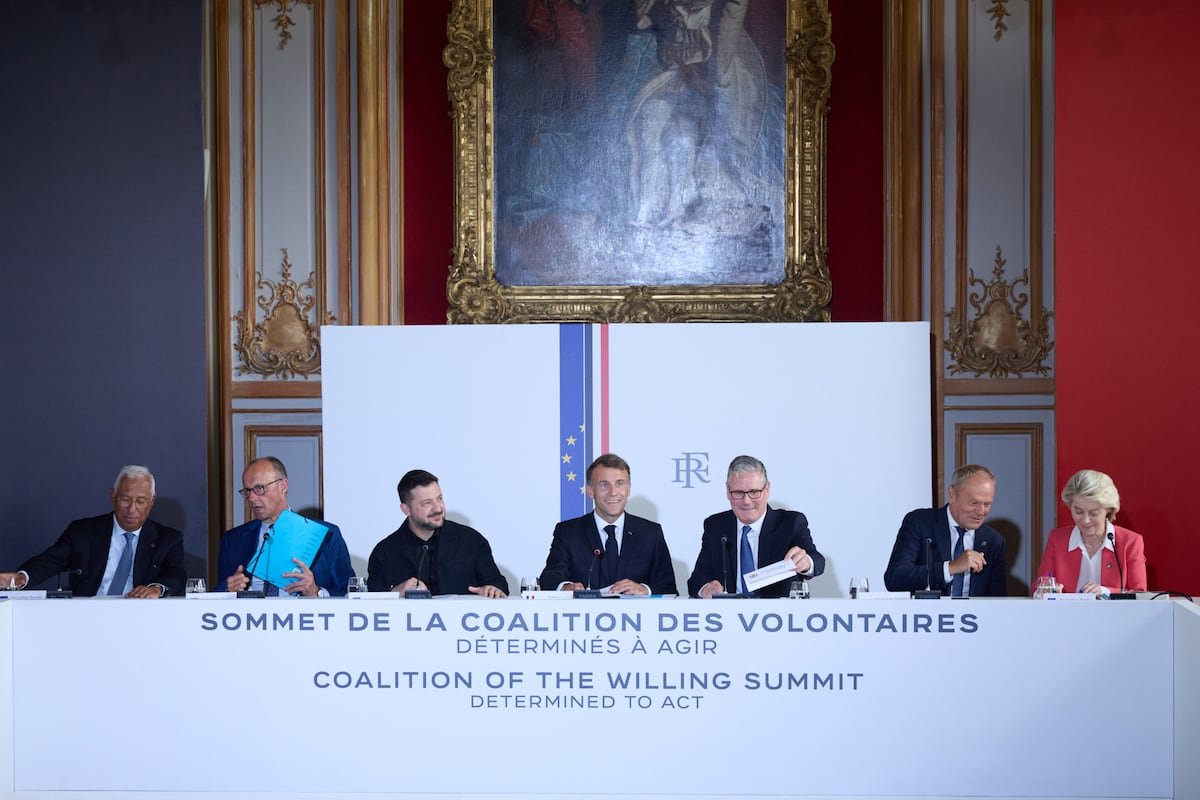
KYIV, Ukraine — Nine nations have joined Ukraine in a nascent anti-ballistic coalition to speed up production of Ukraine’s Freyja interceptor system and get it operational within a year, Ukrainian President Volodymyr Zelenskyy announced at a meeting of defense allies in France on Monday.
He first said a coalition of allies would work together to build the complicated weapon at last week’s NATO summit in Ankara, where U.S. President Donald Trump pledged to let Ukraine build its own Patriot interceptors after recognizing that, in Zelenskyy’s words, Ukraine is “a country that is ready to do this.”
The initiative was launched as a result of a global shortage of anti-ballistic interceptors, as the war in Iran and nearby countries carries on into its fifth month and allied partners across the world push to stock up on defensive weapons.
Nine European countries joined Ukraine as founding members in Paris: Denmark, France, Germany, Italy, the Netherlands, Norway, Spain, Sweden and the United Kingdom.
“We believe that the protection of Europe requires a global solution of integrated missile defence architecture to deter and defeat future missile threats — developed through collective effort, technological openness, and trusted industrial cooperation,” officials wrote in the joint statement formalizing the new coalition.
Although the United States has increased Patriot output and Europe has expanded production of the surface-to-air missile systems SAMP/T, IRIS-T and NASAMS, the shortfall between demand and supply is still wide.
“By bringing together our defence industrial base, our research, and our operational experience, we aim to build a shared antiballistic missile capacity for Europe and support relevant contributory activities. We do this not against any people, but in defence of our own,” the signatories said.
For Ukraine, gaining antiballistic capabilities would enable better protection of its cities and frontlines, both which have increasingly been targeted by Russian ballistic missiles that cannot be taken out by air defenses — and free them from completely depending on allies for this type of support.
For Europe, the coalition offers a fast-tracked path to resolving weapons shortages, strengthening their own defenses at a discount and benefiting from the battlefield expertise Ukraine has gained over years of full-scale war.
The group’s current priorities are to “establish common operational requirements, joint technical working groups, clear governance mechanisms, and a roadmap towards the Coalition’s first operational capabilities,” the announcement said.
In statements about the new coalition posted on social media on Monday, the president explained why Kyiv and Europe need their own anti-ballistic system.
“The threat of ballistic missiles in the world is only going to increase. This is one of the main consequences of the wars in Russia and Iran,” Zelenskyy said. “Therefore, FREYJA must become a reality.”
Ukraine will head the project, supplying the interceptor itself, with partners providing the radar, tracking and command-and-control systems it lacks, Zelenskyy said last week.
“Europe needs more protection against ballistic threats. Together, we can create such a system,” he said. “It is important to politically confirm that FREYJA is our joint project, serving the interests of all of Europe.”
NATO Secretary General Mark Rutte, European Commission President Ursula von der Leyen and European Council President António Costa also attended Monday’s meeting in Paris, in addition to representatives from several European defense companies, including: Destinus, Diehl Defence, Eurosam, Fire Point, HENSOLDT, Kongsberg Defence & Aerospace, Leonardo, MBDA, Saab, Safran, Thales and Weibel Scientific.
“Everyone present here is a vital part of what we need to create this system,” the Ukrainian president said. “I am grateful to the companies for their willingness to work together.”
Although the partnership’s nuts and bolts are still in the works, each country in the coalition will retain a certain degree of autonomy, Zelenskyy said.
“Europeans themselves will be able to decide how many systems Europe needs and where they should be located. This would create a strategically new situation,” he said. “Each European system would add to the overall strength and provide different parts of Europe with a strategic foundation for defense.”
Like Patriot interceptors, Freyja is an entire system that will rely on allies for production support, centering on Fire Point’s FP-7.X interceptor, designed to hit a ballistic target at roughly 15 miles altitude.
But while Patriots take 24 months to build, Zelenskyy said he wants Freyja flying much sooner.
“Each of us holds a crucial piece of the puzzle: we in Ukraine have the missiles, but these are only parts of the system,” he said. “Together, we can create this comprehensive system – FREYJA – within the next twelve months.”
