

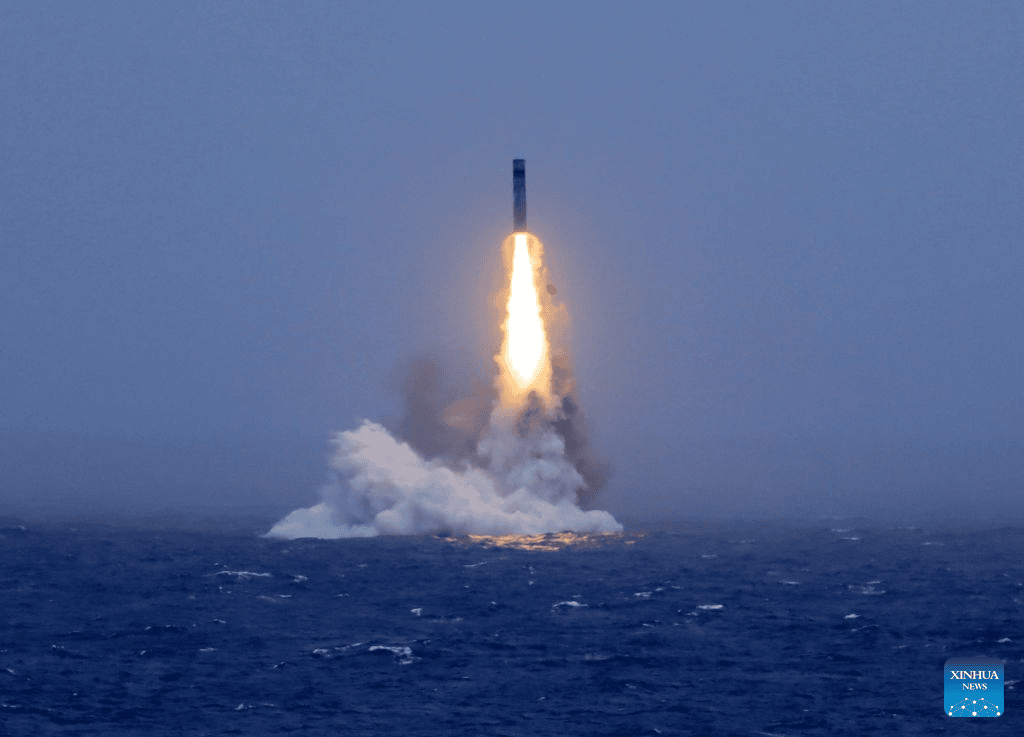
From near the Chinese coast, a nuclear-powered submarine of the People’s Liberation Army Navy (PLAN) launched a ballistic missile deep into the Pacific Ocean on 6 July. The event was significant because it was the first time a Chinese submarine has ever launched a ballistic missile into international open waters in a near-full-length flight.
Senior Captain Wang Xuemeng, a PLAN spokesperson, said it “successfully launched a strategic missile carrying a dummy warhead toward relevant high seas of the Pacific Ocean at 12:01p.m., which landed precisely within the designated waters”. Just what “relevant waters” are is a mystery, because numerous countries protested the Chinese weapon splashing down in their vicinity.
China called it a “routine arrangement of the annual training of the PLA Navy,” while Taiwan’s Presidential Office described it as an “irresponsible unilateral action”. It accused China of “attempting to intimidate the international community by test-firing an intercontinental ballistic missile (ICBM)”.
What actually happened?
China issued notices to airmen (NOTAM) warning of a possible missile launch from the Bohai Sea and following a flightpath over southern Japan, or a second one heading east from the South China Sea.
In the end, the missile was launched from the latter location. The identity of the launch platform was not given by China, but it was likely a Type 094 SSBN, the submarine type that forms the PLAN’s nuclear strike capability. However, the navy also has a single Type 032 diesel-electric submarine that can be used for SLBM tests.
It is also unclear whether the PLAN fired a JL-2 or a JL-3 submarine-launched ballistic missile (SLBM). However, Joseph Wu, Secretary-General of Taiwan’s National Security Council, claimed it was a JL-2. The JL-3 was only unveiled at a September 2025 military parade in Beijing, so it is not yet as widely fielded as the JL-2.
The SLBM’s flightpath is believed to have taken it over northern parts of the Philippines, before returning to Earth between Nauru and Tonga. This resulted in a flight measuring approximately 7,300km, landing in the South Pacific Nuclear Free Zone. If the missile was a JL-2, then it was being tested to nearly its full range. On the other hand, the newer and more-capable JL-3 can travel 10,000+km.

The last time China launched a nuclear-capable missile into the Pacific Ocean was 25 September 2024, when it fired a land-based DF-31B ICBM from Hainan Island. Before that, China’s previous such action occurred way back in 1980. It is quite possible this latest test marks a new drumbeat for such Chinese missile activities far from home.
Signalling or routine?
Decker Eveleth, an associate research analyst at CNA Corporation, posited the question on X: “Is China’s SLBM test a primarily a signalling exercise for other countries? Almost certainly not,” he concluded.
He pointed out that the South China and Bohai Seas are China’s two submarine “bastions.” “China has a geographic problem with their nuclear submarines, as slipping a sub past the First Island Chain is hard [because] US/allied sub detection capabilities could pick it up and follow it.” Instead, China tends to base its submarines in protected zones, or bastions, closer to its own coast.
The issuance of two NOTAMs suggested to Eveleth that “China was exercising forces in each bastion simultaneously”.
According to the CNA Corporation analyst, “I’d interpret the multiple NOTAMs and the confusion over trajectories as evidence China is exercising their sub-based nuclear deterrent command and control, combined with a flight test, to ensure the SLBMs are working.” Communicating with submarines is difficult, and coordinating a nuclear second strike across multiple bastions is challenging. China would therefore want to rehearse this.
Some might see significance in the date of the test, for it coincided with the start of the US-led RIMPAC naval exercise in Hawaii, and it came a day before the anniversary of the outbreak of China’s eight-year resistance war against Japan on 7 July 1937. It also happened to coincide with the start of an annual Chinese naval drill with Russia.
However, Eveleth rejected this notion of Chinese political signalling. “We commonly over-index on ‘signalling’ as the reason China does anything, and ignore the reality that the PLA is a massive, lumbering bureaucracy.”
He continued, “Not every single test is a signal, and these things have to be planned months, if not years in advance, especially when testing new tech. The PLAN has some programme office somewhere and some officer marked this date out months ago.”

Mao Ning, the Chinese Foreign Ministry spokesperson, said the test was “aimed at verifying the reliability, safety and effectiveness of relevant weapon systems”.
Eveleth said this was China’s “new routine in the Pacific, and there’s not really any reason to lose our cool about it”.
Chinese opacity
China claimed its missile test complied with international law and practice because it notified countries in advance, and it was “not directed at any specific country or target”. However, it failed on several accounts according to Hague Code of Conduct obligations, which China refuses to ratify.
Its notification to other countries occurred less than 24 hours before the test, when a full day is required. Furthermore, its notifications were given to selected countries bilaterally, rather than to all 140 Hague Code of Conduct members. The code also requires parties to make mandatory disclosures about the missile class, coordinates and azimuth, for example. China gave only a vague alert.
Instead of transparency and confidence-building measures, China’s action on this occasion exemplified its disregard for others. Indeed, opacity about Chinese nuclear intentions is a typical of China’s approach, as the PLA Rocket Force (PLARF) currently undertakes the fastest and most intensive build-up of nuclear weapons the world has ever seen.
China has tripled its nuclear arsenal from 200 weapons to more than 600 in just six years. The Pentagon predicts “the PLA remains on track to have over 1,000 warheads by 2030”. The USA also assesses that the PLARF currently has 400 ICBMs available for launch from 550 launchers. It also possesses 300 intermediate-range ballistic missiles like the DF-26, which can confusingly carry either a nuclear or conventional warhead.
Tong Zhao, Senior Fellow at the Carnegie Endowment for International Peace, predicted, “Beijing appears increasingly willing to display its strategic nuclear capabilities openly and more regularly.”
This poses the question whether a Chinese bomber will be next fire an air-launched, nuclear-capable ballistic missile next. Beijing has already publicly exercised its land-based and sea-based legs of its nuclear triad.
by Gordon Arthur
