

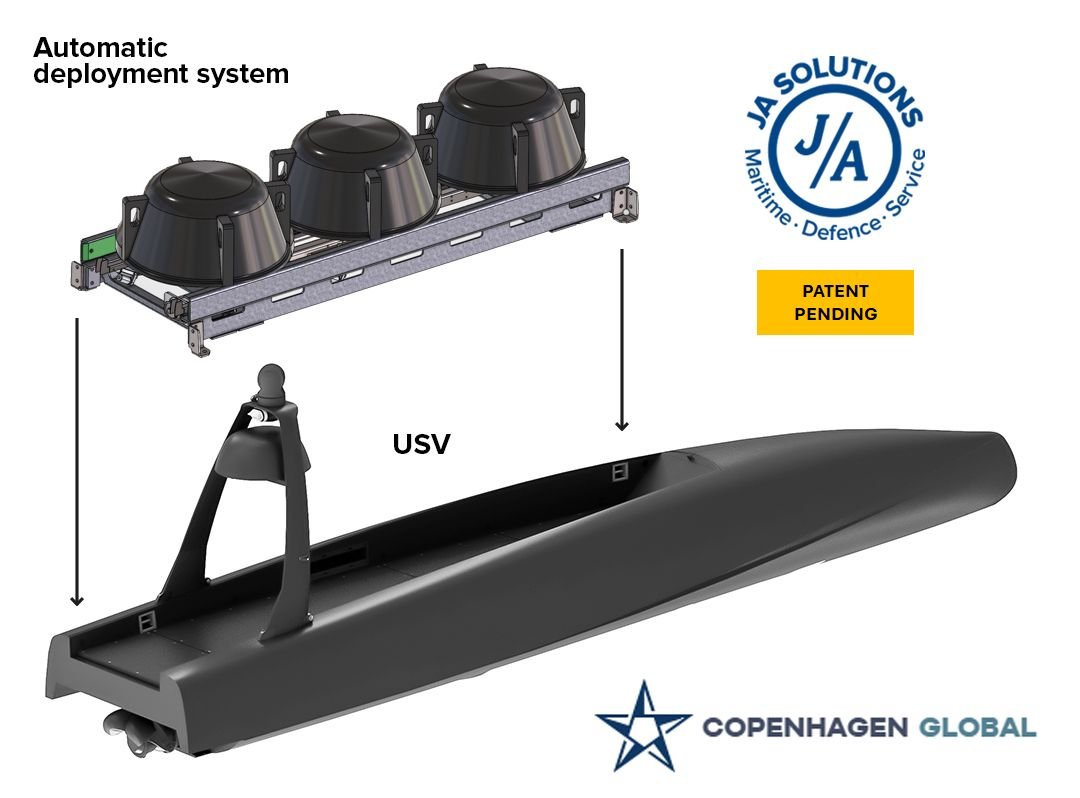
Danish company J.A. Solutions A/S has presented an automatic deployment system intended for unmanned surface vessels and other maritime platforms, covering both military and search-and-rescue applications.
The company has shown the system in two different configurations. One is designed for the deployment of life rafts from a USV during SAR operations. The other is a modular frame arrangement that can be used to carry and release sea mines, drones, sensor packages or life rafts, depending on the mission and the host platform.
According to J.A. Solutions, the life raft configuration allows one or more rafts to be deployed remotely inside an operational area without sending a manned SAR platform. The number of rafts depends on the size and payload capacity of the USV, with a standard configuration carrying two to three life rafts per rail section. The company lists the approximate weight of each rail section as 300 kg.
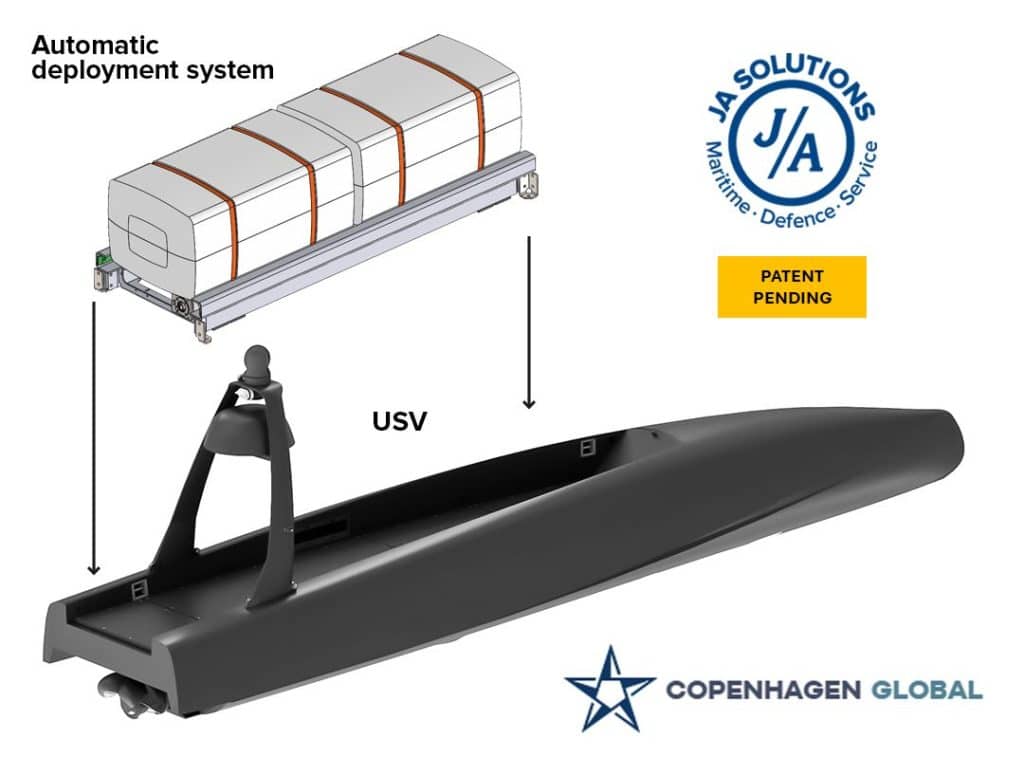
The system was shown fitted on the Orca USV from Copenhagen Global A/S. Naval News previously covered the Orca at Dalo Industry Days 2025 and DSEI UK 2025. J.A. Solutions says the deployment system can be adapted to most USV platforms. In a separate configuration, the company also showed the system on larger naval and coast guard platform designs from OMT – Odense Maritime Technology.
For the minelaying and payload deployment version, one frame set has an approximate weight of 300 kg, a length of 3 m and a width of 1 m. This allows two frame sets to be installed on a 10 ft container rack, or four frame sets on a 20 ft container rack. The company says the same frame can be used for sea mines, drones, sensor packs or life rafts.
The concept reflects a wider trend in which unmanned surface vessels are being considered for more than surveillance or simple patrol tasks. A USV fitted with a deployment system could be used to place payloads, deliver emergency equipment, or reduce the need for a crewed vessel to enter a high-risk area in the first phase of an operation.
The military relevance is particularly visible in mine warfare, where remotely operated or unmanned platforms could reduce the exposure of crews during minelaying missions. In SAR, the same basic idea could allow flotation equipment to reach survivors before a helicopter or rescue boat arrives.
