

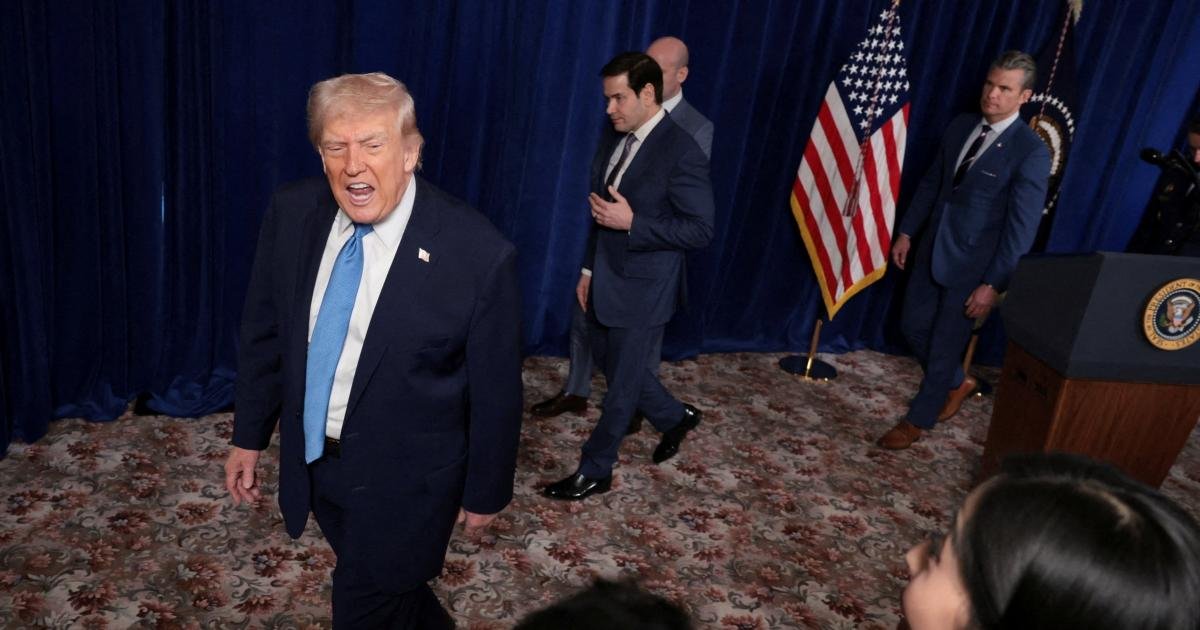
At the G-7 summit in June, the global media eagerly gathered to hear U.S. President Donald Trump provide details about his administration’s latest agreement with Iran. But Trump insisted on returning to one of his favorite subjects: the U.S. military operation that captured Venezuela’s then leader, Nicolás Maduro, in early January. “We have the most powerful military in the world. You saw that with Venezuela, which was . . . 48 minutes, and now our relationship with Venezuela is great,” Trump enthused. “We paid for the cost of the war 40 times, taking millions of barrels [of oil] out. Venezuela’s benefiting, we’re benefiting.”
Trump’s desire to turn his gaze south, rather than east, west, or north, is understandable. At a time when the president’s war on Iran looks like a miscalculation of historic proportions, and when his rhetoric, tariffs, and other actions have alienated traditional U.S. allies in many parts of the world, Latin America stands out as the foreign policy sphere in which Trump has enjoyed the most success in advancing his agenda.
Indeed, this White House has focused more attention and resources on Latin America than any U.S. administration in at least 40 years, including Trump’s own first term. Shortly before Trump’s inauguration, I argued in Foreign Affairs that this was likely to occur, not because the region fit a grand foreign policy theory but because it is instrumental to some of Trump’s most important domestic priorities: halting unauthorized immigration, reducing drug overdose deaths, and guaranteeing the United States’ long-term security in energy and critical mineral supplies. The administration has also sought to roll back China’s rising influence in Latin America, which both Republican and Democratic leaders have increasingly seen as a threat to U.S. national security.
Perhaps the most striking element of Trump’s Latin America policy is not the renewed focus on the hemisphere per se, but the extent to which it so unabashedly echoes U.S. President Theodore Roosevelt’s “big stick” policy and other episodes from the past two centuries of U.S. interventionism in the region. The administration’s 2025 National Security Strategy promised that “after years of neglect, the United States will reassert and enforce the Monroe Doctrine to restore American preeminence in the Western Hemisphere,” referencing the 203-year-old idea, introduced by U.S. President James Monroe, that outside powers should not meddle in the Western Hemisphere. Whereas previous post–Cold War U.S. administrations had mostly emphasized values such as sovereignty and mutual respect in their dealings with Latin America, Trump has threatened to “take back” the Panama Canal and conduct unilateral strikes on cartels in Mexico; publicly endorsed candidates who share his conservative, tough-on-crime views; and, in the case of Venezuela, used U.S. military might to topple a leader he did not like, as numerous presidents in the nineteenth and twentieth centuries did.
To the surprise of some, this heavy-handed, frequently coercive approach has produced some results for Trump, at least in the short term, as governments across the hemisphere offer greater cooperation, especially on migration and security. This alignment has been aided by the recent election victories by Trump allies in countries including Chile, Colombia, and Peru as part of a right-wing wave that has swept much of the region in the past year. Yet some Latin American policymakers, even as they acknowledge Trump’s victories, warn of a backlash in the long run. In the twentieth century, mounting resentment over U.S. occupations and other interventions eventually gave rise to anti-American leaders such as Fidel Castro in Cuba and Juan Perón in Argentina. With major decisions still to come for U.S. policy on Cuba, Mexico, and Venezuela, the return of interventionism in the twenty-first century may ultimately have the opposite effect that Trump wants: driving the region away from the United States and into the arms of China.
THE BULLY PULPIT
The Trump administration’s military intervention in Venezuela, and the incipient, still highly uncertain effort to transform that country into a stable, business-friendly ally, is the most visible result of Washington’s focus on Latin America. But it is not necessarily the most important. In particular, Trump’s dealings with Mexico’s leftist president, Claudia Sheinbaum, have been unexpectedly productive. He has leveraged the threat of higher tariffs and military strikes, and a cordial relationship with Sheinbaum, to secure a degree of coordination on security that officials in both countries describe as unprecedented. Over the past year, the United States and Mexico have expanded their intelligence sharing, and Mexico has extradited or handed over dozens of cartel leaders, some of whom previous U.S. administrations sought custody of for years. Mexican security forces have deployed extra personnel to stop migrants from third countries from reaching the 2,000-mile U.S.-Mexican border, helping Trump deliver one of the main promises of his 2024 campaign: to dramatically reduce unauthorized crossings there.
When it comes to narcotics flows and drug-related violence, the Trump administration’s record so far has been more mixed. Trump’s campaign of strikes on alleged drug smuggling boats in the Caribbean, which has killed more than 200 people, may be both illegal and ineffective, with independent investigations so far finding no material reduction in cocaine supply to the United States. But the overall number of drug overdose deaths in the United States fell 14 percent in 2025, the third straight year of declines. Although experts cite multiple reasons for the decrease, U.S. officials point to a 22 percent decline in fentanyl overdose deaths as a sign that greater cooperation from Mexico, where most of the synthetic opioid is smuggled from, has brought results. A 40 percent decline in Mexico’s official homicide rate since Sheinbaum took office in late 2024 has led to hopes of a calmer security dynamic that will ultimately benefit both countries. Several Central American countries, including Costa Rica, Guatemala, and Honduras, have also notably stepped up their security and drug interdiction efforts since Trump returned to office.
After two decades in which China’s expansion into Latin America went virtually unchecked, U.S. pressure has recently pushed some countries to limit their partnerships with Beijing. In December, Mexico implemented tariffs on imports from several countries, which primarily affected Chinese goods and was widely seen as an effort to address Washington’s fears that Beijing was using Mexico as a backdoor for entry into the U.S. market. In January, Panama stripped control of the Panama Canal’s two ports from a Hong Kong–based company after U.S. officials repeatedly raised concerns about China’s presence there. The same month, Chile halted plans for a Chinese undersea Internet cable linking Valparaíso and Hong Kong shortly after the U.S. embassy in Santiago summoned officials from Chile’s telecom ministry. (The State Department later canceled the diplomatic visas of three officials who had considered the proposal.) Since 2017, five Latin American countries that had formally recognized Taiwan have switched to recognize China. But Honduras, under its new president, Nasry Asfura, is now considering switching back to Taiwan. These are serious setbacks for Beijing, even if its presence in the region is strong and growing in other areas.
Meanwhile, Trump has showered his ideological allies in Latin America with military, financial, and political support. Trump’s approval, in October 2025, of a $20 billion rescue package for Argentina was widely perceived as decisive in stabilizing the country’s economy, thus allowing President Javier Milei’s party to win a critical midterm legislative election that month and helping keep the libertarian’s pro-business reform agenda on track. Trump has sent U.S. troops to Ecuador to help President Daniel Noboa—who traveled to Mar-a-Lago to take a photo with Trump two weeks before his successful reelection bid in April 2025—to combat the cartel-related violence that has made Ecuador the country with the highest homicide rate in South America. Trump’s endorsement of right-wing candidates in Latin American elections has only had a marginal effect in some countries, but it had an apparently decisive effect in at least one—in Honduras, Asfura languished in third place in polls until Trump endorsed him. Although most elections in Latin America have been decided primarily by local factors, right-wing or center-right candidates have now won 12 of the last 15 presidential elections in the region, producing a new generation of leaders broadly sympathetic to Trump—and willing to work with the White House on drug interdiction, migration, China, and other shared priorities.
BENEATH THE SURFACE
Trump has been aided in his regional efforts by several Latin America–focused aides, most notably Secretary of State Marco Rubio, the son of Cuban immigrants. Some of these advisers see Latin America not just through a national security lens but as part of a broader, decades-long struggle against communism. They believe, moreover, that Washington is tantalizingly close to winning that battle following the downfall of Maduro, the economic crisis in Cuba, and the recent losses of left-leaning leaders elsewhere in the region. Trump has also appeared at times to take personal satisfaction from deploying Washington’s hefty military and economic might in a region that does not offer the same immediately obvious complications as regions such as the Middle East. At a press conference in the hours after Maduro and his wife were captured in January, Trump seemed eager to turn back the clock to the heyday of the Monroe Doctrine and the absolute power it implied. “They now call it the Donroe Doctrine,” Trump told reporters. “American dominance in the Western Hemisphere will never be questioned again.”
But some kind of backlash may already be underway. In the Pew Research Center’s 2026 poll of global attitudes toward the United States, the percentage of those with a very or somewhat favorable view of the United States declined sharply in several Latin American countries, mirroring trends in other parts of the world. Trump’s biggest policy setback in the region has been an ill-fated attempt to use tariffs and sanctions to pressure Brazil’s government and Supreme Court to drop criminal charges against his ally, former President Jair Bolsonaro. A nationalist backlash ensued, bolstering the popularity of the leftist President Luiz Inácio Lula da Silva, a Trump critic. Bolsonaro went to jail anyway, and Trump eventually dropped the tariffs. Frustration with Trump was a main reason why the Mercosur bloc of Argentina, Brazil, Paraguay, and Uruguay finally agreed to a trade agreement with the European Union this year after more than a quarter century of negotiations.
Several tests of Trump’s regional agenda await.
Some observers inside Latin America warn that Trump’s successes are a kind of mirage, in which official cooperation on security and smiling photo opportunities have disguised a deep and growing resentment at the way his administration has disrespected the sovereignty of even his allies. In a recent meeting, the foreign minister of a Latin American government aligned with Trump told me with palpable anger: “We will not be anyone’s vassal.” The president’s preference for working with ideologically similar leaders led to the exclusion of Brazil and Mexico, the region’s two largest countries, from Trump’s “Shield of the Americas”—a coalition among countries embracing a militarized approach to antidrug policy—raising questions about what will happen to the initiative when the political pendulum in some of these countries inevitably swings left again.
Yet for now at least, Trump can point to signs that, even if he may not be personally popular in the region, key parts of his agenda are aligned with many Latin American governments and their constituents. Crime consistently appears in polls as the number one political issue in countries including Chile, Colombia, and Mexico, reflecting public frustration with cartels and gangs that have grown even more powerful over the past decade because of soaring cocaine production, illegal mining, and human trafficking. Those trends, more than any other, have underpinned Latin America’s shift to the ideological right—and explain why Trump’s stated desire to “destroy” the region’s organized crime groups has earned considerable support. The capture of Maduro, whose government was widely blamed for a surge in migration and crime elsewhere in Latin America, was popular in the region; in a January Atlas/Bloomberg poll, 74 percent of Peruvians and 64 percent of Colombians surveyed approved of the U.S. military operation. When the State Department labeled two local criminal organizations in Brazil as foreign terrorist organizations in June, Lula’s government protested, but 59 percent of respondents in a survey by Brazilian polling institute Datafolha supported the classification.
In recent presidential elections, some right-wing candidates have shied away from seeking Trump’s explicit support or endorsement, including the eventual winners José Antonio Kast in Chile and Keiko Fujimori in Peru. But others, such as Abelardo de la Espriella, who won Colombia’s election by less than a percentage point in June, and Flávio Bolsonaro, who is campaigning ahead of Brazil’s election in October as the heir to his imprisoned father’s conservative movement, have made Trump’s support a centerpiece of their campaigns, suggesting that the U.S. president still has coattails—and therefore, considerable influence—in much of the region.
BACK TO THE FUTURE
Several tests of Trump’s regional agenda await. In Venezuela, the political and economic outlook has become even more uncertain since June, when twin earthquakes killed thousands and undermined already low public confidence in Delcy Rodríguez, Maduro’s former vice president who has run the country under U.S. tutelage since his capture. Even after the tragedy, Trump has continued to shower Rodríguez with praise, apparently content with her success at increasing Venezuela’s oil exports by some 46 percent and otherwise doing Washington’s bidding. This has led to fears among the Venezuelan opposition and democracy advocates elsewhere that Trump may prefer to leave her in place indefinitely rather than risk the instability of holding elections. In the meantime, delegations of investors from the United States and elsewhere have flooded Caracas hotels in anticipation of better economic times ahead. But with annual inflation still running above 500 percent, hundreds of political prisoners still languishing in jails, and few signs so far of the incipient oil bonanza filtering down to the population at large, polls show that approval for Rodríguez among Venezuelans is extremely low—and the gratitude they felt for Trump in the wake of Maduro’s removal has faded. If Trump does not push Rodríguez to agree to a firm date for elections before his term is over, the glow could quickly dim on what he sees as one of his biggest accomplishments to date.
Many believe that Trump’s relative success in Venezuela will lead him to target Cuba next. Indeed, the U.S. military has begun a buildup of assets in the Caribbean that, although smaller than the flotilla that preceded Maduro’s removal, would still provide Trump with an array of options, including the capture of Cuban officials. A U.S. blockade of oil imports, which Cuba relies on to produce electricity, has led to long blackouts and food shortages that many expect will come to a head in the sweltering Caribbean summer. Trump has designated Rubio, a longtime hawk for regime change in the country, to oversee negotiations with the Cuban regime. Some believe the Trump administration might accept a Venezuela-type arrangement, in which part of the Cuban regime remains in place if it opens up its economy and promises eventual elections, but others wonder if Trump and Rubio will be tempted to pursue a more dramatic change—toppling the regime that has been in place since 1959 and which has defied 13 different U.S. presidents. This latter scenario may be tempting, because if successful, such a transition could help obscure memories of Trump’s war in Iran before the November U.S. midterm elections, and it could also likely boost Rubio’s seemingly ascendant chances to succeed Trump as the Republican nominee for president in 2028.
Trump’s upcoming decisions on Mexico will also be legacy defining. Despite the Sheinbaum government’s strong cooperation on security, many in Washington and Mexico City expect trouble ahead. In July, the Trump administration announced that it “did not agree to renew . . . in its current form” the U.S.-Mexico-Canada Agreement, the trade deal Trump negotiated in his first term. Although that decision does not mean the immediate end of the agreement, it does open up a protracted negotiation process. That will produce additional uncertainty for Mexico’s economy, which sends more than 80 percent of its exports to the United States, and carry potential disruptions for U.S. companies and supply chains as well. Meanwhile, Trump has continued to ratchet up pressure on Sheinbaum by demanding that her administration extradite a state governor from her party on drug trafficking charges. Mexican officials fear that Sheinbaum’s acquiescence would cause a rupture in her leftist party, which includes strong anti-American elements; if she refuses, however, Trump could decide to launch unilateral drone strikes or other military action against cartel targets in Mexican territory. Such a scenario is viewed in Mexico as a redline that could completely transform the country’s relationship with the United States, reviving nationalist memories of the nineteenth century and forcing Sheinbaum to severely curtail the cooperation that has allowed Washington to subdue irregular migration at the border.
Nothing may prove more important in the long term than how Trump handles the U.S. rivalry with China in Latin America. In South America especially, where China is now the number one trading partner by a substantial margin, even some of Trump’s strongest allies have been highly reluctant to alienate Beijing. Milei has called the Chinese “fabulous” partners. Ecuador’s Noboa is planning to visit Beijing, for the second time, this August. Meanwhile, Washington has sent mixed messages about what exactly it wants from its allies on China policy; in May, just days after the Colombian-born Republican Senator Bernie Moreno told a security conference at Florida International University that Latin American countries should pursue a “monogamous” relationship with Washington, Trump landed in Beijing with a large delegation of U.S. CEOs, including SpaceX’s Elon Musk and Apple’s Tim Cook, to pursue a wide variety of business deals. Many expect that Trump will ultimately settle on a balance: pressing Latin American allies not to allow Chinese investments in sensitive areas, including telecommunications, ports, and the space industry, while conceding that trade will otherwise continue, as it has for the United States. Even then, many regional governments will be tempted to maintain a balance between the two superpowers.
It may seem counterintuitive that a politician who launched his campaign for president in 2015 by accusing Mexico of sending drugs, crime, and rapists to the United States would be enjoying even qualified success in Latin America. But even some former Biden administration officials have privately conceded that Trump’s approach has been effective in unexpected ways. Some have wondered whether, had President Joe Biden threatened tariffs or other coercive action, the Mexican government of that era might have worked harder to control migration, thus possibly avoiding the crisis at the U.S.-Mexican border that many Democrats blame for their defeat in the 2024 election. Whether Trump will be able to sustain his successes, or whether his policies will go down as another chapter in more than two centuries of U.S. overreach and unintended consequences, there are signs that Washington’s big stick in Latin America may be here to stay.
Loading…
