

Abstract:
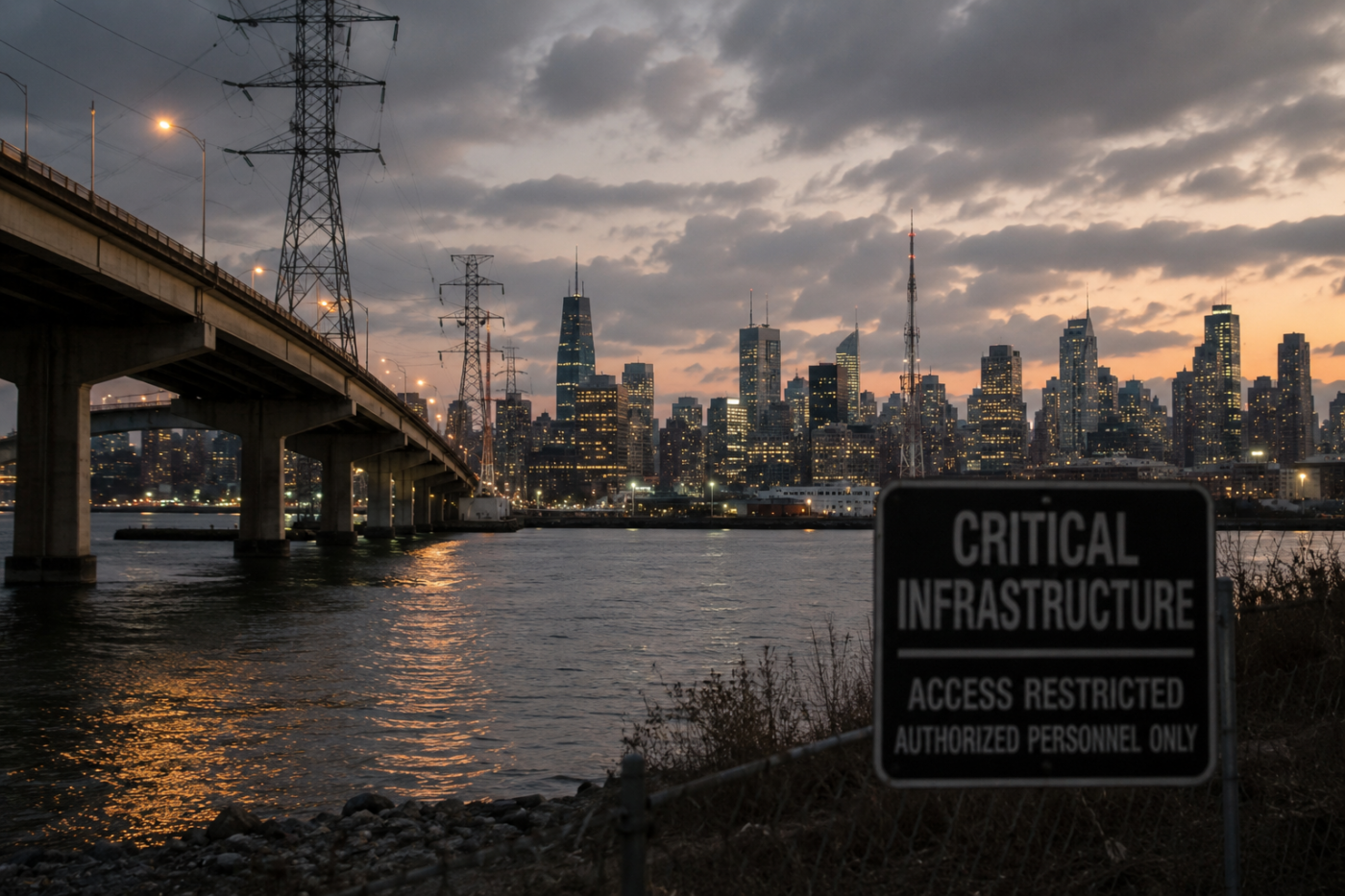
Critical infrastructure is not attacked only for what its destruction immediately achieves. It may also be placed at risk to communicate capability, shape expectations and alter an adversary’s political choices. Responding effectively, therefore, requires protection of both the physical system and the surrounding decision environment, namely the interconnected legal, informational, and cognitive conditions through which governments, publics, infrastructure operators, and allies interpret an attack, assess future risk, and determine how to respond.
The Power to Hurt is Bargaining Power
Recent commentary on the operational integration of the physical dimension, including critical infrastructure, and the cognitive dimension, including decision-making, highlights a feature of contemporary conflict that is easily missed. The physical effect of an operation may be limited, yet its strategic influence may be much greater. A drone damages part of a desalination facility but leaves reserve capacity intact. A cable is cut without producing a sustained communications collapse. A cyber operation briefly interrupts a service without destroying its underlying machinery.
Viewed only through a damage assessment perspective, such operations may appear unsuccessful or restrained. Viewed as coercive signals, they may have achieved precisely what was intended.
The immediate action demonstrates access, capability, and willingness. Its limited character leaves open the possibility of repetition and escalation. Public statements, legal claims, and amplified images then direct attention toward what could happen next. The strategic objective is not necessarily the damaged facility. It is the decision of governments, populations, companies, and allies who now understand that an essential dependency can be held at risk.
This combination of limited physical action and accompanying informational influence is sometimes described as cognitive warfare, in which physical and informational activities are coordinated to shape perception, judgment, decision-making, and behavior. In the context considered here, the relevant conduct is the targeting, disruption or threatened destruction of critical infrastructure, particularly water, energy and communications systems on which civilian populations and governments visibly depend. Such operations move across physical, informational, and cognitive layers. Damage to, or demonstrated access to, the system supplies credibility; public statements, legal claims and amplified images frame responsibility, legality and the prospect of further harm; and the resulting fear, uncertainty and loss of confidence may affect governmental, public and commercial decision-making. Critical infrastructure remains the physical object of the operation, but its targeting also functions as a communicative act conveying capability, vulnerability, and the prospect of further harm.
The contemporary information environment compresses the practical distance between tactics, operations, military strategy, and grand strategy. A strike may be tactically local but immediately global in visibility, operationally significant for campaign tempo, strategically important to alliances and markets, and grand-strategic in the claims it generates about legitimacy and international order. Influence also moves in the opposite direction, as grand-strategic narratives and legal positions shape operational campaigns and tactical choices. The levels remain analytically distinct, but effects move rapidly and recursively between them.
In the global information environment, the level at which an action is conducted need not be the level at which its most important effect occurs. This framework adapts David Kilcullen and Greg Mills’ levels-of-analysis model to show how physical and informational actions generate cross-level influence effects in the global information environment. The relationship between the level of effect, illustrative action, principal decision audiences, and principal influence effect can be expressed as follows:
Grand strategic level:
- Illustrative action: Narratives concerning international order, legitimacy, alliances, and acceptable conduct.
- Principal decision audiences: States, international institutions, global publics, and markets.
- Principal influence effect: Shapes legitimacy, coalition alignment, and the perceived rules of competition.
Strategic level
- Illustrative action: Coercive threats, legal framing, signaling and cross-domain pressure.
- Principal decision audiences: National leaders, allies, adversaries, and major commercial actors.
- Principal influence effect: Alters political choices, risk tolerance, and willingness to continue or terminate conflict.
Operational level
- Illustrative action: Sequenced kinetic, cyber, informational, diplomatic, and proxy activities.
- Principal decision audiences: Campaign commanders, regional governments, operators, and intermediaries.
- Principal influence effect: Coordinates effects across theaters, domains, and audiences.
Tactical level
- Illustrative action: Strikes, intrusions, disruptions, demonstrations of access and localized messaging.
- Principal decision audiences: Local commanders, operators, affected populations, and immediate observers.
- Principal influence effect: Produces physical effects and credible evidence of capability, vulnerability, and future harm.
The resulting question is whether such actions remain bounded forms of coercive signaling, operate principally as a form of cognitive warfare, or contribute to an escalatory and hybrid process in which the conflict expands across military, civilian, economic, informational, and regional domains toward total war. Here, total war refers not necessarily to total national mobilization in its classical sense, but to an escalatory process in which political aims, geographic scope, operational domains, and civilian target sets progressively expand until the distinction between the battlefield and the wider society becomes increasingly difficult to preserve.
The Diplomacy of Violence
Thomas Schelling distinguished brute force from coercion. Brute force succeeds by taking, destroying, or physically denying what an adversary values. Coercion instead leaves the adversary with a choice and seeks to alter that choice through the prospect of further harm. Violence thereby becomes a form of bargaining. The significance of a limited attack lies not only in the damage already caused, but in what the attack communicates about capability, resolve, and the greater damage that remains possible. When the purpose is to prevent an adversary from acting, coercion operates as deterrence. When it seeks to make the adversary stop, reverse, or undertake particular conduct, it operates as compellence.
Critical infrastructure is especially suited to this logic because its value lies not only in the physical assets themselves, but in the systemic dependence placed upon them. Water, electricity, communications, and transport systems sustain public health, economic activity, political confidence, and governmental legitimacy. A limited attack can therefore demonstrate access and vulnerability without exhausting the attacker’s coercive leverage. Indeed, leaving much of the system intact may preserve the ability to threaten further harm if the target refuses to alter its conduct.
Water infrastructure provides a particularly powerful example. An attack on a desalination facility may leave reserve capacity intact and cause no immediate humanitarian catastrophe. Its coercive purpose may nevertheless be to bring future scarcity into present political calculation. Governments, populations, and infrastructure operators are prompted to ask how long redundancy would last, whether repairs would remain possible under continuing attack, and whether political or military alignment increases their exposure.
The attack demonstrates a present power to hurt while leaving the prospect of greater harm in reserve. Its purpose is to force a choice on the conventionally superior actor, namely, whether to escalate and accept a growing risk of wider war, including outcomes that neither side fully controls, or de-escalate and weaken the credibility of its demands. Coercive leverage arises from making both alternatives costly.
The same logic applies elsewhere. An attack on an undersea cable may demonstrate the vulnerability of financial and governmental communications without producing a sustained collapse. A limited strike against energy infrastructure may affect insurance, investment, and public confidence before causing prolonged shortages. A cyber intrusion or reconnaissance operation may signal that access has been obtained and that destructive options remain available. In each case, the coercive value of the operation may exceed its immediate physical effect because the attack communicates both repeatability and escalation risk. Such operations occupy the space between demonstration and implementation in that they impose some harm, display the capacity to impose more, and leave the target to decide whether continued resistance is worth the risk.
Iran’s Gray-Zone Logic
The forced-choice logic of Schelling’s diplomacy of violence provides the bridge to Iran’s gray-zone strategy. Iran has generally not sought decisive battlefield victory over militarily stronger adversaries. Instead, it has used limited, calibrated, dispersed, and often deniable actions to alter their calculations, forcing them toward the strategic dilemma of whether to escalate and risk a wider conflict whose costs and course may become difficult to control, or exercise restraint and surrender some of the leverage needed to impose demands, reassure allies, and preserve regional access.
Iran’s approach can be understood through three overlapping strategic logics shaped by recurring features of Iranian strategic culture:
- Gray-zone logic, managing thresholds and tempo:
- Strategic loneliness and a legitimating narrative of resistance reinforce the priority placed on autonomy, adaptability, and avoiding dependence upon external security guarantees.
- Iran uses proxies, covert or unacknowledged action, ambiguity, calibrated force, reciprocity, and the careful pacing and spacing of operations to secure incremental gains, probe red lines, and impose costs without presenting the adversary with a single incident that clearly demands a major response.
- Pragmatism within ideology permits pauses, negotiated accommodations, and changes in narrative where these preserve the regime, maintain capabilities, or postpone confrontation on more favorable terms.
- Asymmetric logic, turning strength into vulnerability:
- Memories of invasion, foreign intervention and abandonment, reinforced by the experience of the Iran–Iraq War, encourage endurance, dispersal, self-reliance and preparation for protracted conflict.
- Iran’s geographic duality, substantial territorial and demographic depth combined with exposed borders, maritime chokepoints and vulnerable infrastructure, shapes both its defensive anxieties and its opportunities for regional leverage. Iran adaptively exploits differences in geography, motivation, risk tolerance, political constraints, and time horizons.
- Military bases, maritime routes, critical infrastructure, alliance commitments and dependence upon regional partners can transform a superior actor’s reach into exposure.
- Hybrid logic, integrating instruments and effects:
- Long-horizon preparation and asymmetric deterrence are reflected in cumulative investment in missiles, drones, hardened facilities, cyber capabilities, regional partners, redundant channels of command, supply, and influence. Iran combines regular and irregular forces, proxies, economic dependencies, diplomacy, state media, and political and legal narratives across political, economic, military, social, informational, infrastructural, and cyber domains, and across physical, informational, and cognitive layers.
- Physical action demonstrates capability; diverse narratives frame responsibility and legitimacy; cognitive and emotive effects influence how governments, publics, companies and allies respond. Threats and costs can thereby be displaced outward across geography, domains, and partners rather than concentrated solely in a direct bilateral confrontation.
These are not three separate forms of conflict, nor are they culturally predetermined responses. They are overlapping operational expressions of a strategy and strategic culture that values autonomy, endurance, depth, adaptability, and the cumulative construction of leverage. Together, they enable Iran to impose costs, divide coalitions, and influence political will while managing the danger of a major, protracted war.
A further strategic mechanism cutting across these three logics is triangular coercion. Where Iran lacks sufficient direct leverage over a militarily superior target, it may instead apply pressure through third parties that possess economic, political, logistical or diplomatic influence over that target. Neighboring states, host governments, energy consumers, infrastructure operators, insurers, commercial actors, and markets may all become intermediaries in the coercive relationship. By inducing them to restrict access, distance themselves from the target, or press for restraint or a cessation of hostilities, Iran can alter the target’s vulnerability indirectly and make continued pressure more difficult to sustain.
The distinction between vertical and horizontal escalation helps explain how this mechanism operates. Vertical escalation increases the intensity or directness of action within an existing theater, category, or domain. Horizontal escalation expands the geography, target set, operational domains, or range of actors involved, with or without increasing the intensity of action at any single point. A recurring strand of American strategic culture has privileged decisive, technologically enabled applications of force and relatively linear conceptions of escalation. This can create a tendency to answer horizontally distributed pressure across geography, proxies, infrastructure, and markets through vertical military intensification, even where greater force does not address the mechanism through which coercion is being applied.
The June 2026 exchange illustrates their interaction. Following US strikes described by Washington as targeting Iranian surveillance, communications, and air-defense systems, Iranian authorities alleged that drinking-water reservoirs had also been damaged. Iran then launched missile and drone attacks against US military targets in Kuwait, Bahrain, and Jordan. The direct exchange between US and Iranian forces represented vertical escalation, although the apparently calibrated scale of the Iranian response may have been intended to limit that increase in intensity. Its extension to US assets located in neighboring states simultaneously widened the confrontation horizontally, exposing host governments, populations, and regional systems to interception risks, disruption, and political pressure.
Triangular coercion cut across both dimensions. The immediate military targets were principally US assets rather than the intermediary states themselves, but the location of those assets redistributed the costs and risks of confrontation to the host states. This could encourage those governments to restrict US access, distance themselves from the campaign, or press Washington for restraint. Whatever the precise intention behind each strike, the effect was to widen the audience for the coercive signal and make regional partners participants in the bargaining relationship.
Pacing is central to this strategy. Operations may be separated across time, geography, and domain so that no individual incident appears to justify a large response. Ambiguity complicates attribution and gives conflict-averse adversaries reasons to delay. Limited action also preserves an apparent distinction between the immediate incident and the wider confrontation, even where individual operations form part of a cumulative campaign.
The informational component helps maintain that distinction. An operation may be presented as retaliation, reciprocity, resistance, or a proportionate response to an earlier wrong. Warnings that a local confrontation could expand into regional war increase the perceived cost of resistance. At the same time, the limited character of the operation suggests that restraint remains possible if the adversary modifies its behavior. This is not simply concealment. It is bargaining through risk.
An attack on critical infrastructure can consequently address several audiences at once. It signals capability to the immediate target, vulnerability to neighboring states, resolve to domestic and proxy constituencies, and escalation risk to external powers. It may also test whether an alliance will protect exposed partners or avoid responding for fear of widening the conflict.
The resulting political effects may include hesitation, coalition friction, changes in basing or access arrangements, increased insurance and security costs, and pressure on regional partners to distance their policies from those of the principal adversary.
These patterns of coercion operate not only through material capability, geography, and political narrative, but also through legal signaling. Claims about restraint, retaliation, protected status and permissible response help communicate limits, justify commitments and shape how allies, adversaries and affected populations interpret both the present operation and the risk of what may follow.
Strategic Legal Influence
International legal and political norms matter to coercive signaling because legal categories help shape the decision environment. They influence whether governments, publics, allies, and adversaries interpret an attack as lawful, reciprocal, escalatory, or tolerable, and therefore whether they support, resist, or accommodate it.
Some of this activity may be described as lawfare, namely the strategic use or misuse of law and legal processes to obtain operational or political advantage. The term should not be treated as inherently pejorative. Legal advice, dissemination, protest, investigation, litigation, and sanctions can lawfully constrain conduct, mobilize allies, and communicate credible commitments. The malign counterpart arises when legal categories are selectively or misleadingly deployed to widen the perceived field of permissible violence.
International humanitarian law (IHL), also known as the law of armed conflict (LOAC), is therefore not only a retrospective system applied by courts, commissions, and investigators. Its obligations concerning respect, implementation, dissemination, and legal advice are also designed to influence conduct before and during operations.
IHL may be viewed as having four strategic functions:
- It constrains, by removing certain persons, objects, and methods from permissible action;
- It communicates, by identifying protected status, legal limits, and expected consequences;
- It commits, by supporting credible undertakings concerning restraint, humanitarian access, and accountability;
- It facilitates contestation by supplying the language through which conduct is justified and challenged.
Legal contestation remains legitimate where facts or interpretations are genuinely disputed. The difficulty arises when a civilian object is labeled “dual-use” or “war-sustaining” as though the label itself establishes targetability, without applying the complete military-objective test. Similar effects arise when protected personnel are described generically as enemy agents, coercive movement is presented as voluntary evacuation, or an earlier attack is invoked as though it creates a reciprocal entitlement to strike a comparable civilian object.
Such claims may not themselves violate IHL. Nevertheless, repetition can weaken the presumption of civilian protection, shift the practical burden of proof, undermine trust in protected functions, and normalize categories of attack that would otherwise attract greater resistance. This is strategically harmful legal communication: legal language prepares the decision environment in which later violence is interpreted and tolerated.
The Decisive Cognitive Dimension: Legal Legitimacy and Critical Infrastructure
NATO information operations doctrine describes the cognitive dimension as decisive to the achievement of an enduring outcome. Physical action against critical infrastructure, therefore, cannot be separated from the legal and political judgments through which that action is interpreted. In an increasingly fragmented and multipolar environment, governments, publics, allies, international institutions, and commercial actors form part of a competitive marketplace of legitimacy and governance. Compliance with international law and the credibility of the legal explanations offered for military action can influence whether an attack attracts support, condemnation, restraint, retaliation, or political accommodation.
Legal resilience consequently depends on precision. Water infrastructure is strongly protected, but international humanitarian law does not treat it as an undifferentiated or absolutely inviolable category. Its protection instead emerges through overlapping rules governing civilian objects, objects indispensable to civilian survival, proportionality, and precautions.
The debate over war-sustaining objects illustrates why precision matters. The US Department of Defense Law of War Manual interprets “military action” broadly to include contributions to an adversary’s war-fighting or war-sustaining capability. The scope and terminology of that institutional US interpretation remain debated. Even on its own terms, however, “war-sustaining” is not a self-executing label that makes an economic or infrastructural object targetable. The object must still make an effective contribution to military action, and its destruction, capture, or neutralization must offer a definite military advantage in the circumstances ruling at the time.
Article 52(2) of the 1977 Additional Protocol I to the Geneva Conventions sets out this two-part military-objective test, which is also widely reflected in customary international humanitarian law. Civilian objects may not be attacked unless, by their nature, location, purpose or use, they make an effective contribution to military action and their destruction, capture or neutralization offers a definite military advantage in the circumstances ruling at the time.
Article 54 of Additional Protocol I provides additional protection to objects indispensable to the survival of the civilian population, expressly including drinking-water installations and supplies and irrigation works. For non-international armed conflicts, Article 14 of the 1977 Additional Protocol II to the Geneva Conventions similarly prohibits attacking, destroying, removing, or rendering useless such objects for the purpose of starving civilians. Customary IHL Rule 54 likewise protects objects indispensable to civilian survival. The application of these rules remains fact-specific, depending upon matters including the object’s actual use, the purpose of the operation, the foreseeable civilian consequences and the classification of the conflict.
Even where a particular component qualifies as a military objective, the proposed attack remains subject to the rules on proportionality and precautions. An attack must not be expected to cause incidental loss of civilian life, injury to civilians, damage to civilian objects, or a combination thereof, that would be excessive in relation to the concrete and direct military advantage anticipated.
Article 57 of Additional Protocol I requires, among other things, verification of the target, feasible care in the choice of means and methods of attack, assessment of expected civilian harm, cancellation or suspension where circumstances change, and effective warning where feasible. The obligation to take feasible precautions in an attack is also reflected in customary IHL.
Overbroad claims that every water installation is absolutely immune in all circumstances are vulnerable to challenge because they do not account for the fact-specific legal tests governing military objectives, proportionality, and precautions. The stronger position is that civilian water infrastructure benefits from a powerful and overlapping framework of protection; any claimed military use must be substantiated; and civilian dependence and foreseeable cascading consequences remain central to the legal assessment. A precise legal baseline therefore strengthens strategic resilience by denying adversaries the opportunity to exploit ambiguity while avoiding claims of absolute protection that may not survive factual or legal scrutiny.
Reciprocity, Reprisals, and the Escalation Trap
Reciprocity is strategically powerful because it can make escalation appear fair, proportionate or unavoidable, even where international humanitarian law does not permit one party’s violation to erase protections owed to civilians or civilian objects. The danger is an escalation trap wherein each alleged violation is recast as permission for a matching attack, protected categories are progressively narrowed, and restraint is portrayed as weakness. Repeated across targets and domains, this logic can transform limited coercive signaling into widening target sets and a drift toward total war.
One strategic function of IHL is to interrupt that dynamic by preserving legal baselines even when an adversary breaches them. States remain the primary duty-bearers, while all parties to an armed conflict must apply the relevant rules in real time. Compliance is therefore not merely an ethical commitment or a matter for retrospective adjudication. It can preserve legal legitimacy, coalition cohesion, and freedom of action while maintaining space for de-escalation.
The obligation to comply with IHL is not conditioned upon reciprocity. An adversary’s violation does not ordinarily remove the protection of civilians or civilian objects, nor does it convert a comparable object into a military objective.
Countermeasures under the International Law Commission’s Articles on State Responsibility are intended to induce compliance with international obligations, but Article 50 preserves the prohibition of the threat or use of force. A forcible response cannot therefore be justified merely by describing it as a countermeasure.
Belligerent reprisals occupy a different and highly restricted legal category. The Geneva Conventions prohibit reprisals against specified protected persons and property. Additional Protocol I, for parties bound by it, extends those prohibitions to the civilian population and civilian objects, among other protected categories. Any residual claimed right of reprisal is subject to stringent conditions and cannot displace the ordinary rules governing distinction, proportionality and precautions.
Nor can a retaliatory purpose bypass the military-objective test. The status of a hospital, desalination plant, communications network, or energy installation depends upon its actual function and the applicable legal rules, not upon whether another party is alleged to have attacked comparable infrastructure.
Legal framing can nevertheless produce strategic effects before that analysis is completed. By presenting an attack as reciprocal, an actor seeks to reduce its reputational cost and shift attention away from the protected status of the object toward the alleged conduct of the adversary. The resulting contest is partly over the applicable baseline, i.e., is civilian infrastructure presumptively protected unless loss of protection is established, or presumptively exposed once an allegation of precedent has been made?
Failure to challenge the second framing can gradually alter institutional and public expectations without formally changing the law. In that sense, manufactured reciprocity is not only a legal argument. It is a coercive technique that seeks to reshape the decision environment before the next attack occurs.
Response Discipline
The challenge for governments is to avoid both underreaction and overreaction. Silence may allow an operation to establish a new coercive baseline. Yet an immediate or disproportionate military response may validate the adversary’s warnings of uncontrollable escalation, divide allied governments and convert limited action into the wider confrontation the response was intended to deter.
The objective is not simply to answer every signal with a larger signal. It is to reduce the coercive value of the threat, preserve legal and political legitimacy, impose sustainable consequences, and retain control over escalation. This requires six connected forms of response and legal discipline:
1. Factual resilience:
- Response and legal discipline: Establish prearranged capabilities for technical assessment, attribution, evidence preservation and public explanation, using sensor data, commercial imagery, cyber forensics and trusted information-sharing.
- Strategic effect: Shortens the period in which ambiguity and unsupported claims can shape perceptions. It denies the adversary narrative initiative and reduces pressure for premature escalation.
2. Legal resilience:
- Response and legal discipline: Apply the rules governing military objectives, proportionality and precautions precisely; reject automatic reciprocity while avoiding unsustainable claims of absolute immunity.
- Strategic effect: Preserves credibility and coalition cohesion, prevents the normalization of widened target sets, and maintains the lawful baseline against which conduct is assessed.
3. Protective communication:
- Response and legal discipline: Communicate protected status, contingency planning, verified facts, and legal assessments to affected populations, operators, and allies through reliable and authenticated channels.
- Strategic effect: Reduces fear, uncertainty, and contradictory messaging, preventing cognitive and emotive effects from magnifying limited physical damage.
4. Material resilience:
- Response and legal discipline: Develop redundancy, distributed supply, repair capacity, protected data, alternative routing and mutual assistance, alongside feasible measures to protect civilians and essential services.
- Strategic effect: Reduces the greater harm that can credibly be threatened in the future. In Schellingian terms, it diminishes the coercer’s bargaining power by reducing the pain held in reserve.
5. Calibrated consequences:
- Response and legal discipline: Use diplomatic protest, exposure, sanctions, legal proceedings, retorsion, lawful countermeasures, and technical defensive action. Any use of force requires a separate legal basis and assessment under IHL.
- Strategic effect: Imposes costs without automatically validating the adversary’s escalation narrative. It preserves allied support and avoids turning retaliation into a pathway toward systemic war.
6. Communication and off-ramps:
- Response and legal discipline: State clear legal positions, red lines and substantiated consequences while maintaining deconfliction channels and credible routes to restraint.
- Strategic effect: Makes consequences credible without making escalation automatic. It preserves choice, reduces miscalculation, and enables the adversary to modify its conduct without either side treating de-escalation as capitulation.
The aim is not to answer pain with pain, but to alter the coercive bargain without surrendering legal legitimacy or control of escalation. The utility of force should therefore be judged not by whether it produces an immediate pause or temporary change in behavior, but by whether it secures a durable, verifiable, and strategically sustainable outcome proportionate to the financial, military, and human costs incurred. Where force produces only a fragile pause, displaces risk onto regional partners, or leaves the underlying vulnerabilities intact, strategic resilience is not merely an adjunct to coercion. It becomes the principal measure of whether any apparent gains can endure.
Protecting the Decision Environment: Strategic Maxims
Physical, informational, legal, and cognitive effects must be understood and planned as parts of the same campaign. NATO doctrine identifies the cognitive dimension as decisive to the achievement of an enduring outcome. Yet recurring institutional reorganization, persistent doctrinal confusion, and the treatment of information as a specialist addition rather than part of the same campaign reveal a continuing difficulty in integrating kinetic action with the informational and cognitive dimensions. An attack, its legal justification, and its public explanation are not separate events. Together, they shape the decision environment in which threats are perceived, harms are classified, and responses are selected.
The following maxims do not assume a fixed American way of war. They respond instead to a recurring strand of American strategic culture that privileges decisive, technologically enabled applications of force, a way of battle that may prove more adept at securing battlefield victory than translating force into political success, and relatively linear understandings of strategic thresholds. These tendencies are neither universal nor immutable, and the historical variation within American military practice cautions against treating them as a single national essence.
That said, four strategic maxims follow:
- Integrate effects before applying force.
Every kinetic action also communicates capability, intent, legitimacy, and future risk. Planning must therefore ask not only whether an object can lawfully and physically be struck, but what the attack will cause governments, publics, allies, markets, and adversaries to believe and do. The relevant measure is not destruction alone, but the political choice produced by it. Physical, informational, legal, and cognitive effects should consequently be planned and assessed together rather than treated as separate lines of activity.
- Do not confuse vertical escalation with strategic control.
Military doctrine has long recognized that greater force can sometimes be less effective. A preference for decisive, technologically enabled action may encourage vertically intensified responses to horizontally distributed pressure. Yet an operation may destroy its immediate target while leaving the underlying coercive mechanism intact, strengthening adversary narratives, dividing a coalition, creating new vulnerabilities, or exposing additional partners. Greater force does not produce greater control where it fails to alter the political choices, dependencies, and channels through which pressure is transmitted.
- Compete for legitimate control, not merely physical dominance.
Coercion seeks to organize the choices available to the target. The counterstrategy must therefore protect the normative and institutional systems through which populations and partners decide whose authority, assurances, and rules they trust. In a competitive marketplace of governance, compliance with international law can constitute a strategic advantage. It preserves credibility, supports coalition cohesion, narrows the adversary’s narrative space and maintains a visible distinction between limited coercion and an expanding logic of total war. Restraint is therefore not passivity, where it protects legitimacy and denies the adversary the politically damaging overreaction it sought to provoke.
- Avoid conceptual envelopment, distinguish the direction of escalation, and plan for the endgame.
A stronger actor should not permit an adversary to define a horizontally distributed campaign as a problem that can be solved only through vertical military intensification. Decision-makers must identify whether pressure is being applied through geography, proxies, host states, infrastructure, markets, legal narratives or information effects, and match the response to that mechanism. Horizontal escalation should not automatically be answered by moving upward through the scale of kinetic force. The response may instead require a combination of legal, diplomatic, informational, economic, protective, and, where necessary, military measures.
Nor should an operational pause or stalemate be mistaken for strategic success. Force has utility only where it contributes to a durable and legitimate political condition, supported by credible off-ramps, verified restraint, repaired infrastructure, and legal baselines capable of surviving the next crisis. The wider post-1945 international legal order is itself a strategic asset. It was hard-won and is sustained not by inertia, but through repeated compliance, restraint, institutional maintenance, and collective defense of agreed rules. Once those habits, expectations, and institutions are seriously eroded, they cannot readily be reconstructed within the timescale of an immediate crisis. Tactical gains achieved by weakening the rules-based international order may therefore generate strategic costs that endure long after the fighting has stopped.
