

To sustain future maritime operations, the U.S military will need to run supplies through an environment that spans thousands of miles of open ocean, denied ports, contested straits, and archipelagic chokepoints against adversaries that have spent decades studying how to target American logistics. That problem does not require one identical vessel for every mission. It does require a more common family of watercraft for the manned ships that carry cargo and vehicles inside a theater, built for scale, interoperability, and wartime replacement. Getting this right is arguably the most important acquisition problem the joint force faces in the next decade.
So far, the Army’s response has been separate intra-theater sustainment vessel efforts in the Pacific and the Atlantic, neither coordinated with each other nor with the Maritime Training Division at Fort Eustis, nor nested within a coherent doctrine for sustaining a high attrition war. Before the Army proceeds further with its current watercraft procurement, Congress should require a formal review of whether a larger variant of the commercial landing ship design already selected by the Navy and Marine Corps can satisfy enough of the Army’s requirements to justify a common hull. If so, the joint force should consolidate around that family.
The Proliferation Problem
The Army is developing the Maneuver Support Vessel (Light) to replace its nine Landing Craft Mechanized-8 “Mike Boats,” which first saw service in Vietnam. The Mike Boat can carry 60 tons of cargo, enough for an M60 Patton tank, but not enough for an Abrams. The new watercraft will cost $63.1 million apiece, with a total program cost of $1 billion. There are only 13 hulls planned — cut from the original plan of 36, each capable of hauling 82 tons. This is enough for a single M1 Abrams tank — although the 73.6-ton M1A2 SEPv3 doesn’t leave much room for anything else, like fuel, ammunition, or soldiers, or four Light Medium Tactical Vehicles, or 45 personnel.
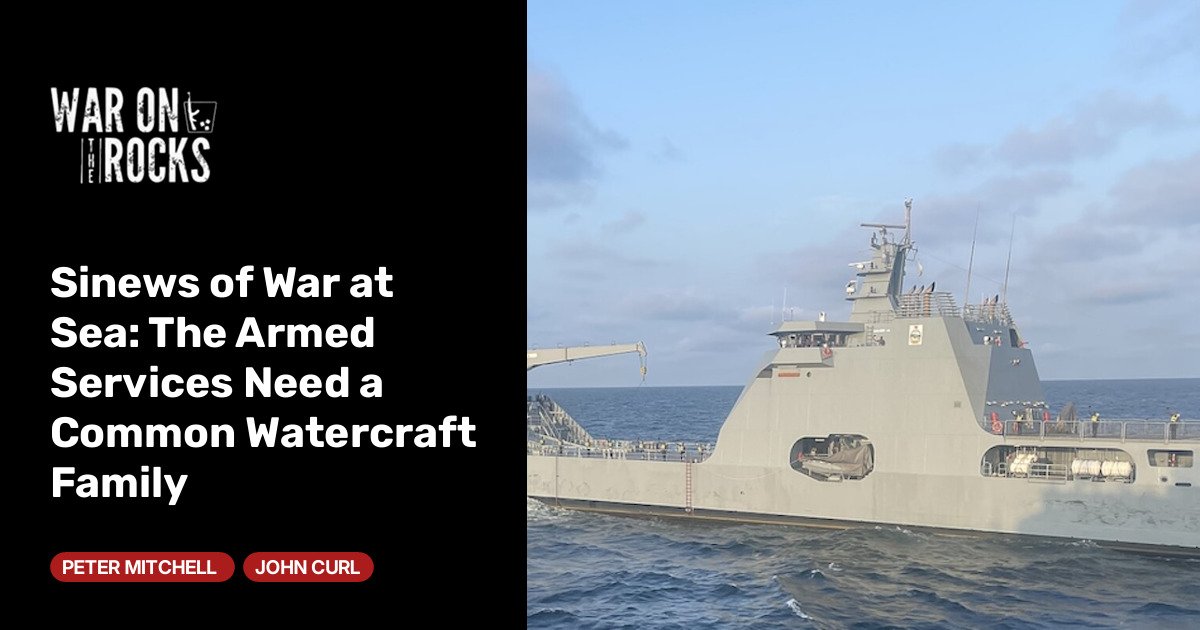
The Army is concurrently developing the Maneuver Support Vessel (Heavy) to replace its 4,199-ton Gen. Frank S. Besson-class Logistics Support Vessels as they age out between 2028 and 2038, with no firm production numbers, no design chosen, and no fielding timeline yet. The Navy and Marine Corps spent years and considerable money attempting to design a bespoke medium landing ship from scratch. They abandoned that effort in late 2024 when industry bids far overran budget. In December 2025, they selected the Damen Landing Ship Transport-100 design. The resulting program has since been designated the McClung-class, with an initial plan to build 18–35 hulls.
The Navy/Marine Corps-selected Damen design is the same commercial off-the-shelf design the Australians selected for their own eight-ship Landing Craft Heavy program, as well as the Nigerian Navy. In its 100-meter (328-foot) form, the Damen ship is reported to carry over 500 tons of cargo in 1020 square meters of roll-on-roll-off space at 15 knots. The design can be converted into a larger 120-meter (393-foot) variant by adding a 20-meter (65-foot) modular block during construction, which makes it highly relevant to the Army’s heavy lift requirement.
At the same time, the Navy is pursuing drone surface vessels, first framed under Project Replicator as strike and intelligence platforms and now being adapted in part for logistics. The Army is also exploring an Autonomous Resupply Vehicle intended to move at least two 20-foot containers over a 1,600-nautical-mile round trip in sea states four through six. Those drone systems matter to the broader sustainment picture, but they do not fit the common hull question as neatly as the manned landing ships do. They are better understood as a related standardization and support problem than as part of the same hull family solution.
The result is a growing set of ships with different manning concepts, maintenance demands, and support chains.
During the same period, the Army watercraft fleet’s mission-capable rate fell from about 75 percent in 2020 to 35 percent in 2024. The Logistics Support Vessels and Utility Landing Craft are, on average, more than three decades old. As of May 2024, one vessel had been out of service for more than five years.
These ships do not all perform the same mission, but the distinctions are narrower than the Army may suggest. The clearest overlap is in the manned vessels designed to move cargo and vehicles in theater to austere shore sites. The Army’s planned Maneuver Support Vessel (Heavy) and the Navy/Marine Corps McClung-class landing ship both operate in that space. The commercial Damen design could satisfy enough of the Army’s requirements in lift, speed, and shore access to justify a common hull, but that case has yet to be formally tested.
An unclassified October 2023 executive summary reported that Army Futures Command analyzed whether the Army should continue development of its own heavy watercraft or pursue joint development of the Navy’s bespoke medium vessels. This analysis stated that the Navy’s design was not a suitable replacement for the Army’s design due to its smaller size and slower speed in comparison to the Army’s planned heavy watercraft. This decision was made two years before the Navy and Marines switched to the commercial Damen Landing Ship Transport-100 and evaluated a different vessel.
The 120-meter Damen variant is not the 100-meter ship the Navy selected. It is a larger member of the same commercial family, and one that has not yet been formally evaluated against the Army’s stated requirement.
The stated requirements for the Army’s heavy watercraft are for a length of 400 feet and a speed of 18 knots while carrying up to 175 soldiers and their equipment to shore. The 120-meter Damen variant is reported to carry 1,500 square meters of roll-on-roll-off cargo, enough for 80 light/medium vehicles and 400 troops, at a laden speed of 14.5 knots.
No published unit cost exists for the Army’s heavy watercraft. The Navy/Marine Corps program’s failure to meet budget targets before switching to a commercial design suggests that bespoke military shipbuilding carries significant cost risk.
Cost estimates for the Damen-based medium landing ship also vary widely. Navy figures have put the figure near $155 million per hull once production efficiencies set in, while the Congressional Budget Office has estimated a range of $350–$430 million per hull. 25 ships at those figures would cost about $3.9 billion at the low end and roughly $8.5–10.7 billion at the higher end.
This case rests on the comparative claim that even at the higher estimate, a commercial-derived common hull may still prove more affordable and more practical than a separate Army design. Since the Army has not yet published a cost estimate, this needs to be tested rather than assumed.
It is important to note that in Army watercraft doctrine, stated vessel speeds serve primarily as theoretical planning factors for Time-Phased Force Deployment Data rather than hard operational guarantees. A slower craft can be simply compensated for by adding more hulls to the equation. Nevertheless, whether the speed shortfall is operationally disqualifying is exactly the question that a formal hull family review should answer.
Modification of the 100-meter hull into the 120-meter variant also carries risk. The case for a common hull is strongest when it relies on a minimally changed commercial design. The more the Army’s heavy watercraft requirement pushes the Damen family toward a larger, faster, or otherwise more specialized configuration, the more the program begins to recreate the spiraling cost and divergence that has doomed joint programs in the past. Adding a 20-meter modular block may be a relatively simple adaptation, or it may also prove to be the point at which a common hull stops being common. That is another reason why a hull family review should be directed.
The Forces Command watercraft fall under U.S. Army Western Hemisphere Command as of December 2025. 25 Damen landing ships could replace the aging 120-meter Logistics Support Vessels and 100-meter Landing Craft Utilities for all Army commands.
The Sherman Lesson
The United States built 49,234 Sherman tanks between 1942 and 1945. During that same time, Germany built roughly 6,000 Panthers. The Panther was technically superior in several measurable categories —acknowledging, without endorsing, the corpus of vigorously researched scholarship produced by the War Thunder community on this precise question — and it did not matter. Germany could not produce, crew, maintain, or replace Panthers at the rate the war consumed them. America’s advantage lay in scale and standardization.
For a maritime sustainment analogy, consider the humble Liberty ship. Between 1941 and 1945, 2,710 hulls were built across 18 shipyards — an average of three every two days — using a commercial design based on the Ocean-class freighter. This is not to say that the U.S. shipbuilding base can reproduce that feat on command, but that leveraging such pre-existing designs allows industrial capacity to be surged into wartime output.
As Lt. Gen. Karl Gingrich stated while serving as the Army’s deputy chief of staff for programs, the joint force must look to commercial solutions. That observation shapes our recommendation here. A common hull family will not recreate the industrial conditions of 1943, and it will not by itself solve the shortage of shipyard capacity or skilled workers. Its advantage is that it increases production efficiency by reducing the number of designs that existing yards must support. Commercial designs may also expand the pool of yards able to contribute outside the yards in Wisconsin and Mississippi presently contracted to build the Navy/Marine Corps design, but the stronger case is interchangeability, not a miraculous surge in output.
In a protracted high attrition peer conflict, production and interoperability are more decisive than exquisiteness. The deployment of the Joint Logistics Over-the-Shore system to Gaza and the wars in Ukraine and Iran have further driven the point home: The joint force does not have enough sustainment capacity.
Transformation in Contact
There is a cultural problem here. The U.S. Army presently equates visible transformation with lethality. A plethora of new programs signals institutional seriousness. Stuffing autonomy into logistics nodes, rebranding command architectures, pursuing drone vessel concepts, and standing up new commands with new patches all signal that the institution is taking the Chinese threat seriously. In practice, this outlook favors novel platforms over less glamorous transport ships. It has not yet produced combat-ready hulls for the Army at the amount that it needs for steady-state operations, let alone supported distributed fires in the South China Sea. Sustainment, as it so often is in the American military, is an afterthought.
In the late 2000s, the Army and Navy codeveloped a catamaran-hulled watercraft dubbed the Joint High Speed Vehicle to replace their Mike Boats. In 2010, the Army reasoned that it did not need watercraft and gave its share of boats over to the Navy, which dubbed them the Spearhead-class Expeditionary Fast Transport.
The Army’s latest light maneuver support vessel prototype broke down en route to Camp Pendleton in early 2024 and had to be towed back to Newport News. It then spent nearly a year in repair — including a $200,000 cooling system fix — because the Army still lacks global maintenance support for its watercraft. After exercising the 82-ton craft around Hawaii, the decision was made to continue development. The joint force is adding new hull types faster than it is building the maintenance and support architecture to keep them operating.
The Navy’s shift to a commercial-derived landing ship shows more flexibility. Naval Sea Systems Command selected an off-the-shelf hull already being bought and operated by allied countries, and assessed it as coming very close to the original capability requirement. The Navy and Marine Corps also intend to use a common production standard set of maintenance and production equipment, geared towards meeting maintenance and readiness goals.

The Silo Problem
Each combatant command and service identified a real requirement and pursued it through its own acquisition lane. U.S. Pacific Command requirements drove Army watercraft modernization through the Program Executive Office for Combat Support and Combat Service Support. Force Design 2030 drove the Marine Corps’ demand for a littoral connector. The Navy’s drone strike and reconnaissance programs are now being retrofitted for sustainment. Western Hemisphere Command’s maritime sustainment requirements for the Caribbean and Arctic regions are not integrated into any of the above.
Secretary Hegseth has called for a more joint-qualified force in the interests of warfighting readiness. The watercraft proliferation problem is a case study in how siloed acquisition damages that readiness. Left alone, each service buys to its own concept of operations. The Marine Corps’ landing ship supports Expeditionary Advanced Base Operations. The Army’s watercraft supports theater sustainment and Large-Scale Combat Operations. The Navy drone surface vessels support Distributed Maritime Operations. In a contingency, all of them will compete for the same sea lanes, repair capacity, port access, and manpower.
Of course, joint programs that have promised to serve everyone have historically delivered platforms optimized for no one. The poor Marines have painful institutional reasons to distrust joint acquisition — the Joint Light Tactical Vehicle being only the most recent example.
That risk is real, but it’s not a reason to ignore obvious opportunities for finding efficiencies. The manned landing ships used for intra-theater cargo and vehicle movement are the clearest case. Drone resupply craft belong in the broader sustainment discussion, but they should be treated primarily as a standards and control issue rather than as part of the same common-hull recommendation.
There is no joint acquisition integrator for intra-theater watercraft, and no one owns the problem across service lines. U.S. Transportation Command, the logical doctrinal integrator for intra-theater watercraft across the joint force, has no such authority or resourcing despite issues arising with joint logistics over the shore since 2013. The Army’s Maritime Training Division schoolhouse at Ft. Eustis is forced to train to the programs it receives rather than shaping the programs it will have to sustain.
This is not how the United States won World War II. Production standardization came first and the training pipeline and maintenance ecosystem followed. The joint force has inverted the sequence. Congress has already taken note of this, saying in June 2026 that “the Army may not provide resourcing consistent with a realistic strategy to support the watercraft needed for operations in the Pacific.”
Build the Liberty Ship
This argument does not require canceling every existing watercraft program or forcing every service into one vessel. The United States does not have the luxury to build distinct ships with our present industrial constraints. We need consolidation, joint architecture, and congressional compulsion — because the services will not do it voluntarily.
The Damen landing ship family is the most obvious candidate for a common hull. Naval Sea Systems Command has already ordered it to be built in American shipyards. Australia has already procured it. Allied navies operate it from Europe to the Pacific, which means forward repair facilities and logistics support exist in the theaters where it will be needed. If the 120-meter variant is judged materially short in payload, speed, or beach access, the Army will have a stronger case for a separate heavy watercraft. If it closes the gap at lower cost and with a shared maintenance and training base, then a separate hull family becomes much harder to justify.
Writing this way of a modular joint acquisition program will necessarily raise the specter of the F-35 Joint Strike Fighter, an analogy worth confronting directly. That program produced three distinct variants — most remarkably the Marines’ vertical takeoff and landing F-35B — at enormous cost because the services’ operational requirements were incompatible with the basic airframe. One lesson that critics draw from it is that joint programs produce compromised platforms. But a landing ship is very different from a fifth-generation fighter jet. Army and Marine sealift are closely related enough missions that one shared family of watercraft can cover them. The F-35B exists today because vertical landing is a physical constraint no modular airframe can engineer around. There is no equivalent constraint in naval architecture that requires the Army to build a ship the Navy and Marines will never maintain or crew.
Congress should direct four things:
First, it should designate U.S. Transportation Command as the lead integrating authority for joint intra-theater watercraft, homeported at Fort Eustis. Transportation Command is not an acquisition executive and cannot unilaterally rewrite service requirements or program objective memoranda. That authority rests with the services under Title 10. But Congress can close that gap by conditioning watercraft program funding on Transportation Command concurrence during the requirements validation phase. This would give the command leverage without reorganizing the acquisition system. Concurrence at validation, not at program execution or funding release, means Transportation Command could shape requirements before money flows rather than slowing programs already in motion. This is the same stage at which concurrence from the Joint Requirements Oversight Council already governs other joint capability areas.
Second, condition further funding for the Army’s Maneuver Support Vessel (Heavy) on completion of a formal hull family review comparing Army requirements against the 100- and 120-meter Damen variants.
Third, require a joint-qualified crewing and training pipeline at Fort Eustis for Army-manned intra-theater watercraft. The Navy and Marine Corps are already moving toward common maintenance standards for their selected landing ship. The Army should be brought into that effort, rather than building a parallel pipeline.
Fourth, mandate a single enterprise readiness reporting system covering all joint watercraft programs before the next program review. The Government Accountability Office identified the fleet as critical but poorly tracked in 2024. That deficiency cannot carry into a contingency.
A common hull family built from a commercial foundation and sustained through a shared maintenance and training pipeline is the most realistic path to a watercraft fleet the force can field when the shooting starts.
Peter Mitchell is an Army officer. He is currently a strategist at Futures and Concepts Command.
John “T.J.” Curl is an Army officer. He is currently the brigade intelligence officer for 7th Transportation Brigade (Expeditionary) at Joint Base Langley-Eustis, VA.
The views expressed are those of the authors and do not reflect the official position of the Department of the Army or Department of Defense.
Image: Marinha do Brasil via Wikimedia Commons
