

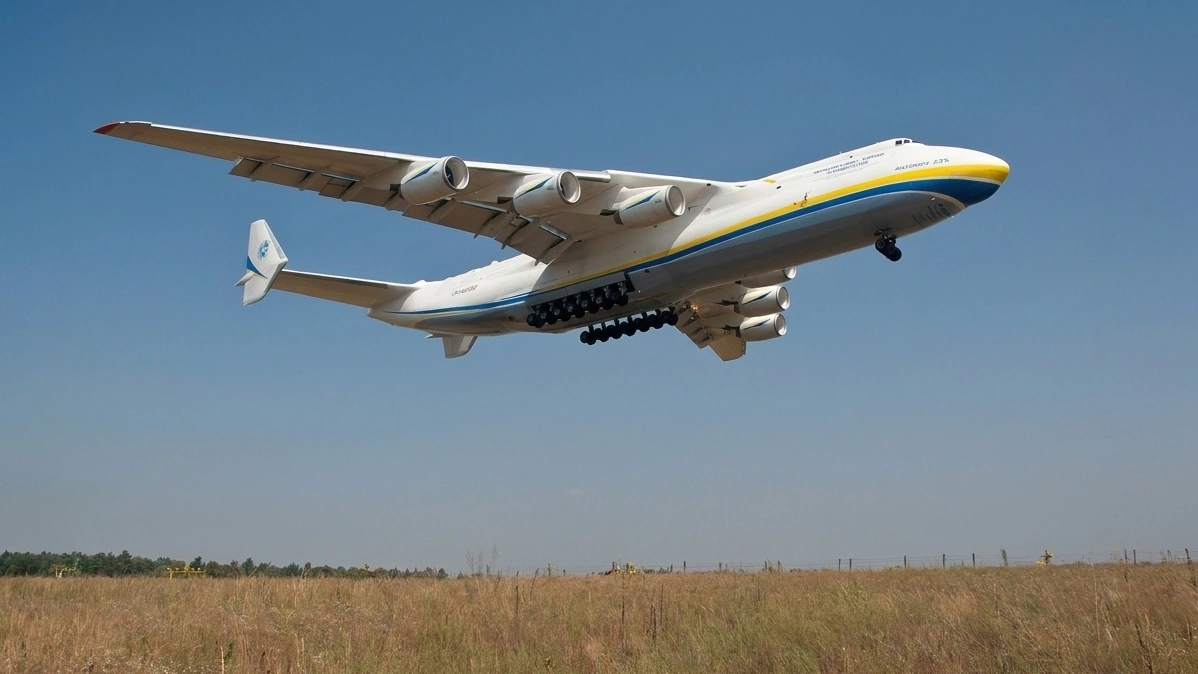
There’s something almost unreal about standing beneath one of the biggest aircraft ever built. The landing gear alone towers over most people, the wings stretch farther than a football field, and the engines generate enough thrust to move hundreds of tons of metal into the sky. It’s the kind of engineering that makes you pause, look up, and wonder, How can something this massive actually fly?
When people talk about the world’s largest airplanes, they often focus on a single number, usually wingspan or weight. But size is only part of the story. Some aircraft were designed to carry entire power plant turbines across continents.
Others transport hundreds of passengers in remarkable comfort, while a few exist for highly specialized missions that push the boundaries of aerospace engineering. One aircraft even carried loads so extraordinary that no other plane has been able to fully replace it.
In this post, we’re taking a broader view. Instead of ranking aircraft by just one measurement, we’ll compare them using several factors that truly define aviation giants: wingspan, maximum takeoff weight (MTOW), payload capacity, engine power, and overall dimensions. That approach paints a much more complete picture of what makes these flying machines exceptional.
Along the way, you’ll discover fascinating engineering decisions, surprising historical milestones, and a few records that still remain unbeaten decades later.
Whether you’re an aviation enthusiast, a student, or simply curious about the largest aircraft ever to leave the runway, you’ll find plenty of insights that go beyond the usual “big plane” lists.
How We Ranked the World’s Biggest Aircraft
Before comparing the five biggest aircraft ever built, it helps to answer a simple question: What does “biggest” actually mean? The answer isn’t as straightforward as measuring length with a tape measure.
In aviation, size is a combination of engineering decisions, mission requirements, and performance. An aircraft with the widest wings isn’t always the heaviest, and the plane carrying the largest payload may not be the longest.
To create a fair ranking, we evaluated each aircraft using five key measurements that engineers and aviation experts rely on.
| Ranking Factor | Why It Matters |
| Wingspan | Determines lift, stability, and overall footprint. |
| Length | Reflects the size of the fuselage and cargo or passenger space. |
| Maximum Takeoff Weight (MTOW) | Shows the greatest weight an aircraft can safely leave the ground with. |
| Payload Capacity | Measures how much cargo, equipment, or passengers it can carry. |
| Engine Power | Indicates the total thrust available for lifting enormous loads. |
These categories reveal that every aircraft excels in different ways. The Stratolaunch Roc boasts the widest wingspan ever built, stretching an astonishing 117 meters (385 feet).
Meanwhile, the legendary Antonov An-225 Mriya still holds records for the heaviest maximum takeoff weight and one of the largest payload capacities in aviation history.
On the commercial side, the Airbus A380 changed long-haul travel by carrying more passengers than any other production airliner.
Another important consideration is purpose. A military transport aircraft is built for strength and flexibility, often operating from rugged airfields. Passenger airliners prioritize efficiency and comfort, while heavy cargo aircraft sacrifice luxury for enormous carrying capacity. Comparing them directly isn’t always fair, unless you look at the bigger picture.
That’s exactly what this ranking does. Rather than crowning a winner based on a single headline statistic, it weighs multiple dimensions of size and capability.
The result is a more balanced look at the world’s most impressive flying machines, highlighting not just how enormous they are, but why each one earned its place among aviation’s true giants.
1. Antonov An-225 Mriya — The Undisputed King of Giant Aircraft
If there were a hall of fame for aviation giants, the Antonov An-225 Mriya would sit comfortably at the very top. Built in the 1980s by the Soviet Union, this six-engine cargo aircraft wasn’t created to impress spectators, it was designed to transport the Buran space shuttle and oversized rocket components.
The result was an airplane so massive that, decades later, no operational aircraft has truly matched its combination of size, strength, and lifting capability.
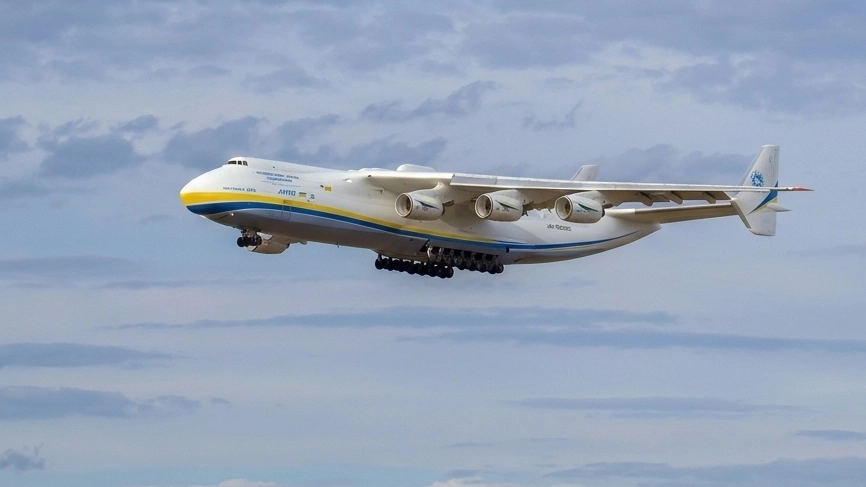
The name Mriya means “Dream” in Ukrainian, and it lived up to that title. Every detail of the aircraft was engineered for extreme heavy lifting. Its enormous wings generated enough lift to carry industrial equipment that couldn’t fit inside any other airplane, while its reinforced landing gear spread incredible weight across multiple wheels to reduce stress on airport runways.
| Specification | Antonov An-225 Mriya |
| Length | 84 m (275.6 ft) |
| Wingspan | 88.4 m (290 ft) |
| Height | 18.1 m (59.4 ft) |
| Maximum Takeoff Weight (MTOW) | 640,000 kg (1.41 million lb) |
| Maximum Payload | 250,000 kg (551,000 lb) |
| Engines | 6 × Progress D-18T turbofans |
| Top Speed | 850 km/h (528 mph) |
What made the An-225 especially remarkable wasn’t just its dimensions, it was its versatility. It transported wind turbine blades, locomotives, mining equipment, humanitarian aid, and even oversized generators weighing well over 100 tonnes.
In 2009, it set a world record by carrying the heaviest single cargo item ever transported by air, a generator weighing approximately 189 tonnes.
Sadly, the aircraft was destroyed during the early stages of the Russia–Ukraine conflict in 2022 while parked at Hostomel Airport.
Even so, the An-225’s legacy remains unmatched. It still holds dozens of aviation world records, and its story continues to inspire engineers, pilots, and aviation enthusiasts around the globe. For many, it isn’t just the biggest aircraft ever built, it’s a symbol of what’s possible when engineering ambition has virtually no limits.
2. Stratolaunch Roc — The Aircraft with the World’s Largest Wingspan
When you first see the Stratolaunch Roc, it almost looks like two airplanes flying side by side. That’s not an illusion. Its unusual twin-fuselage design supports the largest wingspan of any aircraft ever built, making it one of the most extraordinary engineering projects in modern aviation.
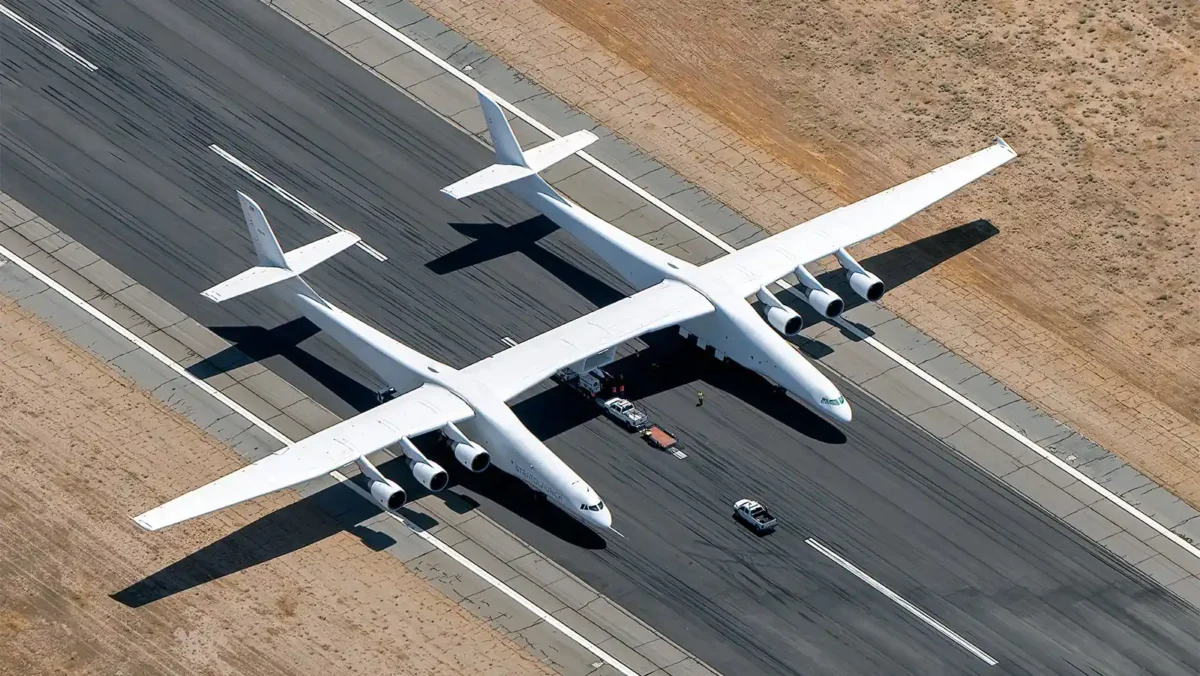
Unlike traditional cargo or passenger aircraft, the Roc wasn’t designed to move people or freight. Its mission is much more specialized: launching hypersonic vehicles and rockets from high altitude.
By releasing payloads in the thinner upper atmosphere, the aircraft helps reduce fuel requirements and offers greater flexibility than conventional ground launches.
The scale is staggering. With a wingspan of 117 meters (385 feet), the Roc stretches wider than the length of many professional football fields.
Yet despite its immense size, engineers relied on proven components wherever possible, incorporating landing gear, cockpit systems, and six engines originally developed for the Boeing 747. This clever approach reduced development costs while simplifying maintenance.
| Specification | Stratolaunch Roc |
| Length | 73 m (238 ft) |
| Wingspan | 117 m (385 ft) |
| Height | 15 m (50 ft) |
| Maximum Takeoff Weight (MTOW) | 590,000 kg (1.3 million lb) |
| Engines | 6 × Pratt & Whitney PW4056 turbofans |
| Top Speed | Approximately 850 km/h (528 mph) |
| Primary Role | Air-launch platform for hypersonic and space vehicles |
One of the Roc’s most fascinating features is that its giant wing isn’t simply about size, it serves a practical purpose. The enormous span creates enough lift to carry experimental vehicles beneath the center section between the two fuselages. This arrangement keeps the payload safely separated from the aircraft while allowing for clean release during flight.
Although it doesn’t carry record-breaking cargo like the Antonov An-225, the Stratolaunch Roc represents a different kind of milestone. It bridges aviation and spaceflight, proving that the largest aircraft of the future may not be built to haul freight or passengers at all.
Instead, they could become airborne launchpads, opening new possibilities for satellite deployment, hypersonic research, and reusable space systems. In that sense, the Roc isn’t just big, it’s a glimpse of where aerospace engineering is headed next.
3. Airbus A380 — The World’s Largest Passenger Aircraft
For millions of travelers, stepping aboard the Airbus A380 feels less like boarding an airplane and more like entering a flying building. Two full passenger decks, wide staircases, spacious cabins, and a surprisingly quiet ride have made it one of the most recognizable aircraft ever produced.
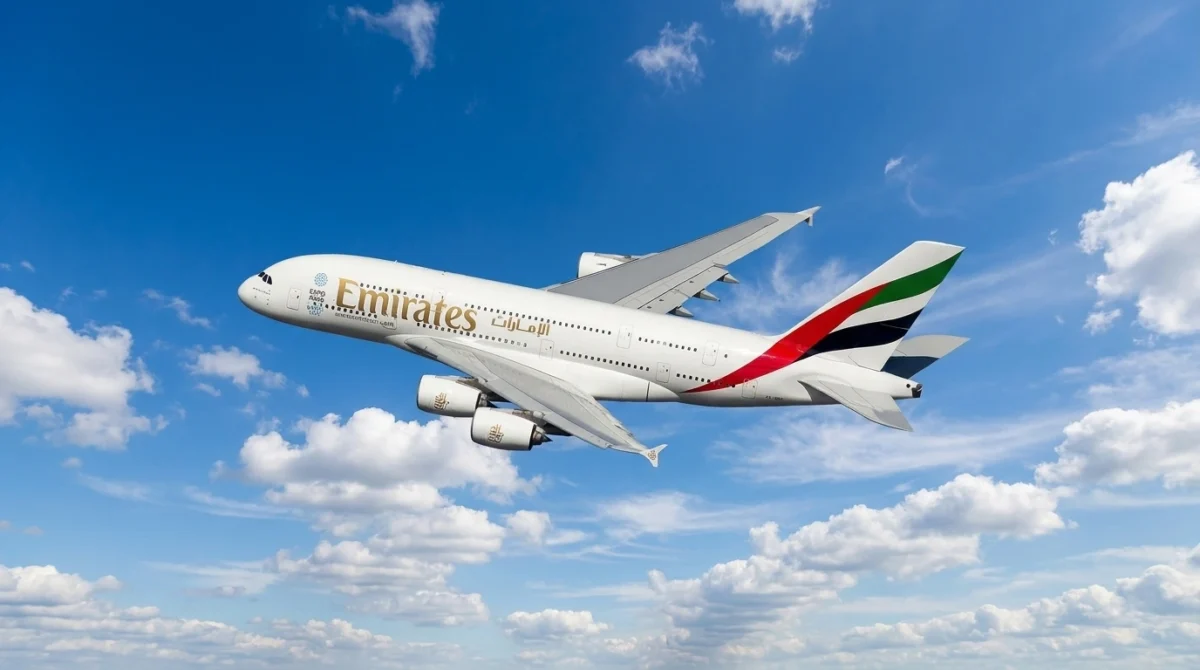
While cargo giants dominate headlines for sheer lifting power, the A380 earned its place among the biggest aircraft by redefining commercial air travel.
When Airbus launched the A380 program, the goal was ambitious: create an airliner capable of carrying more passengers than any previous aircraft while maintaining long-range efficiency.
The result was a double-deck jet that could comfortably connect the world’s busiest international hubs, reducing congestion by transporting hundreds of passengers in a single flight.
| Specification | Airbus A380-800 |
| Length | 72.7 m (238.5 ft) |
| Wingspan | 79.8 m (261.8 ft) |
| Height | 24.1 m (79 ft) |
| Maximum Takeoff Weight (MTOW) | 575,000 kg (1.27 million lb) |
| Typical Passenger Capacity | 555 passengers |
| Maximum Certified Capacity | 853 passengers (all-economy layout) |
| Engines | 4 × Rolls-Royce Trent 900 or Engine Alliance GP7200 |
| Range | Up to 14,800 km (9,200 miles) |
One of the A380’s greatest strengths is its efficiency per passenger. Although the aircraft burns a significant amount of fuel overall, that fuel is shared across hundreds of seats.
On busy long-haul routes, this helped airlines lower operating costs while giving passengers a quieter, smoother experience thanks to advanced aerodynamics and extensive sound insulation.
Several airlines even transformed the A380 into a showcase of luxury. First-class suites with closing doors, onboard showers, cocktail lounges, and business-class bars became signature features that few other commercial aircraft could accommodate. It wasn’t simply transportation, it was an experience.
Despite its technological success, changing travel patterns gradually worked against the A380. Airlines increasingly favored smaller, fuel-efficient twin-engine aircraft capable of flying directly between cities instead of relying on massive hub airports. As a result, Airbus ended production in 2021.
Even so, the A380 remains the largest passenger aircraft ever built and continues to serve on major international routes. It stands as a remarkable chapter in aviation history, proving that bigger can indeed be better, especially when the goal is moving hundreds of people across oceans in comfort and style.
4. Antonov An-124 Ruslan — The Heavy-Lift Workhorse of Global Cargo
If the Antonov An-225 Mriya was the superstar of oversized air cargo, the Antonov An-124 Ruslan is the dependable heavyweight that has quietly kept global industries moving for decades.
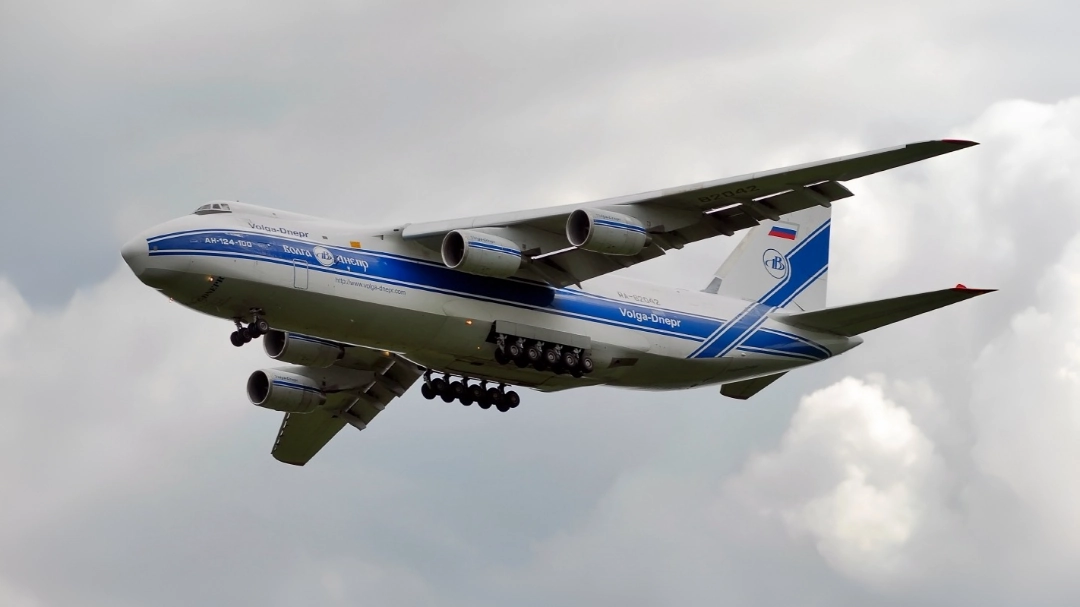
Introduced in the early 1980s, the An-124 was designed to transport massive military equipment, but it quickly proved just as valuable in the commercial world. Today, it’s still one of the most capable heavy-lift cargo aircraft in operation.
The Ruslan was built with versatility in mind. Its nose can swing upward for front loading, while the rear cargo door opens simultaneously, allowing vehicles and oversized machinery to be driven straight through the aircraft. Engineers also equipped it with a “kneeling” landing gear system that lowers the front of the plane, making it easier to load exceptionally heavy cargo without specialized airport equipment.
| Specification | Antonov An-124 Ruslan |
| Length | 69.1 m (227 ft) |
| Wingspan | 73.3 m (240.5 ft) |
| Height | 21.1 m (69 ft) |
| Maximum Takeoff Weight (MTOW) | 405,000 kg (892,900 lb) |
| Maximum Payload | 150,000 kg (330,700 lb) |
| Engines | 4 × Progress D-18T turbofans |
| Top Speed | Approximately 865 km/h (537 mph) |
The An-124 has transported everything from helicopters and railway locomotives to power station turbines and humanitarian relief supplies. During natural disasters, it has delivered emergency hospitals, rescue vehicles, and thousands of tons of aid to regions where speed was critical.
In the energy sector, it routinely carries equipment too large to fit inside conventional cargo aircraft, helping keep major infrastructure projects on schedule.
What truly sets the Ruslan apart is its balance. While it doesn’t match the An-225’s record-breaking payload, it combines enormous carrying capacity with the ability to operate regularly across international routes. That practicality has made it indispensable for governments, defense organizations, and industries requiring reliable transport for oversized cargo.
More than forty years after its first flight, the An-124 continues to demonstrate why it remains one of the largest cargo aircraft ever built. Its enduring service is a testament to thoughtful engineering, proof that true greatness isn’t measured only by records, but by decades of dependable performance in some of the world’s most demanding missions.
5. Lockheed C-5 Galaxy — America’s Strategic Airlift Giant
The Lockheed C-5 Galaxy wasn’t built to break aviation records or impress airline passengers. It was designed for a single purpose: moving enormous amounts of military equipment anywhere in the world at a moment’s notice.
Decades after entering service, it remains one of the biggest aircraft ever produced and one of the most capable strategic airlifters in military aviation.

First introduced in 1968, the C-5 transformed how armed forces deployed across continents. Before its arrival, transporting tanks, helicopters, or missile systems often required multiple flights, or even weeks at sea.
The Galaxy changed that equation by carrying exceptionally large and heavy cargo over intercontinental distances without stopping frequently for refueling.
One of its most practical design features is the ability to open at both ends. The nose swings upward while the rear cargo door lowers into a ramp, allowing vehicles to drive straight through the aircraft. This “drive-on, drive-off” capability dramatically reduces loading time, a crucial advantage during humanitarian missions or military deployments where every hour counts.
| Specification | Lockheed C-5 Galaxy (C-5M Super Galaxy) |
| Length | 75.5 m (247.1 ft) |
| Wingspan | 67.9 m (222.8 ft) |
| Height | 19.8 m (65 ft) |
| Maximum Takeoff Weight (MTOW) | 381,000 kg (840,000 lb) |
| Maximum Payload | 127,000 kg (281,000 lb) |
| Engines | 4 × General Electric CF6-80C2 turbofans |
| Range (with payload) | Up to 4,800 km (3,000 miles) |
The modern C-5M Super Galaxy upgrade gave the aircraft a new lease on life. More efficient engines, improved avionics, and greater reliability significantly boosted performance.
The upgraded engines produce around 22% more thrust while shortening takeoff distances and improving climb rates, critical improvements for operating from a wider range of airfields.
Over the years, the C-5 has transported everything from M1 Abrams tanks and Apache helicopters to satellites, disaster relief supplies, and even other aircraft components. It has supported combat operations, humanitarian aid missions, and emergency evacuations across the globe.
While it may not have the immense payload of the Antonov An-225 or the record-breaking wingspan of the Stratolaunch Roc, the Lockheed C-5 Galaxy has something equally impressive: consistency.
For more than half a century, it has quietly carried some of the world’s heaviest and most important cargo, proving that one of the largest military aircraft ever built is also one of the most dependable.
Biggest Aircraft Comparison Table
Now that we’ve explored each aviation giant individually, it’s time to place them side by side. Looking at a single aircraft in isolation is impressive, but comparing their dimensions reveals just how differently engineers approached the challenge of building the biggest aircraft.
Some designs prioritized lifting the heaviest cargo imaginable. Others focused on carrying hundreds of passengers efficiently or serving as airborne launch platforms for space technology.
That’s why no single measurement tells the whole story. Wingspan, payload, engine configuration, and maximum takeoff weight each highlight a different kind of engineering achievement.
The table below compares the five aircraft using the specifications that matter most.
| Rank | Aircraft | Wingspan | Length | MTOW | Max. Payload | Engines | Top Speed | Primary Role |
| 1 | Antonov An-225 Mriya | 88.4 m (290 ft) | 84 m (275.6 ft) | 640,000 kg | 250,000 kg cargo | 6 | 850 km/h | Heavy cargo transport |
| 2 | Stratolaunch Roc | 117 m (385 ft) | 73 m (238 ft) | 590,000 kg | Rocket and hypersonic vehicle launch | 6 | 850 km/h | Aerospace launch platform |
| 3 | Airbus A380-800 | 79.8 m (261.8 ft) | 72.7 m (238.5 ft) | 575,000 kg | Up to 853 passengers | 4 | 903 km/h | Commercial passenger transport |
| 4 | Antonov An-124 Ruslan | 73.3 m (240.5 ft) | 69.1 m (227 ft) | 405,000 kg | 150,000 kg cargo | 4 | 865 km/h | Heavy cargo transport |
| 5 | Lockheed C-5 Galaxy | 67.9 m (222.8 ft) | 75.5 m (247.1 ft) | 381,000 kg | 127,000 kg cargo | 4 | 855 km/h | Strategic military airlift |
A few trends stand out immediately.
The Stratolaunch Roc dominates in wingspan, exceeding even the legendary An-225 by nearly 29 meters. That extraordinary width isn’t for carrying cargo inside the fuselage; it’s designed to support large vehicles suspended beneath the center wing for air-launch missions.
The Antonov An-225, however, remains the undisputed heavyweight. It still holds records for the highest maximum takeoff weight and the largest payload capacity ever achieved by an operational aircraft. No production airplane has surpassed its ability to lift oversized cargo.
Meanwhile, the Airbus A380 proves that “big” isn’t just about freight. It remains the world’s largest passenger airliner, carrying hundreds of travelers across continents with remarkable comfort.
Together, these aircraft demonstrate that the title of largest aircraft can mean very different things depending on the mission, and that’s exactly what makes each one extraordinary.
