

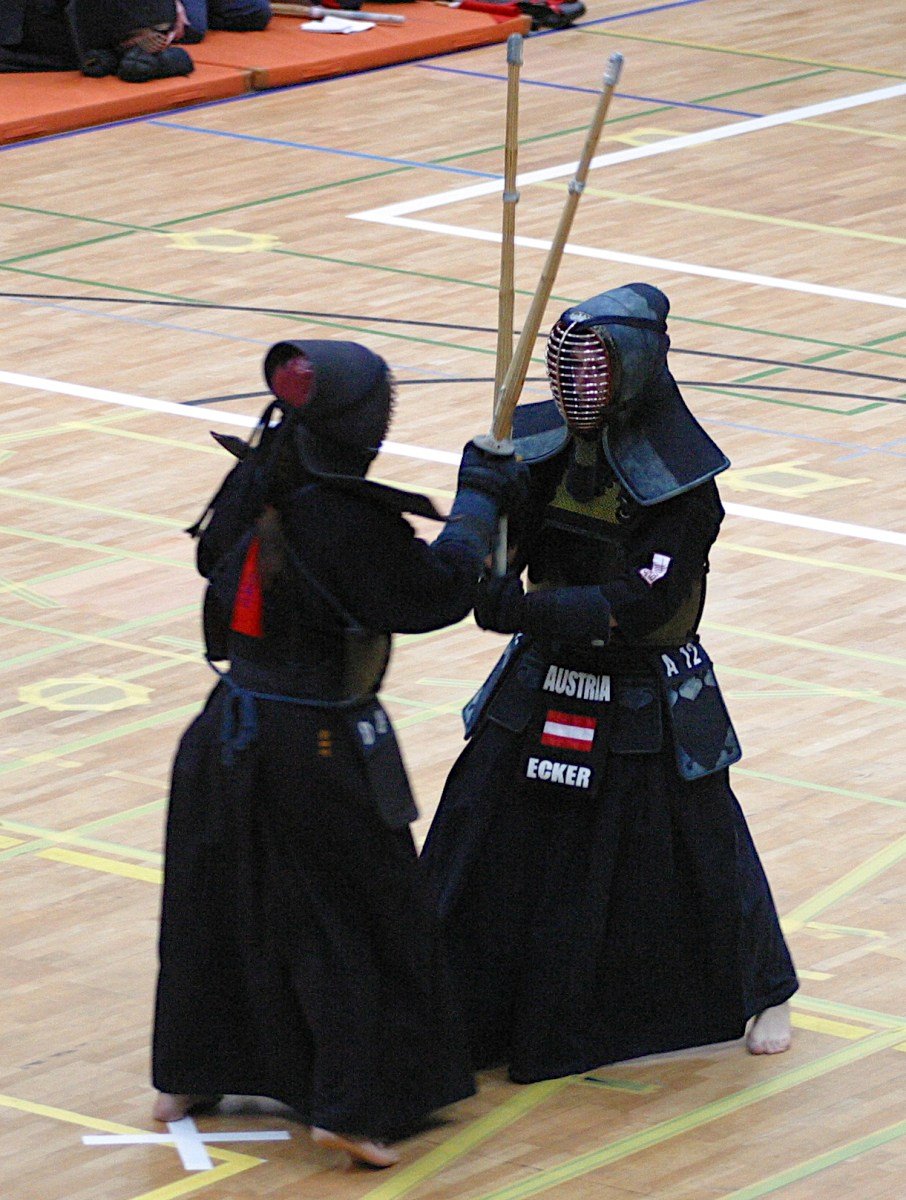
A foreign exchange student invited Ronald Fox to a kendo practice while on the Michigan State University campus and he was immediately hooked on the experience. After completing graduate school at UIUC and finding a job at MSU, Fox became the consistent instructor of the MSU Kendo Club. Since then, Fox has helped maintain the club’s presence on campus, assisted in national political discussions in the American Kendo community, and continued to spread the holistic benefits of kendo.
MAYTT: In terms of outreach, have there been any crossovers with Olympic or historical fencing with joint practices and the like?
RF: Haven’t really done that. The best I can probably say about it is that the Midwest Kendo Federation is also tied into the All US Kendo Federation, the International Kendo Federation, and the U.S. Kendo Federation, and therefore the regional Kendo Federations are also responsible for a subset of the iaido and the jodo population, the group that does what used to be called Seitei Iaido, which is now called Zen Nihon Kendo Renmei Iaido Kata. So, we do have a small group of iaido dojos that we support and maintain. There are, however, iaido dojos that are not affiliated with the kendo organization. In my area, for example, the United States Honbu dojo for Tamiya-ryu Iaido is also in East Lansing and run by Michael Alexanian sensei (eight dan). They are not affiliated with the kendo organizations. This is the case for many koryu iaido dojos.
The other kind of interesting crossover is not so much with classical fencing, but with HEMA. We’ve had a few members come in from HEMA, and they’re kind of interesting. We haven’t gone back in that direction ourselves, but some people have come in from HEMA and stayed, training in both disciplines.
The other thing that’s kind of interesting is ishūjiai, which in Japanese means practicing with two different weapon systems, or two different systems within Japanese martial culture. There are a couple – three, four, five – people in the Midwest who also practice naginata. If we have a get-together, sometimes they’ll sometimes bring their naginata shinai, and teach basic naginata. We’ll sometimes do something like jigeiko between a naginata person and a kendo person. That’s fairly common.
If you’ve watched any of the Kyoto Embu Taikai – the Kyoto demonstration tournament, which should be coming up pretty soon during Golden Week – there are demonstrations that are part of that which usually include ishūjiai between kendo and naginata. There are some interesting ones too, like kendo and kusarigama. Seeing that was interesting to watch. So that’s more the sort of crossover we’ve seen.
MAYTT: Outside of the three pillars of the MWKF, who else would you consider to be an influential kenshi to help disseminate Kendo in the Midwest?
RF: Every year, there’s a Midwest Kendo Summer Camp, and Shigeki Yamanaka Sensei and Shigeki Saito Sensei from Saitama Prefecture have been brought in for many, many years. They’ve gotten a little old for that now, so we’ve started having them recommend newer people to bring in, but they’ve been very influential on kendo in the U.S. The last few years, they would bring in various female kendoists, women kendoists, and that’s been a good thing for helping build women’s kendo in the Midwest. Of course Yoshiteru Tagawa Sensei (eighth dan hanshi) has been very influential.
One of the issues in bringing people from Japan is that you’ve usually got to have a translator. My Japanese is pretty poor, but I usually get about two or three times what the translator actually says. Which means the translator’s probably only getting about ten percent translated.
So I kind of started a program where I began bringing in English-speaking instructors from Japan and elsewhere. For example, the first person I brought in was the late Tatsuo Hayashi Sensei, one of the old MSU-Waseda people. He had kyoshi hachidan, and his brother, Nobu Sensei, also had kyoshi hachidan. Hayashi Sensei ran an English language school in Kyushu, in Oita, so he spoke English very well. We had him tour the Midwest Kendo Federation, and then brought him back a couple years later, and he said, “Yeah, I just want to stay in Michigan,” so he toured Michigan instead.
I also brought Alex Bennett over. He’s a New Zealander, so his English is pretty good once you get past the accent. He toured the Midwest Kendo Federation as well. I was bringing in about one or two people per year up until COVID came, and I haven’t really reestablished that yet. But I probably need to reach out to Alex and see about bringing him in again. Another person I’ve considered bringing in is Masayuki Miyasaka Sensei. He’s a mostly retired medical doctor in Japan, and I think he got his hachidan two years ago. I got to know him through the foreign instructors’ seminar that the All Japan Kendo Federation runs every year in Kitamoto, in Saitama Prefecture. Miyasaka Sensei was a camp physician and one of the translators there, and we stayed in touch afterward through other activities. He got his medical degree in Australia, so he speaks very fluent English. He’d be a very good person to bring in if he wants to come. Though, I should say that I’ve not invited him yet, just in case he sees this.
From my point of view, one of the biggest influences on me was the late Larry Nakamura Sensei in Toronto. He was just an exceptional kendoist. He reached out to me pretty aggressively when I started taking over the club at MSU. He literally cold-called me, introduced himself, and said, “Why don’t you come visit me?” So I did. And I just kept going back to visit him. The last time I saw him was the year before his death, when he was ninety-one. For more about him, see
MAYTT: There was a split that occurred within the original American Kendo federation. From your knowledge, how did that split come about?
RF: It happened somewhere around, I think, in either 1989 or 1990. I know that, for reasons I’m still not clear about, I was invited to participate as a goodwill competitor at the 1991 World Kendo Championships in Toronto, and by then we were already split. So it was somewhere in that timeframe: the split was between the Kendo Federation of the USA (KFUSA) and a splinter group, the Beikoku Kendo Renmei (BKR), which translates to the All U.S. Kendo Federation. The reasons for the split, I’m going to be very careful in what I say. The actual reasons are a little shrouded. There are “official” reasons for the split, but they just don’t hold water, so I’m not even going to sully your ears with them.
Somewhere after the 1991 World Kendo Championships – and this is where my timescale gets fuzzy; I wish I had kept notes, but I didn’t – Ken Sakamoto Sensei, who is now the head instructor at Choyokan Dojo in Chicago, invited representatives from KFUSA and the BKR to get together in Chicago to discuss how to move forward and bring kendo back together. I don’t know why, but I was invited to attend too, so I had a front-row seat for all of that. The KFUSA delegation was Jeff Marsten Sensei from Seattle, Jim Totten from Atlanta, Charlie Tanaka Sensei from the Los Angeles area, and Tsuyoshi Inoshita sensei, who I think was in Cleveland at the time but is now somewhere near Portsmouth, Ohio, working with the Portsmouth Cancer Center. The BKR delegation included Jeff Wortman sensei from New York City Kendo Dojo, who has since passed away, and Jack Dwash, who was a lawyer in the Hollywood area specializing in contract and intellectual property law (I think).
So, we all got together, and somehow, I became an English-to-English translator. I think there was a lot of bad blood between the two sides. One thing I should point out is that the Midwest Kendo Federation, which had been part of KFUSA at the time of the split, officially stayed neutral. We didn’t join either body. That’s why Dr. Sakamoto thought maybe we could broker something.
I remember the KFUSA people saying, “Here’s what we think we should do. We should form a new federation, and then both KFUSA and BKR would dissolve and join that new federation.” It sounded perfectly reasonable to me. The BKR people immediately got really huffy and said, “We’re not going to disband the BKR. That’s not going to happen.” And I’m sitting there thinking, they just don’t like each other – that’s what’s happening. So, I said, “Let me see if I understand the KFUSA proposal correctly. You’re saying we form a new federation, and both existing federations join it. Am I understanding that right?” They nodded yes. Then I turned to the BKR side and asked, “Is there any common point here we can negotiate around?” I kid you not, they said, “Well, that was going to be our proposal.” The whole meeting was like that. One side would say something, the other side would reject it out of hand, and then I’d rephrase it and ask if there was room for negotiation around the common points. Most of the time, there was actually complete agreement.
For my sins at that meeting, I was appointed mediator for the further negotiations, which lasted for about a year. The major sticking points were mostly about the corporate structure of what became the AUSKF: how the corporation would be organized, how the board would be formed, how directors would be elected, and even what constituted a “member” of the new federation. The KFUSA team thought the members were individual practitioners. But the BKR side said, “No, actually, the members of this federation will be the regional kendo federations.” We had to hammer all of that out.
Toward the end of my involvement, we in the Midwest Kendo Federation had a member ready to test for godan. Promotion exams for yondan and below could be done regionally, but godan and above required national-level testing. Since the Midwest was still neutral and couldn’t conduct the exam, he tested through one of the national organizations and passed. I then got a phone call from one of the representatives from the other federation asking, “What’s going on? Is the Midwest no longer neutral?” By that point, though, everyone was talking more or less amicably, so I saw an opportunity to step away. I said, “Look, if this is a concern, I’m gone. You guys can talk on your own now.” About ten minutes later, I got a similar call from the other federation, and I basically told them the same thing: “You’re all talking well now. You don’t need me anymore. I think you’re on a good path.” That was the end of my involvement.
In the end, the AUSKF came into being. There was a provisional appointed board of directors, and somehow, again for my sins, I got elected to the first elected board. I served, I think, two terms before finally saying, “You know, this is taking too much time away from MSU.” At that point, I basically gave up on national kendo politics.
As a side note, Masayuki Miyasaka Sensei, whom I mentioned earlier, was sent by the Japan Kendo Federation to talk with me privately about all this. He wanted to know, “Is this going to work? Is this actually going to happen?” I reassured him that everyone was negotiating in good faith and that I thought things would come together. At some point, the International Kendo Federation was apparently considering stepping in and essentially declaring, “KFUSA is it,” and sidelining the BKR. I told Miyasaka Sensei, “Don’t do that. That’s just going to create more resentment. Give us a chance to settle this ourselves, and we’ll settle it.” And, in the end, we did. Things finally came together in 1994. Two years later, in 1996, I was invited professionally to visit Osaka University for summer. As it turned out, Miyasaka sensei was at Osaka University’s research hospital at the time. He took me aside and asked, “We hear there are rumblings and grumblings in this new federation. How are things?” I reassured him that there were teething problems, sure, but nothing was falling apart. I basically told him: patience, patience.
MAYTT: So, from 1991 to 1994, that was about three years of back and forth talking?
RF: Yeah, I think it might already have been 1992 before we met in Chicago. The World Championships were in the summer of 1991, and I remember driving to Chicago in conditions that weren’t exactly wintry, but definitely cold. So, I think it would have been late winter or early spring of 1992 before we really got started. Now, I don’t know whether the establishment date refers to when the articles of incorporation were actually submitted or whether it refers to when the first board of directors took office. There was a period where there was an appointed board formed by the negotiating groups, along with a few additional people. I think that arrangement lasted a good year or so before the first election took place.
MAYTT: That clears up some misconceptions. Coming from an aikido background, there was major fallout from the first schism and this split within the American Kendo world, it does not seem like there was much of a lasting issue.
RF: It was a pretty bitter one. If you look at the regional kendo federations, you’ll still see the after effects in places like Southern California, where there’s a Southern California Kendo Federation and a Southern California Kendo Organization. The Southern California Kendo Organization is essentially what remained of the BKR-aligned group after the reunification, while the Southern California Kendo Federation represents the KFUSA side. New York shows a similar bifurcation, though I think it’s now the Eastern U.S. Kendo Organization on one side, and the Greater Northeastern U.S. Kendo Federation on the other, which was the KFUSA structure. It was bad enough that I wouldn’t say all the bad feelings have fully healed. For example, Gardena Kendo Dojo: there are actually two of them. They split right down the middle into BKR and KFUSA groups and never really came back together after AUSKF was formed. So, I imagine there are still some rumblings under the surface, even though things have gotten quite a bit better over time.
But the rift was a pretty bitter one. And again, to me, it’s not entirely clear, because it centered on events in Southern California and also on the East Coast. There was a guy who I think was a bit of an instigator on the East Coast side of things.
MAYTT: One more thing about this topic: From 1994 to the present day, how have you seen the AUSKF try to mitigate or heal these organizational wounds?
RF: It was a gradual process, and a lot of the people who were involved in the original rift kind of aged out. A good example is my yudansha certificate; it’s a Midwest Kendo Federation certificate. I got it during the split. I should really look at the date on that, because that would be instructive, wouldn’t it? I could grab it if you want. [Proceeds to find the certificate] let me see if I can find the right menjo now. That’s shodan, so these are the old ones… Oh, here we go. That’s a certificate that meant a lot to me many years ago. Oh, here it is: 1992. Okay, so that makes sense. Let’s see, the month was jūgatsu, October. I almost called it “tenth.” So…
MAYTT: So, then that would make it October 1992.
RF: Yeah, so the split was still ongoing, and that makes sense, because we must have started the negotiations quite a bit later than I was thinking, since we were still split in October 1992. I think I already had this menjo by the time we started negotiations. My recollection is that the negotiations lasted about a year, so maybe late 1992 or 1993 was when they started. That would line up with the 1994 incorporation date.
This menjo is an interesting story too, because it’s an example of what’s been happening since then. One of the things I negotiated was that they would recognize this menjo, along with the ones given out by MWKF, BKR and KFUSA during the split. Those were all considered no-brainers. But last year [2025], or maybe the year before last, AUSKF started using the Sport:80 system for membership management, and we all uploaded scans of our menjos and everything else. Somebody, I think the promotions vice president, came across these Midwest Kendo Federation menjos. I think there are still only two of them left: mine and one belonging to a guy in Cincinnati that I know. They said, “Wait a minute, what the heck is this?” I actually wound up getting a call about it, and when I mentioned that there had been a split, the fellow on the phone said, “Oh yeah, there was a split. I was always told just to stay out of it, don’t worry about it, and don’t pay attention to it.” I think that’s kind of how it’s been handled; the older generation basically told the younger generation, “Just let it go.”
That’s one way to do it. It just means the next people’s problem becomes a problem among my generation or younger. I believe most of the people who were directly involved in the split are dead now. So, for lack of a better word, it would be their students or disciples who might have inherited a grudge to hold – “Hey, you’re fighting my sensei, so I’ve got to fight you.” But now those guys are my age or older too. For example, on the negotiating committee, two members, one from each side, have passed away: Wortman Sensei and Tanaka Sensei. That kind of gives you an idea of how much time has passed. I think you talked with Jeff Marsten at some point, unless I’m mixing you up with someone else.
MAYTT: I did speak to him, however, that was years ago.
RF: As an example, I’m almost seventy, and he’s about fifteen to twenty years older than me, maybe more. He’s probably in his eighties at least. I’m thinking back to when we both went to that Kitamoto, Japan event together, and I believe he told me he was fifty at the time, while I was only thirty. So that’s about a twenty-year difference, which would put him close to ninety now.
Originally, I kind of, semi-jokingly, not so seriously, said that all of the bad feelings would go away as the old guys die out. And maybe that’s not as far off as I originally thought.
MAYTT: Hopefully time heals all wounds.
RF: I think things are going well now, but my issues with the National Federation are more about priorities. I think they spend a bit too much effort on the national tournament, the World Taikai, and the national team, which I don’t think benefits as many people as it could if more of that energy and funding went into education in the regions. That said, there are programs aimed at that already. When I was Vice President for Education in the Midwest, we held an Iaido summer camp and brought in instructors from AUSKF to run it. So those kinds of programs do exist, but I think they’re relatively limited. Seminars are few and far between. There’s a summer seminar occasionally, and refereeing seminars maybe once a year. If they were rotated more consistently through the regions, I think they’d be more attractive and more useful overall. But I’m not really involved in the board anymore; I leave that to younger people.
MAYTT: Final question; What do you think American Kendo will look like in the next fifteen to twenty years? How will the art evolve?
RF: That’s hard to say. I’ve lived through a few oscillations of the pendulum between kendo as a sport and kendo as a budo emphasis. Right now, we’re kind of moving further into the kendo-as-sport direction, far enough that I’m not really comfortable with it outside of our dojo, which tries to keep a more balanced approach.
There’s also ongoing discussion about making kendo an Olympic sport or Olympic demonstration sport, and getting more involved in Olympic committees. I know practitioners in Europe who are already part of Olympic-linked structures, partly because it helps with access to space and liability issues, especially around certified instruction. But I’ve also seen enough of what has happened in judo and taekwondo after becoming Olympic sports that I don’t want to see the same thing happen to kendo. So far, we’ve held that line internationally, though there are still groups in Korea and even within the U.S. who advocate for it. I hope we stay independent of the Olympic system.
What I’d really like to see is a return toward kendo as budo – kendo as a cultural artifact and a means of self-development. That’s what originally attracted me to it. It’s actually the least “practical” of the martial arts in a street-fighting sense; I know I’m not doing it to beat people up, and I’m not going to use it outside the dojo in any real-world confrontation. At the same time, sport does involve self-development as well. I’ve seen that even in high-level athletics through my stepson’s experience playing in the NBA. But when winning becomes the primary focus of a match, something important gets lost.
I was always taught by Nakamura Sensei that whether you win or lose, you should go to your opponent and thank them for the opportunity. If you win, you still ask what you could have done better; if you lose, you ask what you need to improve. That mindset can disappear if winning becomes everything. As people get older and less able to compete at a high level, they need other reasons to stay in kendo, whether that’s giving back, teaching, or finding personal growth beyond competition. Otherwise, you end up in a situation where everyone else is faster, stronger, and more competitive, and your experience alone isn’t enough. You have to find something more meaningful in the practice itself.
MAYTT: Thank you for that. Is there anything else you would like to add before we finish?
RF: So, as far as the sportification of kendo goes, I see it in Japan as well. The last time I was there, I visited Alex Bennett at Kansai University, where he’s a professor. Unfortunately, I was injured at the time, so I couldn’t practice with them, but I did watch both the regular club keiko and the team practice afterward. One of the things that struck me – and I raised this with Alex – was the difference in demeanor in bowing. You can tell when a bow is sincere and when it’s just being done because it’s expected. At Kansai University, quite a few of the students were bowing out of obligation rather than sincerity. In contrast, at Osaka University, which is more like my “home dojo” in Japan, you don’t see that as much. The students there talk about doing kendo for life, whereas in Kansai University, it felt more like kendo as a sport. Alex, in his typical blunt way, agreed that this was an issue. I hope Japan doesn’t lose the traditional essence of kendo.
At the same time, I’ve also seen how culture and structure shape practice in different settings. For example, at Kitamoto training, which was extremely intense – ten hours a day, five days on, one day rest, then five more days, when I did the camp – one of the most meaningful parts actually came midway through the second half when the senior sensei opened up their room and started sharing alcohol. Japanese drinking culture is very tied to social structure. Society is hierarchical, and normally there are strict expectations about how juniors and seniors interact. But once drinking begins, those social boundaries loosen, and you can speak more freely. As a junior practitioner, I could ask high-ranking sensei very direct questions that I normally couldn’t, and they could answer in a more candid way.
One comment that stayed with me was from Ohta Sensei, I think, who said he believed every country would naturally develop its own version or interpretation of kendo. I thought that was a very perceptive observation. It raises the broader question of what kendo is becoming outside Japan. U.S. Kendo is still, in many ways, trying to replicate Japanese Kendo, but we’re already drifting from that in subtle ways, especially in how it’s taught and practiced. The real question is what kendo means for us in America. I don’t think there’s a single answer yet. Maybe there will be, maybe there won’t, but I think that’s still something we’re in the process of figuring out.
MAYTT: Regarding the last question you posed for the American Kendo Community, I have researched what makes American Kendo, American Kendo. It seems very difficult to pin down to say the least. What do you think makes American Kendo what it is?
RF: I think we’re still early in the process. This is going to sound a bit harsh, and I don’t mean it that way, but many of the people who currently run dojos, teach kendo, and are involved in kendo governance are in their sunset years. And until that generation passes on, I don’t think we’ll really be able to arrive at a clearer idea of what U.S. Kendo actually is. You can already see early signs of that shift in places like Macomb Kendo Dojo, run by Travis Hill, a former U.S. team member who was born and raised in America and, as far as I know, has only been to Japan a couple of times, mostly for events like the World Kendo Championships. His approach to teaching kendo isn’t really a Japanese style in the traditional sense. I can’t always articulate the differences precisely, but when I go there, the “flavor” isn’t Japan. That said, the fundamentals are still there – etiquette, respect – but the way techniques are expressed and how jigeiko is conducted feels different from what I know in Japan. And I think that generation is the one that will have to take over U.S. Kendo and really start defining its identity moving forward. I see that as a good thing
MAYTT: Thank you for this great conversation, Fox Sensei!
RF: It was a pleasure!
