

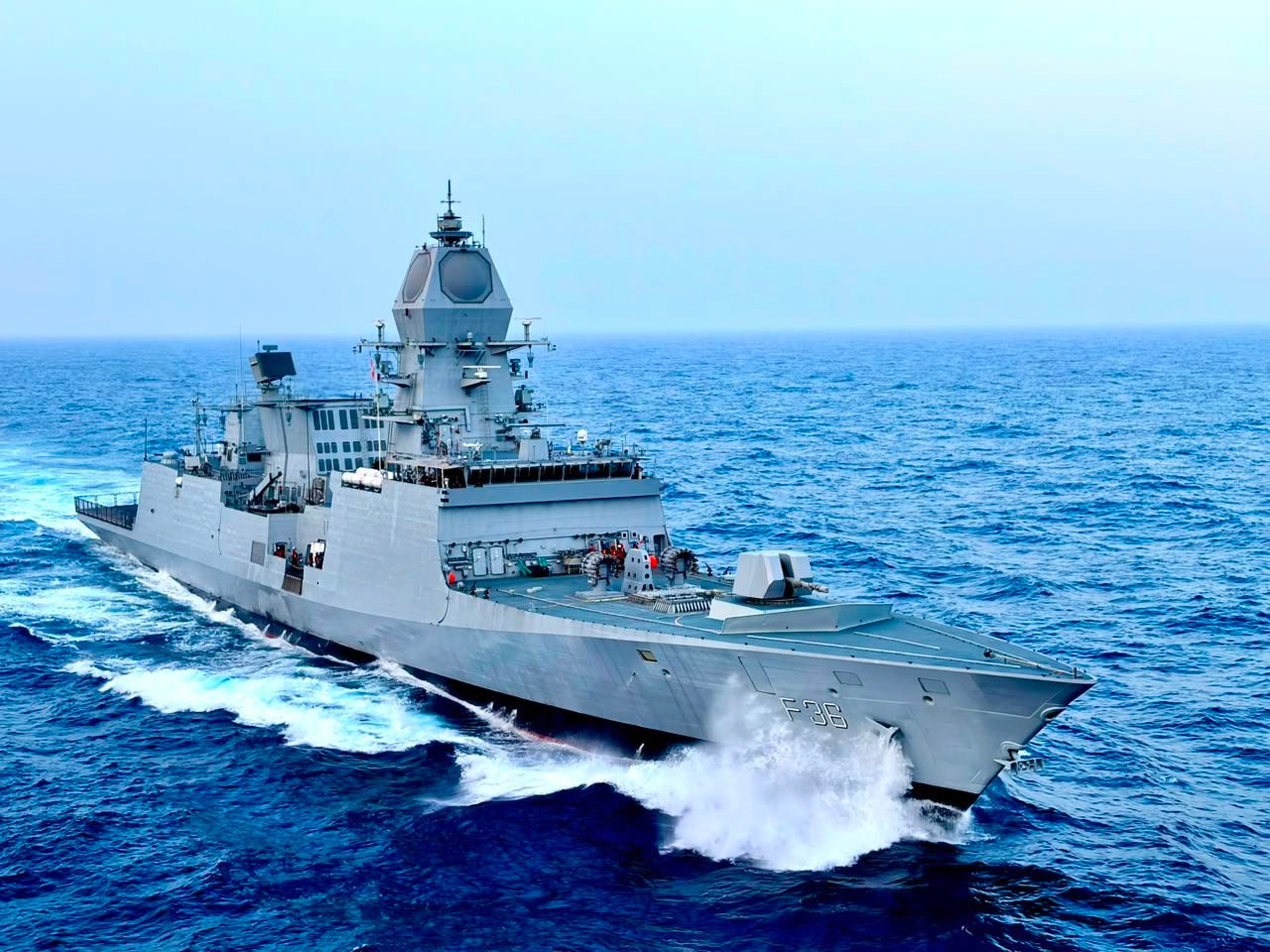
The Indian Navy (IN) commissioned three indigenously designed and built vessels on 21 June. The stealth frigate INS Dunagiri, the Anti-Submarine Warfare Shallow Water Craft (ASW SWC) INS Agray and the Survey Vessel (Large) INS Sanshodhak were commissioned by Prime Minister Narendra Modi in Kolkata, West Bengal.
All three vessels were designed by the IN’s Warship Design Bureau, along with the state-owned shipyard Garden Reach Shipbuilders & Engineers (GRSE). According to India’s Ministry of Defence, the indigenous content on these vessels exceeds 75%.
Navy Chief Admiral Krishna Swaminathan said the commissioning highlighted the progress of India’s domestic warship-building sector. Indian shipyards have delivered more than 40 warships and submarines in the past few years, and 45 major naval platforms remain under construction.
This is only the second occasion on which the IN has commissioned three vessels simultaneously, following a similar ceremony held in Mumbai 17 months ago.
INS Dunagiri is the fifth Project 17A Nilgiri-class frigate to enter service, and the second built by GRSE. India’s Project 17A warship programme has seen five ships delivered to the navy in 16 months. The first-of-class INS Nilgiri took 93 months to build, while INS Dunagiri had a build period of 80 months.
Compared to earlier P17 (Shivalik-class) warships, P17A frigates are fitted with a more advanced weapon and sensor suite, and they are equipped with Indo-Russian BrahMos supersonic cruise missiles, Indo-Israeli Medium-Range Surface-to-Air Missiles (MRSAM) and a 76mm OTO Melara Super Rapid gun that is produced under license in India by Bharat Heavy Electricals Limited (BHEL). There are also close-in weapon systems, and rockets and torpedoes for anti-submarine warfare.
The warship’s Multi-Function Surveillance and Threat Alert (MF-STAR) radar is built by state-owned Bharat Electronics Limited (BEL), under license from Israel Aerospace Industries (IAI). The warship also carries an integral helicopter.
P17A frigates are configured with combined diesel or gas propulsion plants, with a diesel engine and gas turbine driving a controllable pitch propeller on each shaft.

Moving on, INS Agray enhances the IN’s shallow-water anti-submarine and mine warfare posture, and it is the fourth of eight ASW SWCs designed and built by GRSE. The class is equipped with a shallow-water sonar, lightweight torpedoes and indigenously developed rocket launchers to tackle underwater threats.
Approximately 77m in length, the ASW SWCs are the largest Indian warships propelled by waterjets.

Finally, INS Sanshodhak is the fourth and final Survey Vessel (Large) commissioned under a contract signed in October 2018. Previous ships of the class, INS Sandhayak, INS Nirdeshak and INS Ikshak were commissioned in February 2024, December 2024 and November 2025 respectively.
These 3,400-tonne survey ships are capable of full-scale coastal and deep-water hydrographic survey of port/harbour approaches, and the determination of navigational channels and routes.
They are equipped with autonomous underwater vehicles, remotely operated vehicles, four survey motor boats, differential GPS long-range positioning systems and digital side-scan sonar. They are capable of helicopter operations, and can also be configured as hospital ships.
by Atul Chandra
