

The Air Force will soon issue new guidance on the use of artificial intelligence and will implement a sweeping modernization of Basic Military Training by 2027 following a summit of top service leaders.
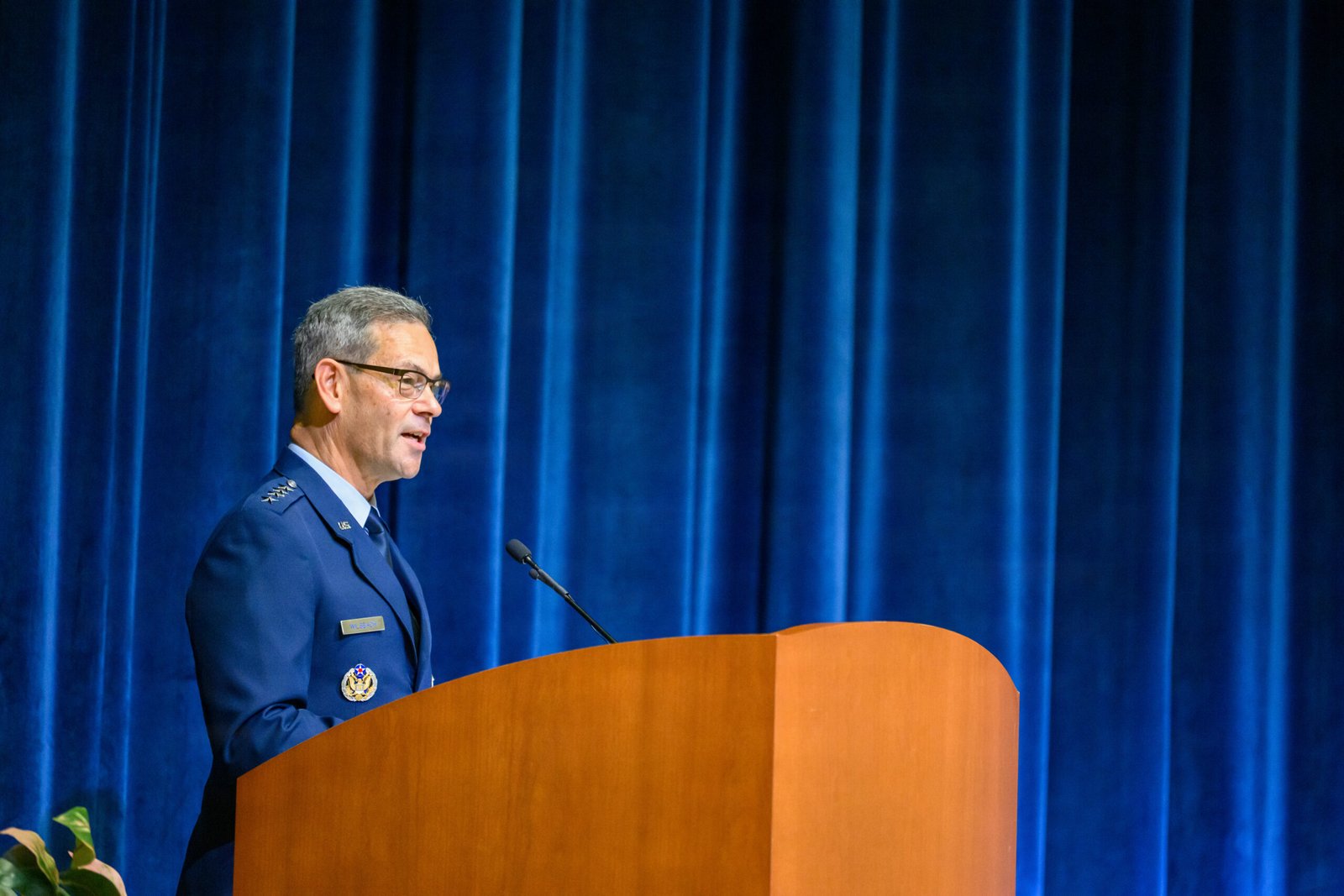
Chief of Staff Gen. Kenneth S. Wilsbach and the rest of the service’s top generals and enlisted leaders discussed these and other major issues during a “Corona” meeting at Wright-Patterson Air Force Base, Ohio, earlier this month.
The semiannual “Coronas” include members of the Air Staff and the heads of each major command, plus their command chief master sergeants and other top leaders, discussing strategy, policy, readiness, and high-level plans. The latest gathering, held June 10-12, featured more than 60 officials, according to a June 26 announcement.
“The three-day summit provided a decision forum to build on recent policy changes and discuss key areas to ensure a ready and capable force for the future,” according to an Air Force news release.
AI Guidance
During the summit, Wilsbach announced that Air Force headquarters at the Pentagon will soon issue guidance to “institutionalize proven AI best practices currently utilized across the enterprise.”
Specifically, the Air Force announcement notes that a key goal of the guidance will be “to automate repetitive administrative tasks.”
Experts and Airmen have been eyeing such use cases for several years. Back in 2024, then-Air Force Maj. Michael Kanaan, the military deputy CIO of the Pentagon’s Chief Digital and Artificial Intelligence Office at the time, told the Defense Innovation Board that the biggest impact of AI will be on so-called “back office functions.”
By April 2026, users on the Pentagon’s GenAI.mil platform had created more than 100,000 AI “agents” to handle automated tasks. An Air Force-led tech startup has developed its own AI agent “marketplace” to help users translate military performance documents into language that civilians can understand for job applications, write reports, build lesson plans and training schedules, and run administrative tasks for driver certification, among other tasks.
As the popularity of AI tools has exploded, however, Pentagon and Air Force officials have also warned of the need for clear policy and training. Chief Master Sergeant of the Air Force David R. Wolfe said in May that the Air Force is developing a new training program to ensure every Airman is trained to use AI in their everyday work.
The effort is separate from other uses of AI in the military, such as using the technology to help select targets on the battlefield or to control the service’s future Collaborative Combat Aircraft fighter drones.
BMT Next
Basic Military Training—boot camp for the Air Force and Space Force—is in the midst of a major reorganization. Last fall, leaders unveiled what they called BMT 2.0, with more physical fitness training and a new emphasis on operating in small teams for combat operations.
Over the next several months, more changes rolled out. An orienteering exercise was added, time spent on drills and inspections were cut, and trainees now have a training event under the wings of a C-130 aircraft.
Leaders say the changes are meant to inculcate a sense of “airmindedness,” or a shared sense of identity around what it is to be an Airman.
Officials are also planning to build an “air base training range” complete with two C-130s and two F-16s where trainees will practice basic airfield support skills such as arming and refueling aircraft, repairing bomb-damaged runways, and loading casualties into a cargo aircraft for evacuation.
Still more changes are in the works. The Air Force announcement teased that “a comprehensive curriculum update will be implemented for BMT by 2027,” focused on airmindedness, the Air Force core values, and military professionalism.
Air Force Special Warfare
Another issue highlighted at Corona was the future of Air Force Special Warfare, the service’s “ground combat forces that specialize in airpower application in hostile, denied and politically sensitive environments.”
Special Warfare includes several different specialties, from combat rescue to Tactical Air Control Parties to special tactics. In 2019 and 2020, the Air Force consolidated some of those into new specialty codes, leading to speculation that the service was laying the groundwork to merge units with different specialties.
Leaders agreed at the recent Corona that they will not do so, specifically stating they will keep TACP and combat rescue “Guardian Angel” units separate.
“[Guardian Angel] remains focused on personnel recovery, while TACP continues its role in precision strike, distributed command and control and integrating airpower with ground combat,” the announcement states.
Audit
As the entire Pentagon comes under increasing pressure to pass a clean audit, Wilsbach directed Air Force major command leaders to submit bimonthly updates on their financial reporting progress.
The Air Force, along with every other military service besides the Marine Corps, has yet to pass its annual audit—auditors say they have been “unable to express a reliable opinion” because the Pentagon’s financial systems are too complex and convoluted to track money accurately.
