

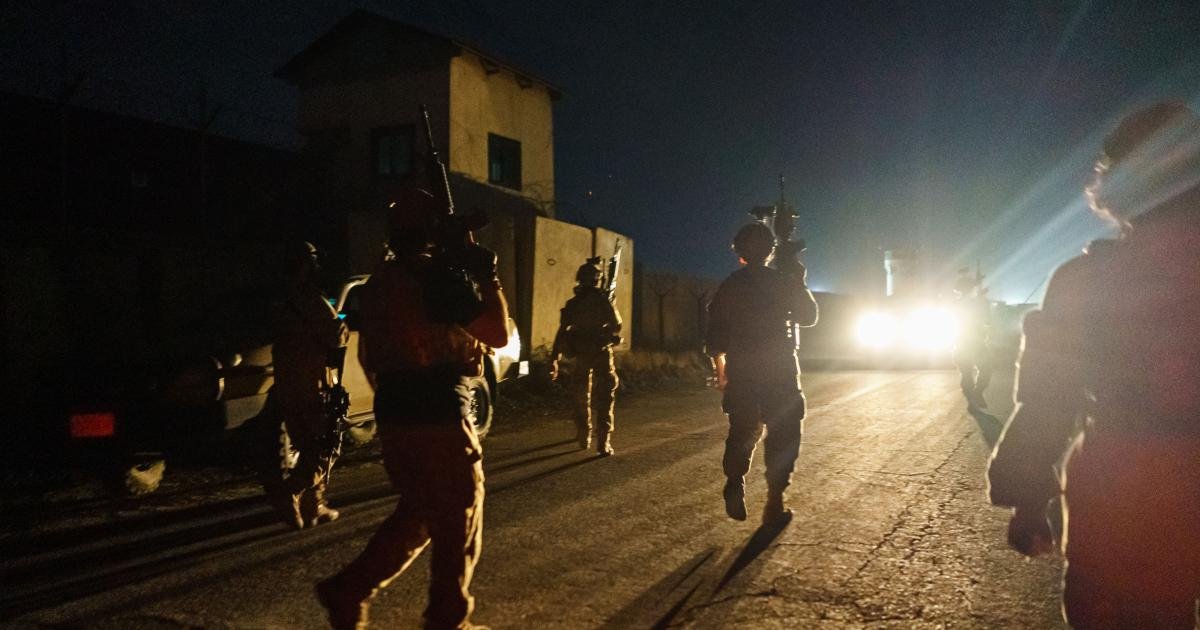
Five years ago, the 20-year American war in Afghanistan came to an inglorious end. In April 2021, the United States had begun its final withdrawal, with the goal of pulling out the 2,500 U.S. troops that remained in the country by September. Within weeks of the first U.S. departures, the Taliban had swept up scores of positions as Afghan government forces melted away. By early August, the group had taken control of most provincial capitals. Finally, on August 15, 2021, the U.S.-backed government in Kabul collapsed. Hundreds of thousands of terrified Afghans besieged the city’s airport. Roughly 120,000 were evacuated in planeloads by the United States, its allies, and even groups of private citizens. In a heartbreaking final blow, 13 American service members died in a suicide bombing at the airport four days before the last U.S. soldier departed on August 30. Two decades of heroic effort had ended in shame.
Recriminations followed—some justified, some not. The same group that had harbored al-Qaeda while it planned and carried out the 9/11 attacks had triumphantly returned to power, and fears of a resurgent terrorist threat mounted. After all, the main reason that successive American presidents had decided to keep U.S. forces in the country for so long was the belief that without them, Afghanistan would once again become a safe haven for terrorists even if the Taliban did not manage to take full control.
Nothing of the sort occurred. Over the past five years, not a single act of terrorism against the United States was carried out by a group based in Afghanistan. Washington spent roughly $1 trillion on the war. More than 120,000 Afghan civilians were killed or injured. More than 775,000 American service members were deployed to Afghanistan, more than 20,700 were injured, and more than 2,400 died—all to defend against a threat that turned out to have been exaggerated.
If American officials had known then what they know now, many of them—including me—would have argued more strongly for an earlier withdrawal. This is an uncomfortable point of view to adopt. It calls into question the judgment of leaders, the effectiveness of the policy process, and the value of the entire effort. Washington might have seen a better outcome, or at least a shorter war, if officials had more seriously debated withdrawal earlier, considered a wider range of threat assessments, pursued negotiations sooner, and, in some cases, recognized the bias instilled by a distaste for defeat.
Five years on, the greatest danger is not that a terrorist safe haven might once again emerge in Afghanistan. A graver threat comes from the risk of collective forgetting. Today, the longest American war rarely figures in public discourse. Americans occasionally acknowledge the noble sacrifices that thousands of U.S. service members made in the conflict. But the country moved on, eager to forget those final days. The riskiest form of forgetting would be for American leaders to fail to recall how perilous it proved to accept high costs and terrible losses, all in response to the fears of the moment. Remembering that will help them avoid future anguish.
“YOU ARE WORTH PROTECTING”
On October 7, 2001, President George W. Bush invaded Afghanistan in retaliation for the 9/11 attacks that had stunned the world. Within months, a combination of U.S. airpower, special operations forces, intelligence operatives, and the Afghan militia known as the Northern Alliance had chased out al-Qaeda and upended the Taliban regime led by Mullah Omar. A new government was formed under the Afghan leader Hamid Karzai. For the next four years, the country was deceptively peaceful. This initial success helped tempt the Bush administration into invading Iraq in 2003, leading to a brutal war that captured most of Washington’s attention for the next five years. During that time, the Taliban regrouped. By 2006, they were regaining territory and seriously challenging the Afghan government.
Throughout this period, the United States was gripped by a fear of terrorism, its anxiety fed not only by the horrors of 9/11 but also by the anthrax attacks that followed in their wake and a series of lethal jihadist bombings and foiled plots in Europe in the mid-2000s. “The global war on terror” was raging, and Afghanistan was the main theater. Countering terrorism was unquestionably the center of U.S. military activity in the country, a mission articulated by presidents, secretaries of defense and state, military commanders, and intelligence chiefs.
The United States had other ambitions in Afghanistan, as well, including a nation-building mission that aimed to establish a sustainable democracy. Bush declared this goal explicitly, and in spite of his successors’ efforts to back away, it remained an implicit part of the American project. But without the terrorist threat, there would have been no war against the Taliban, no arming and training of the Afghan military, no nation building, and no democracy promotion. Terrorism was always the driving concern.
Washington understood little about the Taliban.
For many of the men and women on the ground, that mission justified their efforts and losses. As Ross Berkoff, a U.S. Army lieutenant stationed in Kandahar in 2003, wrote in his diary: “September 11, 2001, is a day that will live in infamy and the fact that Afghanistan became a new place for U.S. soldiers to deploy is directly tied to that infamous day. . . . I am here to respond. We’re here in response.” In a 2019 memoir, Kyle Carpenter, who fought in Afghanistan as a member of the U.S. Marine Corps and received the Medal of Honor, summed up his feelings about his service on behalf of Americans: “You are worth protecting, you are worth fighting for, you are worth time in a hospital bed and deep scars on my body.”
That is not to say that the strategy was always clearly communicated or convincing. Many U.S. troops on the ground were not directly involved in counterterrorism or special operations missions. For some, engaging in firefights in remote mountains and deserts with local Taliban, being targeted by improvised explosive devices, and trying to build up the troubled Afghan government and army seemed a far cry from fighting dreaded international terrorists. Some developed deep skepticism about the purpose of the war, which could turn to resentment when fellow service members died or were wounded.
From 2009 to 2011, I served as the U.S. State Department’s political officer in Garmser, a rural district in the southern province of Helmand. I was part of a small team of around half a dozen civilians attached to a U.S. Marine battalion, advising the district governor, the police, and local tribal and religious leaders. Just about every Afghan in the region believed that without U.S. forces backing a strong army and police force, the Taliban would return. A few claimed that al-Qaeda would come with them.
As far as I could tell, there was little to suggest that al-Qaeda was active in Garmser or elsewhere in the south. The truth was that the chances of the group’s reviving its Afghan stronghold were impossible to measure with any confidence—and such a nebulous threat scarcely seemed commensurate with the 100,000 U.S. troops then in the country. But by the time I left, I was heartened by the Marines’ accomplishments. The Taliban had been pushed out of the vast majority of the district. An Afghan government official could travel unarmed from the top to the bottom of the territory. Over 1,000 new Afghan soldiers and police officers were in place and active. I thought that it was unnecessary for tens of thousands of U.S. forces to stay in Afghanistan, as long as a smaller number remained for the long term. In 2012, Kael Weston and I wrote in these pages that 25,000 U.S. advisers, special operations forces, and air and support personnel should stay. Otherwise, “the Afghan central government would likely lose control of the Pashtun east and south” and, “thrown on the defensive, would be unable to prevent the return of al Qaeda to the vast Pashtun heartland.” The country, we warned, would “backslide, quickly and perhaps irrevocably, taking with it the United States’ ability to combat al Qaeda.”
From 2013 to 2014, I was back in Afghanistan as the civilian adviser to General Joseph Dunford, commander of all U.S. and allied forces in Afghanistan. During those years, U.S. President Barack Obama had begun to withdraw American troops from Afghanistan, and by the time I left, fewer than 10,000 remained, and they were focused on turning the war over to the Afghan soldiers and police. In too many places, however, they were suffering setbacks: in the summer of 2014, at the strategic crossroads of Sangin, in Helmand, hundreds of well-armed Afghan police and soldiers had been overrun by a Taliban offensive. That defeat heralded worse reversals that came in 2015 and 2016, all of which U.S. officials took as indicators that the Afghan government could not hold back the Taliban on its own, nor prevent the subsequent establishment of an al-Qaeda safe haven. For me, it was a sign that the costs of staying in Afghanistan had possibly become greater than the danger of terrorism that would come in the wake of the government’s fall.
For the rest of Obama’s time in office, and during the first term of President Donald Trump, the Afghan war was the focus of constant debate in the White House. The particulars changed over time, but the basic choice was always the same: stay in the country with a small number of troops, a posture that was sustainable but potentially endless, or get out, meaning that sooner or later the government would fall and the terrorist threat would likely return. From 2012 onward, the intelligence community assessed that a terrorist capability to attack the United States could reconstitute in Afghanistan within one to three years after a U.S. withdrawal.
Trump retained the fundamentals of Obama’s strategy until mid-2018, when he decided it was time to leave Afghanistan and pursue direct negotiations with the Taliban. Obama had allowed for talks between 2010 and 2014, but the effort was a low priority for his administration. By 2018, the strategic context had changed. A U.S.-led coalition had defeated the Islamic State in Iraq and Syria, the global terrorist threat was ebbing, and a bipartisan consensus was at last forming that the United States should wind down the war in Afghanistan. Trump’s agreement with the Taliban, signed in February 2020, stipulated that Washington would withdraw all its military forces by May 2021. In return, the Taliban promised not to allow al-Qaeda to recruit, train, or conduct operations from Afghanistan—although the Taliban refused to break relations with the group.
THE BAD GUYS WON
On taking office in January 2021, U.S. President Joe Biden faced a hard choice: keep 2,500 troops in Afghanistan to suppress the terrorist threat, or leave in accordance with Trump’s agreement. Either strategy was viable. The chairman of the Joint Chiefs of Staff, Mark Milley, and senior U.S. generals favored staying. They argued that counterterrorism operations could be better maintained from inside Afghanistan and that the continued presence of American troops would prevent the defeat of the Afghan government. Biden himself was genuinely concerned about terrorism and acknowledged the possibility of a Saigon-like collapse, but he leaned toward escaping from a never-ending mission. For Biden, the COVID-19 pandemic, the U.S. contest with China, and the struggling American economy were far greater worries.
In April 2021, Biden announced that all U.S. military forces would withdraw by September 11 of that year. The administration believed the Afghan government would hold out for at least six months after that point. But Kabul fell in August, and the Taliban have governed Afghanistan ever since, led by their dour emir, Mawlawi Haibatullah Akhundzada. Before taking the top position in 2016, he had been the chief judge of the Taliban’s Islamic court, a position that endowed his leadership with religious legitimacy in the eyes of many Afghans. He is said to have endorsed a suicide bombing by his own son in Helmand in 2018. Following in Mullah Omar’s footsteps, Haibatullah rules not from Kabul but from the traditional Taliban stronghold of Kandahar, and assiduously stays out of the public eye. In Kabul, meanwhile, the minister of the interior is Sirajuddin Haqqani, the leader of the terrorist group known as the Haqqani network and the mastermind of countless wartime suicide attacks, such as a truck bombing in front of the German Embassy in 2017 that killed 150 Afghans and injured 400 more.
The ascent of men like these is precisely the kind of outcome that U.S. officials feared when they contemplated a post-American Afghanistan. Yet far from ushering in a new age of chaos and carnage, Taliban rule has instead fostered a period of relative stability. The country has been at peace for five years, the longest stretch since 1979, when a Soviet invasion was followed by decades of war. Other than periodic attacks by the Islamic State, resistance to the regime has been minimal. Afghans consistently tell me that the country is now aram, or calm. Since retaking control, the Taliban have not ruthlessly oppressed the Afghan people. The group has not systematically imprisoned its former adversaries or those who worked with the United States, its allies, or the Afghan government. Taliban governors and judges have generally permitted those people to go on with their lives. The biggest danger for them is violence carried out by low-level Taliban members with a grudge, or local rivals looking for an excuse to settle old scores.
Perhaps the most unexpected element of Taliban governance has been its ban on the poppy cultivation that long made Afghanistan a major node in the international heroin trade. Poppy was a major source of revenue for the group during the war. But in 2022, Haibatullah banned the cultivation, sale, and consumption of all narcotics. Enforced by public floggings and long prison sentences and backed by eradication efforts, the edict reduced the cultivation of poppy by approximately 95 percent in 2023, according to UN estimates. The Taliban have accomplished this feat even though doing so sharply reduced the tax revenues they could collect and negatively affected the livelihoods of perhaps a fifth of the population.
Many who served in the war now see it as a waste.
Of course, there have also been significant setbacks. Economic growth has stagnated, and poverty has worsened. Health care has degraded with the cessation of international assistance. The most glaring fault is the plight of Afghan women. In 2022, Haibatullah issued edicts that banned girls from attending secondary schools and universities. Women also face restrictions on working and on venturing outside their homes without being escorted by a male relative. The deterioration of health care has hit women particularly hard because hospitals and clinics had been among the few places with personnel dedicated to their care. The cruelty of the policies is thrown into relief by the major strides in rights and opportunities that Afghan women in some parts of the country made in the decades that the Taliban were out of power. Female income per capita doubled between 2000 and 2013. In Kabul, at least, a generation of Afghan women grew up with access to education, job opportunities, and a sense that they could build lives of their own. The Taliban have extinguished those dreams.
By far the most important turn of events for American and Western interests, however, has been the absence of terrorism. There is little evidence to suggest that al-Qaeda is organizing, fundraising, or training on Afghan territory. Seemingly with the Afghan emirate’s permission, fighters and leaders from the Pakistani Taliban have taken refuge in Afghanistan, where they have launched 700 attacks on Pakistani soil. The resulting war has seen Pakistan bomb the Afghan cities of Bagram, Kabul, Paktia, and Kandahar, while Afghan forces have attacked Pakistani border posts. Meanwhile, the Islamic State maintains a few thousand fighters in Afghanistan who have conducted high-profile attacks on the Taliban government in Kabul. But for five years, no known terrorist attack has been mounted from Afghanistan against the United States. Despite the Taliban’s track record as enablers of al-Qaeda and their failure to manage their country’s economy, the group has not fostered global terrorism since 2021 but instead contained it.
A reversal cannot be entirely ruled out because Washington’s ability to monitor Afghanistan is not what it was in 2020, let alone 2011. The United States may be unable to detect terrorist plotting and training in mountain villages or in the backstreets of Kabul, Kandahar, or Jalalabad. And the past five years have not been without red flags. In 2022, a U.S. strike killed Ayman al-Zawahiri, who inherited the leadership of al-Qaeda from Osama bin Laden, at a guest house linked to Haqqani. In 2023, a team of UN investigators concluded that there were still around 400 al-Qaeda members in Afghanistan actively trying to rebuild a base of operations. Similarly, the Islamic State’s Afghan affiliate could be stronger than it currently seems and could shift its focus from undermining the Taliban to attacking Western interests.
But the unmistakable fact is that so far, Taliban rule has been manageable for American interests. Five years after the U.S. withdrawal, it is fair to say that the threat of terrorism, which drove American decision-making, was exaggerated.
LOSING IS NOT AN OPTION
The question that lingers, then, is why American officials so badly misjudged the risk of withdrawing and opted to stay for so long. One factor was domestic politics. Had ordinary Americans not been gripped by fears of jihadism after 9/11, and had they more acutely felt the effects of the war in their own lives, then popular protests, electoral politics, and congressional opposition might have compelled a president to withdraw much earlier. The war in Afghanistan never inspired much passion among ordinary Americans. Presidents confronted little popular opposition to staying and feared that a rapid collapse in the aftermath of a U.S. pullout would be a political disaster—as indeed it was for Biden, whose approval ratings fell sharply after dismayed Americans watched the 2021 evacuation devolve into chaos and bloodshed.
In retrospect, the years immediately following bin Laden’s death, in May 2011, offered the best opportunities to end the war. Washington’s most notorious enemy was dead, and his organization was decimated. Moreover, by that point, it was clear that the surge of troops that Obama had ordered to Afghanistan in 2009 would be too costly to sustain. About a month after bin Laden’s death, Obama announced that 33,000 American troops would withdraw from Afghanistan by September 2012, which would leave around 67,000 in the country. Those forces would continue to draw down until the end of 2014, the president said, when the United States would end its combat mission and shift to a training, advising, and counterterrorism mission. In May 2014, Obama announced that the withdrawal would be complete by the end of 2016. But he reversed that decision the following year amid the rise of the Islamic State, known as ISIS, and Taliban advances in Afghanistan.
If its timeline had been shorter, the withdrawal might have been completed by that point, and Obama might not have been able to reverse course. He did not demand precipitous withdrawal, but he seriously considered a “zero option.” The Pentagon, which was not bent on staying, could have presented the president with options for withdrawing more quickly, and Obama himself could have decided to execute faster.
Throughout the Afghan war, beneath the policy debates lay another, unstated reason to stay: the humiliation of losing. The military had understandable biases when confronting the painful topic of withdrawal. Many generals felt a professional duty to accept any outcome; for others, a Taliban victory carried a deep stigma. They did not want to lose. They did not want their soldiers to have fallen in vain.
U.S. soldiers and generals could not succeed in their daily operations if they were not ruthlessly determined to outfight the enemy. Nor could they succeed if they did not care about the Afghans—genuinely, not as pawns in some great game. Afghans had to put their lives on the line, too. This is a difference between the soldier or officer on the ground and a policymaker back home. Thinking objectively about strategy demands a degree of detachment that a person on the frontline must reject. Emotional commitment, with all its biases, is irreplaceable. It is hard for anyone who goes from the field back to Washington to detach from this kind of commitment. Simply put, one reason the Americans did not leave Afghanistan earlier is that the U.S. military fights to win.
THE PERILS OF CONSENSUS
The Taliban did not make the prospect of withdrawal any easier to contemplate. Between 2010 and 2021, Taliban representatives told U.S. interlocutors that they had no intention of permitting anyone on Afghan soil to plan or carry out a terrorist attack overseas. But they muddied the waters by maintaining a relationship with al-Qaeda. In 2019, I was on the U.S. negotiating team that met with Taliban representatives in Qatar, and they admitted to working with al-Qaeda and wanting its members to be able to live in Afghanistan, all while resisting U.S. requests to offer written guarantees to ban al-Qaeda fundraising, recruiting, and training. If Washington’s great failure was overestimating or exaggerating the terrorism threat, the Taliban’s was keeping that threat alive by refusing, late in the game, to make a clean break with al-Qaeda.
The more important factor that kept Washington from better estimating the threat earlier was the seemingly sturdy conviction among various U.S. intelligence agencies that the threat of terrorism would rise if American forces withdrew. This view was the result of a process of producing national intelligence estimates that, by design, reflected a consensus. Various experts inside and outside government expressed skepticism about the general conclusion, but in an ad hoc fashion; in a consensus-driven process, contrary views were bound to be washed out.
The fault for that, however, does not lie with the intelligence analysts. Decision-makers, congressional representatives, and policy advisers (including me) should have asked the intelligence community for a wider set of forecasts. For the sake of simplicity, I accepted one rough forecast instead of asking for multiple predictions from different viewpoints that I could then present to the principals. It is likely that one such forecast would have described a fair chance of an indefinitely low terrorist threat to the American homeland. That might have weakened the case for staying—and might have caught the attention of Obama, Trump, Congress, and the media.
The United States did not predict the stability that Taliban rule would yield or the relative leniency the group would show toward Afghans who had opposed it. Washington understood little about the movement; its leaders stayed hidden, and few outsiders had access. (Mullah Omar died in 2013, but the rest of the world, as well as most of his own movement, did not even learn of his passing until two years later.) In retrospect, views of the movement were skewed by reports about its first time in power, when it ruled the country in the late 1990s. Executions, stonings, and other abuses were not as widespread as media accounts from that period suggested. Similarly, the maze of Afghan tribal politics—and distorted information from unreliable Afghan government sources—led U.S. officials to underestimate the level of unity and hierarchy within the movement, which partly explain its success in the past five years.
One way to mitigate these misperceptions would have been to prioritize a sustained dialogue with Taliban representatives much earlier. Attempts to reach out between 2010 and 2014 were sincere but underresourced. Contact with and knowledge of the Taliban—and confidence in that knowledge—would have increased dramatically, and might have created an earlier opportunity for the negotiations to end the war.
THE MINEFIELD AT HOME
The American war in Afghanistan had a tragic quality. The United States could not avoid entering the conflict but then had few chances to exit. Many who served in the war now see it as a waste. Some feel betrayed or let down by generals and civilians who, in spite of the futility of the war, continued to put them in harm’s way. An August 2021 Pew Research poll found that two-thirds of veterans from all American wars felt the United States had failed to reach its objectives in Afghanistan. “In the aftermath of 2021, many of us were gripped with existential questions about the meaning and legacy of our service,” Berkoff, the U.S. Army lieutenant, now retired, reflects at the end of his memoir. “We struggle with—and continue to unpack—feelings of guilt or regret, wondering if our sacrifices were really in vain.” Timothy Kudo, a retired Marine captain, is harsher: “I think of the star-spangled banner that flew over my old patrol base. . . . Five men died under that flag, for what?” It is deeply unsettling that thousands of service members who fought, were wounded, or lost friends in the war now see it as an unworthy endeavor.
Americans will not all share any single memory of the war in Afghanistan or accept any single explanation for the outcome. And in addition to those who feel it was a waste are the officers, enlisted personnel, and diplomats who feel the war was a duty and served their country, regardless of the reasons the government chose to wage it. There is also a smaller cohort of veterans of the Afghan campaign who believe that the war could have been won. In their view, the Afghan government could have stood on its own, and the Taliban could have been defeated—if only more U.S. troops had stayed in the country, special operations had been conducted more vigorously, the Afghan military had been better constructed, or Washington had not repeatedly told the Taliban it would withdraw.
These sentiments have created a minefield for military leaders. Today, officers must demonstrate to troops that they will not put lives at risk in endeavors that fall short of victory. To civilian leaders, they must demonstrate that they will not stand in the way of policy. A similar dynamic has not been seen since the aftermath of the Vietnam War, which caused Americans to lose confidence in their military leaders and led the military to refocus on fighting conventional wars and transform itself into a professional all-volunteer force. Perhaps that experience offers some solace: the many lessons from defeat may result in stronger armed forces, improved political judgment, and greater scrutiny of the rationales for putting lives in danger.
The value of a soldier’s life lies at the heart of debates about the meaning of the Afghan war. For much of the war, most American leaders and most ordinary Americans thought the benefit of security outweighed the cost of casualties. Today, hardly anyone believes that. Similar shifts took place after other American wars, most recently those in Vietnam and Iraq. In every case, it all seemed so important at the time. Years later, many people decided that if they had known how things would turn out, they would not have supported sacrificing so much.
Americans must not forget those changes of heart. They must remember what it feels like to look back at a war they once embraced and think, “If only I had known then what I know now.”
Loading…
