

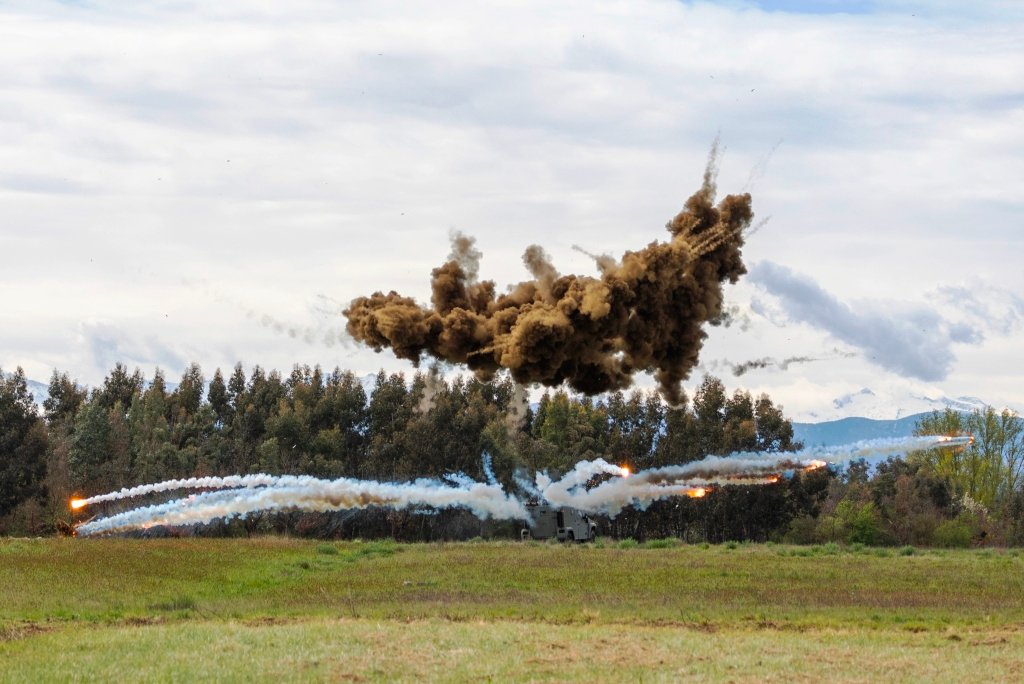
At Eurosatory 2026, counter-drone warfare is entering a new phase. Three French players – Lacroix, Bertin Technologies and MC2 Technologies – are presenting for the first time S-KAPS Counter Drone, a soft-kill protection system designed for armoured vehicles, optimised for drone threats and loitering munitions in contemporary operational theatres
Designed as an open, incremental and integrable architecture for any type of platform, S-KAPS Counter Drone combines multi-layer detection, real-time analysis and semi-automated deployment of Galix countermeasures to improve crew survivability in the most contested environments.
This industrial cooperation is part of the response to a drone threat that has become ubiquitous on modern battlefields. Building on experience gained since 2016 with the first iteration of S-KAPS dedicated to countering laser-guided missile threats (AOS: Automatic Obscurent System), Lacroix has developed its system into a modular solution capable of integrating several heterogeneous detection building blocks. In its Counter Drone configuration unveiled at Eurosatory, S-KAPS relies on two new complementary detection layers: radio-frequency alert and optical detection provided by MC2 Technologies and Bertin Technologies.
The first sensor added to the system, HADDES, from MC2 Technologies, is a passive RF drone-detection sensor that continuously monitors the electromagnetic environment discreetly, without emitting any signal of its own. The HADDES module is derived from a portable solution already used by infantry soldiers. It analyses radio frequencies in the 1 to 6 GHz band in order to detect drones at ranges of up to 3 kilometres depending on the electromagnetic context and topography. HADDES supports the detection of generic protocols as well as Infodrone and Direct Remote ID beacons, which makes it easier to identify hostile vectors amid legal traffic. The embedded artificial intelligence significantly reduces the false-alarm rate and can identify the drone type in around 5 seconds, providing reliable warning of a drone presence that may target the vehicle.
From a mechanical point of view, the system consists of an electronic box and an omnidirectional antenna mounted on the roof of the vehicle. It is connected to the S-KAPS computer, which takes the information into account to alert the crew. Compact and hardened, it is compatible with all types of platforms and easy to integrate.
The second integrated detection building block, PeriSight Top Attack from Bertin Technologies, is a hemispherical infrared optronic surveillance system, entirely passive, designed for the automatic detection of aerial threats such as drones. It relies on 9.3 mm optics at F/1 and four camera modules, each providing a 95° x 76° field of view, making it possible to create a continuous surveillance bubble around the vehicle, day and night. Under nominal conditions, PeriSight Top Attack is capable of detecting a tactical surveillance UAV at a distance of around 1 kilometre and an FPV drone at around 300 metres, including when they use wired links (fibre optic) that are immune to conventional electronic warfare. The embedded automatic detection and tracking algorithm for moving targets helps reduce crew cognitive load and optimise reaction times. In terms of robustness, the system is pre-compliant with STANAG 4370 AECTP 400 edition 3 for shock and vibration resistance. It also meets the requirements of MIL-STD-810-G and STANAG 4370 military standards, and achieves an IP68 sealing rating. Operating temperatures range from -40 °C to +60 °C, while storage temperatures cover the -40 °C to +85 °C range. Finally, the equipment complies with CE, RoHS and REACH environmental regulations, making it easier to deploy in different regulatory frameworks.
At system level, S-KAPS Counter Drone is a soft-kill protection solution covering the entire electro-optical spectrum, without using kinetic weapons. The central generic computer consolidates information from the various detection layers – the HADDES RF sensor and the PeriSight Top Attack infrared chain – to build a coherent picture of the threat and propose the most suitable countermeasure sequence. In time, the system may become fully automated. The soft-kill effects are based on Lacroix’s Galix range of munitions, which is recognised for its decoy and obscuration capabilities. The system offers several modes, ranging from multi-band decoying to hemispherical or hemi-cylindrical obscuration depending on the mounting configuration and the type of threat, with reaction times among the most competitive in its category. S-KAPS Counter Drone’s open and modular architecture allows integration on a wide variety of tracked or wheeled platforms, as well as incremental development in line with operational feedback and technological progress. The concept can be adapted into dedicated variants, such as S-KAPS Counter Missile for protection against laser-guided missiles, through the integration of a laser warning detector, or S-KAPS Global Protection for broader multi-threat defence.
This world first illustrates the ability of French industry to structure a complete ecosystem around the protection of land platforms in the face of the growing drone threat. By combining their respective expertise in effects, RF and optronic sensors, and system architecture, Lacroix, Bertin Technologies and MC2 Technologies are offering a coherent solution that significantly increases the survivability of armoured vehicles while reducing crew cognitive load. S-KAPS Counter Drone therefore stands as a credible operational response to today’s and tomorrow’s high-intensity conflicts and hybrid scenarios.
Photos by J. Roukoz
