

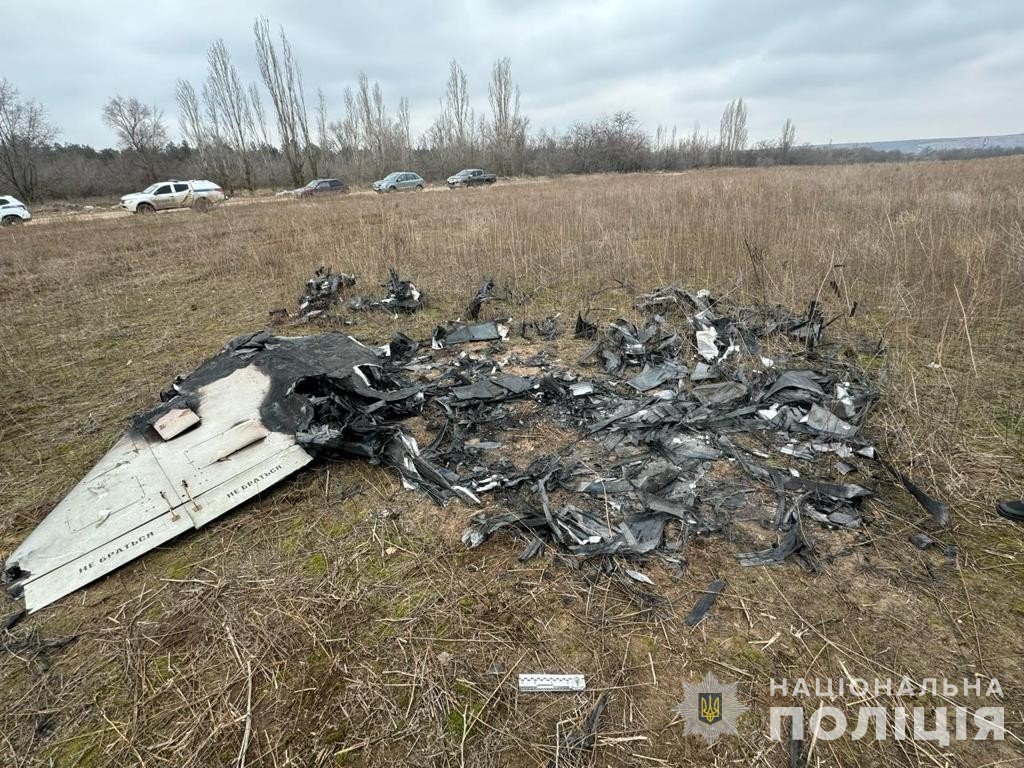

Ukrainian experts have shared details on the electronic counter-countermeasure techniques used by Shahed suicide UAVs against electronic attack systems.
Shahed series suicide Uninhabited Aerial Vehicles (UAVs) began to appear in the ongoing war in Ukraine from January 2024. The weapon was developed by the Islamic Republic of Iran’s Shahed Aviation Industries Research Centre. Shaheds have been supplied to Russia and are also manufactured in that country under licence. According to analysis published by the Adapt Institute, a defence and security thinktank based in Bratislava, Shahed UAVs began to be used en masse in Ukraine from August 2022. The analysis continues that at least 19 distinct Shahed variants have been developed. Among the most notorious have been the Shahed-131 and Shahed-136 versions carrying warheads weighing between ten kilograms/kg (22 pounds/lbs) and 50kg (110lbs).
Publicly-available figures state that, as of September 2025, over 50,000 Shahed suicide UAVs have been launched against targets in Ukraine. Ukrainian air defenders have enjoyed significant success against these aircraft with successful neutralisation rates of between 80 and 90 percent. Nonetheless, air strikes by all munition types against targets in Ukraine have been responsible for over 2,500 civilian deaths in 2025, according to the United Nations Human Rights Monitoring Mission in Ukraine.
Initially, Shaheds were heavily reliant on finding their targets using Position, Navigation and Timing (PNT) signals from Global Navigation Satellite System (GNSS) constellations. Unsurprisingly, as Shahed strikes have increased in tempo and severity, Ukrainian air defenders have worked hard to develop kinetic and electronic effects applicable against this ordnance. The employment of Electronic Countermeasures (ECMs) to support Ukrainian Ground-Based Air Defence (GBAD) as part of the country’s Integrated Air Defence System (IADS) brought a corresponding development by Russian and possibly Iranian engineers to realise Electronic Counter-Counter Measures (ECCMs). These ECCMs are intended to reduce or neutralise the efficacy of Ukrainian electronic attack.
Ukrainian cellular communications
Ukrainian sources have shared details with Armada of the evolution of Shahed ECCMs since these weapons began to be deployed against targets in Ukraine. The first major ECCM development was determined in December 2023 when Shahed rounds were discovered to be using parts of the Ukrainian cellphone network for navigation. How this process works in practice has not been revealed. It is likely that ordnance is equipped with cellular devices to receive communications via Ukraine’s networks. Using illicitly obtained Ukrainian Subscriber Identification Module (SIM) cards, navigation commands can be sent electronically from Russian cellular devices using the Ukrainian SIM cards via the Ukrainian cellphone network. Shaheds equipped with similar devices then receive these commands. Employing the Ukrainian cellphone network to transmit navigation commands helps reduce the reliance on GNSS PNT signals which are vulnerable to jamming. It is also possible that Shaheds thus equipped can employ Ukrainian SIM cards to navigate to their targets via Ukrainian cellphone towers. Each cellphone tower has a unique identification number. By matching the tower’s identification number with its location, a Shahed can ascertain its location and make course corrections to fly to its next cellphone tower waypoint. The UAV keeps repeating this process until it reaches the target.
Controlled Reception Pattern Antennas
From October 2024, Shaheds started to be routinely equipped with Controlled Pattern Reception Antennas (CRPAs). CRPAs are GNSS PNT receivers detecting incoming signals across a 360-degree radius. The antenna can be programmed to recognise a GNSS PNT jamming signal. This is commonly determined by the signal’s unusual level of amplification designed to ‘drown out’ the much weaker signal from space. The CRPA simply stops ‘listening’ for any GNSS PNT signals coming from the direction of the jamming. With a specific area of GNSS PNT reception now nullified, the CRPA will continue to receive unjammed GNSS PNT signals from other directions.
Initially, Shaheds were fitted with four-element CRPAs, each of which covered a 90-degree quadrant, with eight-element CRPAs being sourced from suppliers in the People’s Republic of China (PRC) from October 2024. Twelve-element CRPAs, each covering 30 degrees, began to appear from 2025. These twelve-element CRPAs would be teamed with a cellular receiver to provide additional ECCM resilience as discussed above. Shahed CRPAs have steadily increased in sophistication with 16-element receivers deploying from March 2025. As with the twelve-element systems, these have been obtained from suppliers in Russia and the PRC.
Airborne mesh networking
Alongside the use of CRPAs and cellular communications, Shaheds have been augmented with radios to provide airborne mesh networking. A brace of Shaheds heading towards a target will form the network by establishing radio links between each aircraft. One aircraft, or another UAV type also equipped with a mesh radio, will hang back from the formation to act as a relay. This latter UAV will receive navigation commands from the ground and send these to the Shahed strike package. The strike package which will send back details of their respective aircraft positions. Navigation corrections are sent to the relay UAV for course correction. These mesh networks use frequencies of 1.3GHz to 3.4GHz. Any jamming signals will need to be aimed precisely at the UAV’s radio receivers to have any hope of blocking transmissions between the aircraft. This will be complicated as the aircraft are continually moving. Additionally, the UAV-to-UAV link will have more power than the jamming signal purely on the basis that is has less distance to travel between the aircraft, compared to a jamming signal traveling from the ground to the UAV.
Analysis
By combining capabilities like airborne mesh radios, CRPAs and cellular networking, Shahed engineers are working hard to outflank Ukrainian electronic attack. Traditionally, electronic warfare is a cat-and-mouse game of ECM versus ECCM. Even with impressive miniaturisation, a Shahed remains a space-constrained platform. Logically, there comes a point when the aircraft simply cannot accommodate any additional ECCMs without extensive modifications which may reduce the aircraft’s performance, increase development and procurement costs, and potentially lower manufacturing volumes. Degrading three characteristics that supposedly make the Shahed attractive as an asymmetric weapon is counterproductive: Shaheds are relatively inexpensive weapon to procure, costing between $50,000 and $60,000, according to publicly available sources. Continually adding ECCM capability will continually add cost, potentially until such a point that the suicide UAV no longer has a notable advantage as a cost-effective, yet devastating, weapon. Ukrainian engineers learn the Shahed’s ECCM secrets and share these with other nations either currently facing this weapons or likely to in a future conflict. The more those nations can prepare their GBAD and IADs to ensure that the impact of Shahed use is reduced as much as possible, the less they will have to pay in blood and treasure during future conflicts.
by Dr. Thomas Withington
