

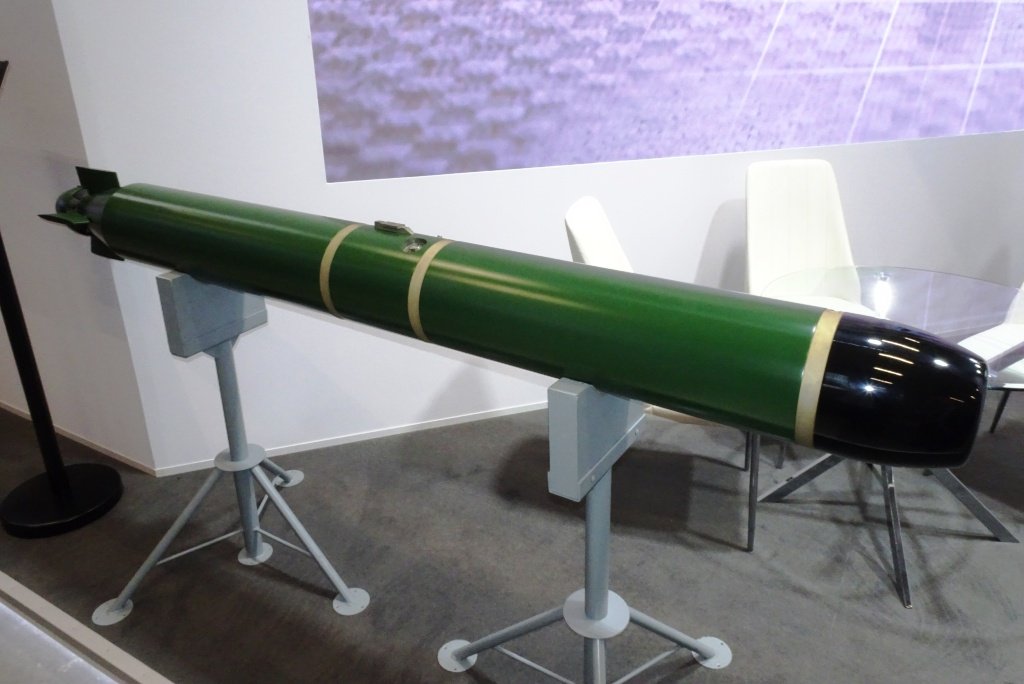
Gidropribor Marine Underwater Weapons (part of the KTRV Tactical Missiles Corporation) unveiled a universal small-size torpedo (universalnya malogabaritnaya torpeda, UMT) at the Fleet-2026 International Maritime Defense Show (IMDS) in Kronstadt
As explained to EDR -On-Line at the company’s booth, the UMT universal small-size torpedo is one of the concern’s latest developments. It can engage not only submarines and certain classes of surface ships and vessels, but also unmanned surface vehicles (USVs) and unmanned underwater vehicles (UUVs).
The UMT torpedo has a traditional cylindrical body with a hemispherical warhead and a tapering tail. The tail section contains protruding surfaces and rudders. The torpedo’s hull and propulsion components measure 2 meters in length. Some configurations can be equipped with additional units that extend the torpedo’s length by 300 mm. The torpedo mass is between 100 and 140 kg, depending on the configuration.
The propulsion system type has not been disclosed. It is connected to a waterjet with an annular channel. The torpedo reaches speeds of up to 27 knots and has a range of 5 to 7 km. It can operate at depths of up to 450 meters.
The UMT is equipped with an active sonar homing system and a proximity detonator. The guidance system’s specifications are not disclosed. It is possible that this torpedo can even home in on a specific area of a naval target to inflict maximum damage. A fiber-optic communication system is also envisaged for the torpedo’s guidance system.
The torpedo has a warhead compartment containing a 35 kg explosive charge. The type and configuration of the charge, as well as its combat characteristics, are unknown.
The torpedo can be supplied complete with a launcher and a data entry console for firing.
At the customer’s request, the torpedo can be adapted to any type of launch vehicle, including unmanned surface vehicles (USVs).
According to a company representative, the universal compact torpedo UMT has already passed preliminary testing.
EDR On-Line has learned that development of the UMT torpedo began at the end of the last decade, and information about the project was not disclosed. The official presentation of a full-scale mockup of the torpedo took place only in 2023 at the International Maritime Defense Show IMDS-2023.
By the time of its first demonstration, the torpedo had already undergone preliminary testing, which was conducted on Lake Ladoga. The purpose of the tests was to validate the torpedo’s design and demonstrate its performance.
In 2023-2024, a mockup of the UMT torpedo was on display at the KTRV exhibitions at the IMDS-2023 and the Army-2023 and Army-2024 International Military-Technical Forums.
The UMT torpedo stands out among other Russian torpedo designs. It differs from other torpedoes in its unusual 220mm caliber, and its design proposed and implemented new solutions for both its placement on various platforms and its operational methods.
The UMT will be used with various launchers on different platforms. According to the developers, a special launcher for the torpedo has been created for unmanned vessels and other platforms. A control panel will be supplied with the launcher.
EDR On-Line has learned that the UMT torpedo can be used as part of anti-submarine missile systems. In this case, the torpedo’s carrier, delivering it to the target area, will be a corresponding missile.
The UMT’s main distinguishing feature is its reduced dimensions and mass. For example, the full-size modern Russian UGST “Fizik” torpedo has a caliber of 533 mm and a length of 7.2 meters. It’s mass is 2.2 tons, of which 300 kg is accounted for by the warhead.
Since the new UMT is significantly smaller and lighter than other torpedoes, it can be used on a variety of surface, underwater, and air platforms. It is proposed to even deploy the torpedoes on heavy UAVs with a payload capacity of 100-150 kg.
Due to its reduced mass, the torpedo carries a relatively light warhead. However, the detonation power of 35 kg of TNT is sufficient to cause significant damage to various surface and underwater targets. For example, the new torpedo can be used against autonomous UUVs, which are not particularly large or robust. The detonation of a 35 kg warhead is guaranteed to destroy any UUV.
Due to its small size and the impossibility of accommodating a large propulsion system, the UMT torpedo is inferior to other models in speed and range. For example, the Fizik 533 mm torpedo accelerates to 50 knots and has a maximum range of 50 km, significantly exceeding the UMT’s performance.
A speed of no more than 27 knots and a range of up to 7 km limit the combat capabilities of the new compact torpedo. However, proper management of its combat use and optimal launch from an advantageous range allow for maximum results, even with objective limitations.
Photo by N. Morris
