

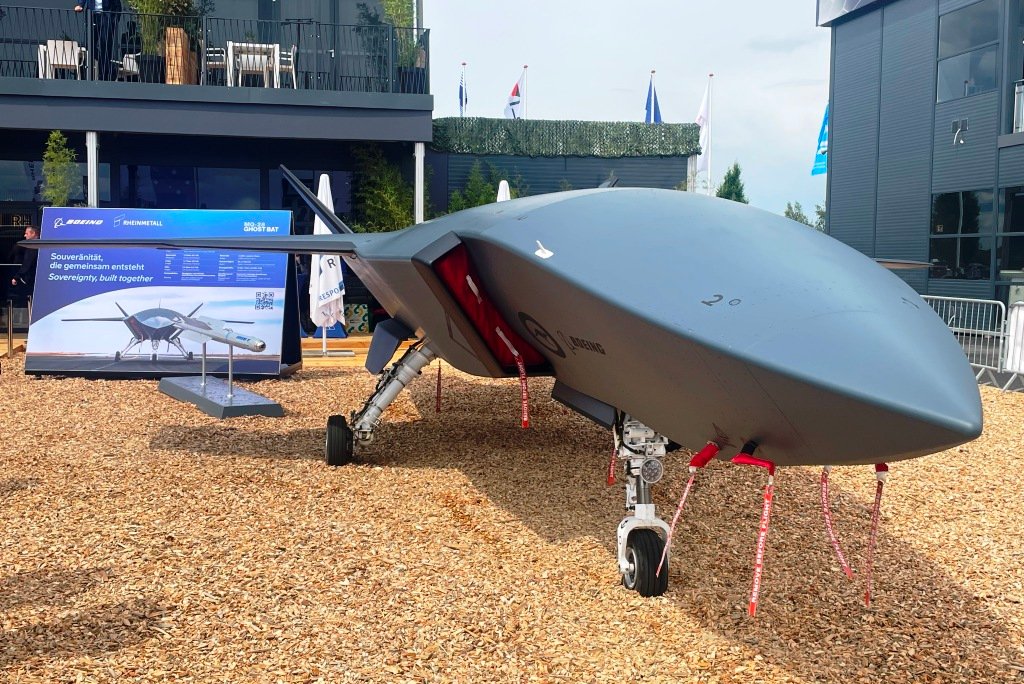
With the German Bundeswehr looking more intently at manned-unmanned teaming arrangements with its new F-35As could the Boeing MQ-28 Ghost Bat be the solution?
Boeing introduced its ‘Team Ghost Bat Germany’ on the first day of ILA 26. All will bring new German know-how, as the Bundeswehr tries to catch up on manned -unmanned teaming routes.
Rheinmetall is set to be the systems integrator for the German MQ-28, while Diehl BGT will provide home-grown weapons solutions while the communications management suite will come from Rohde and Schwarz.
The Ghost Bat on show at the Rheinmetall stand is a real aircraft and according to Boeing the fourth-generation evolution, with a 25% larger wingspan and 3.3 metres longer. According to Boeing Australia, which can offer larger internal weapons load outs, that currently includes two AIM-120 AMRAAMs and four Small Diameter Bombs (SDBs). Any German acquisition would include a Diehl solution too, like the IRIS-T short range infrared homing air-to-air missile on display next to the Collaborative Combat Aircraft (CCA).
The MQ-28 Ghost Bat CCA has been designed, developed, and manufactured in Australia, and according to Boeing Australia is ready to bring mission-ready capability to Germany.
“It has been conceived to meet the evolving needs of the battlespace,” Amy List, Vice President and Managing Director of Boeing Defence Australia told reporters at the Boeing stand. Adding: “It is flexible and designed with an open mission system architecture, which allows for rapid capability insertion to change missions as needed. This brings us new software relevant to Germany or other nations that want to introduce the MQ-28 into their force mix. It is suitable for a range of missions such as electronic warfare, surveillance and reconnaissance/strike.”
Boeing Defence Australia claims the MQ-28 is the most mature CCA and ready to meet Germany needs. Over 25,000 hours of digital engineering and digital testing, has been carried out so far including 200 hours of actual flying.
The MQ-28 should be operational with the Royal Australian Air Force in 2028 and is set to be operated from several RAAF facilities, across vast areas of the Pacific Ocean.
The Australian government has invested £ 2 billion, and under the next defence plan is set to invest another Euros 6 billion over the next ten years to continue to develop and provide a clear path forward for the MQ-28.
Dr Michael Heiner, Boeing Germany President believes that the partnership with Rheinmetall can deliver a CCA capacity to the German Air Force by 2029.
Boeing Australia has been working on the MQ-28 for eight years and flying it for five on operational testing. The first system will be built next year.
Photo by A. Warnes
