

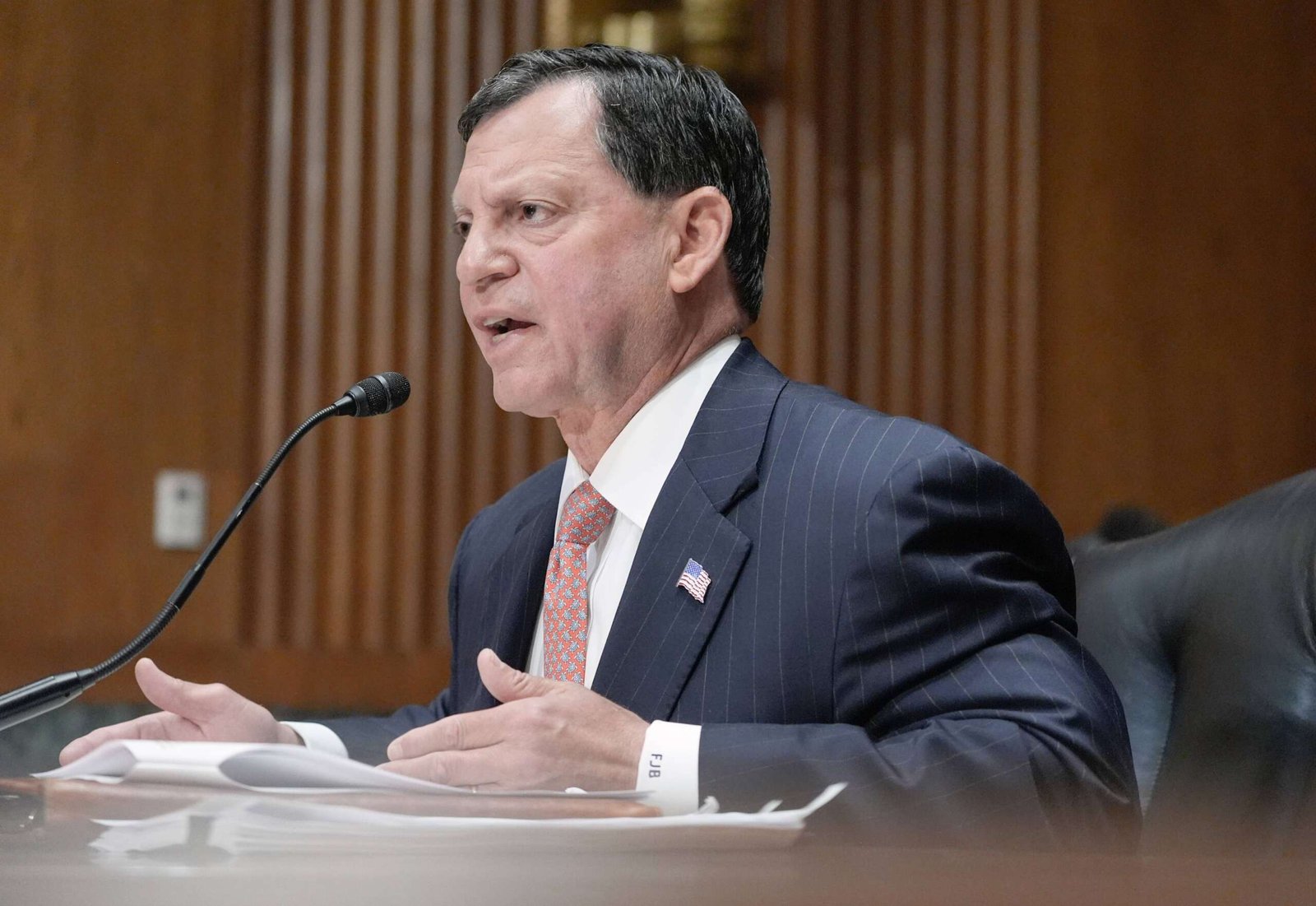
The head of the Social Security Administration says the agency’s customer service metrics are showing improvement, following significant staffing cuts.
SSA Commissioner Frank Bisignano told members of the House Ways and Means Committee on Wednesday that the agency is seeing its “best all-around performance ever,” and that it is doing more with fewer employees.
“You can’t just throw people at problems in this day and age. You’ve got to use technology,” Bisignano said in a hearing held by the Social Security and work and welfare subcommittees.
The IRS, which Bisignano also oversees as its chief executive officer, is following a similar strategy. He told the Senate Finance Committee in April that it saw “the most successful filing season in history,” despite losing 27% of its workforce last year and falling short of its hiring goals.
The IRS, much like SSA, has temporarily reassigned many employees to mitigate staffing losses and tackle the agency’s public-facing workloads. In SSA’s case, it’s reassigned over 2,000 employees to staff its national 1-800 number, pulling them away from processing claims and providing in-person help at field offices.
Bisignano said these reassignments are necessary to address the needs of SSA beneficiaries.
“People wanted to call us in the morning, and we weren’t there. I’d like to make this more complicated, but it’s not. It’s putting people where the work is. It’s building technology in a modern-day fashion. It’s understanding what best-in-class performance looks like, and motivating a workforce that’s fully motivated to be here,” he said.
Bisignano told lawmakers that wait times for SSA’s national 1-800 number have fallen by 89% —from 42 minutes down to under 5 minutes — and that average wait times at field offices have fallen by 30%.
A report from SSA’s inspector general’s office last December found that the average wait time to reach an agent over the phone in fiscal 2025 was over 100 minutes when callers accepted a “callback” option from the agency. Without factoring in callback wait times, callers waited an average of 15 minutes. Bisignano said SSA is following industry norms in how it measures phone service.
“We measure it the same way every industry does,” he said.
SSA cut 7,000 employees from its workforce last year through separation incentives offers. AFGE Council 220 President Jessica LaPointe wrote in a statement for the record that SSA “conducted no meaningful hiring to replace them.”
SSA currently has a workforce of about 50,000 employees, its lowest headcount in decades. On average, it has about one field office employee for every 4,000 beneficiaries.
“The result is a staffing ratio that makes adequate service impossible,” LaPointe wrote.
In a letter to Senate Appropriations Committee Chairwoman Susan Collins (R-Maine), Bisignano wrote that SSA is looking to fill 1,000 positions — a mix of telephone service representatives and field office workers. But that level of hiring won’t keep up with the agency’s rate of attrition.
According to LaPointe, SSA expects attrition to shrink its headcount by 2,000 employees this year. Bisignano wrote in his letter to Collins that workforce attrition this year will be 50% lower than last year, and 30% lower than in 2024, “providing consistency for both staff and the public we serve.”
“What I think, in fact, is we have the right amount of staff in the right places,” Bisignano said at the hearing.
Former SSA Commissioner Martin O’Malley said the agency may have trouble recruiting new hires.
“The workers there are terribly demoralized. They’ve been treated so badly, but have continued to work because they believe in the mission,” O’Malley said in an interview.
Through technology improvements, including greater use of artificial intelligence and automation tools, Bisignano said the agency has generated the equivalent of 2,500 work years in productivity savings, “allowing staff to spend more time serving customers directly.”
AFGE Council 220 is calling on Congress to pass a $3 billion agency supplemental funding package for SSA to hire another 3,000-5,000 permanent telephone service representatives and up to 20,000 frontline field office workers and support staff. But Republican lawmakers say Bisignano has demonstrated that SSA doesn’t need to increase staffing.
Rep. Aaron Bean (R-Fla.) told Bisignano that “you are now serving more Americans with fewer employees.”
Social Security Subcommittee Chairman Ron Estes (R-Kan.) said SSA has seen a “dramatic turnaround” under Bisignano’s tenure.
“We are seeing that by investing in modern technology and focusing on efficiency, the SSA can serve more Americans better with fewer employees,” Estes said.
Democrats on the committee, however, expressed skepticism over SSA’s improved metrics.
“I’m grateful some of the telephone [service] aspects have been restored, but to do so, you’re taking people away from existing jobs that should be providing greater customer service,” Social Security Subcommittee Ranking Member John Larson (D-Conn.) said.
Rep. Gwen Moore (D-Wis.) expressed concern that Bisignano is treating SSA reassignments like a “magic bullet in place of having enough employees.”
“People are waiting on the phone for 46 minutes, and then when they finally do get somebody, somebody can’t answer their questions because they’re not calling the correct benefit officer,” Moore said.
“You wouldn’t know how to manage 50,000 people anyway,” Bisignano told her.
Rep. Don Beyer (D-Va.) said it was important for SSA to reduce phone wait times, but said employees assigned to handle these calls are getting less training.
“Previously, when employees were temporarily assigned to phones or in emergency situations, they apparently received months of training, and they shadowed a full-time phone operator. Now it’s reported that they’re getting three hours of training before being placed on phones, basically the same day,” Beyer said.
GovExec reported in February that SSA employees assigned to the national 1-800 phone line were trained to tell callers expressing suicidal thoughts that suicide is “one option.”
Bisgnano said SSA has since made changes to its training materials.
“We addressed it four months ago when it occurred,” he said.
LaPointe wrote that the union is hearing from frontline employees that they are being instructed to handle calls within five to six minutes.
“They have no break between calls to breathe and tie up loose ends. No consistent inter-office triage system exists — causing chaos, repeat callers, and employee attrition,” she wrote.
O’Malley said the metric SSA prioritized under his leadership was “first-call resolution,” or ensuring that an employee could fully address a caller’s request on their first call, without needing to follow up with more calls or correspondence.
“We created a winnable game and a visible playing field and a compelling scoreboard, because it was honest about improving the speed to answer the 1- 800 number,” he said.
AFGE Council 220 said workforce shortages have forced some field offices to temporarily close, particularly facilities in rural and remote locations that have recently been staffed by a single employee. Bisignano said half of SSA employees work in field offices, which account for about 3% of the agency’s total transactions. Despite SSA’s plans to cut field office visits in half, Bisignano said SSA “will never close a field office.”
“Visitors are down in field offices and up everywhere else,” he said.
If you would like to contact this reporter about recent changes in the federal government, please email jheckman@federalnewsnetwork.com, or reach out on Signal at jheckman.29
Copyright
© 2026 Federal News Network. All rights reserved. This website is not intended for users located within the European Economic Area.
