

For two and a half decades, whenever the Turkish government had a falling out with the United States and Europe, analysts frantically began worrying that the West had “lost” Turkey. It happened first in 2003, after the Turkish parliament voted against granting U.S. forces access to Turkish territory for the invasion of Iraq. It happened again in 2010, when Turkey voted against increased UN sanctions on Iran. The warnings grew even more urgent in 2017, when Ankara purchased the Russian-made S-400 missile defense system, raising fears that NATO’s second-largest military power was cozying up to the alliance’s chief adversary.
Throughout the second half of the twentieth century, secularist leaders had firmly anchored Turkey in the Western camp. Ankara had joined the Council of Europe in 1949, entered NATO in 1952, and signed an association agreement with the European Economic Community in 1963. But Western observers feared that Turkish President Recep Tayyip Erdogan’s Justice and Development Party, with its historical links to Islamist parties, would pull the country away from the Western bloc after it came to power in 2002. In many ways, Erdogan did attempt such a pivot. Starting in the mid-2010s, under the banner of “strategic autonomy,” Ankara cultivated closer economic, energy, and security ties with Moscow and at times pursued policies that drew the ire of its allies in NATO.
Now, however, Turkey is coming back around to its Western partners. Ahead of the NATO leaders’ summit, which Ankara will host in July, Turkish officials are consistently delivering pro-alliance messaging. Turkish Foreign Minister Hakan Fidan, for example, described transatlantic ties as a strategic necessity for Turkey and called the summit a “historic opportunity” to reaffirm NATO unity. And Turkey’s realignment is not just talk. Over the past few years, Ankara has been distancing itself from Moscow by reducing its dependence on Russian energy and pruning the two countries’ economic and defense ties. That shift has opened the door to deeper cooperation with NATO allies—and it reveals a recognition among Turkish policymakers that, after years of insisting on their country’s strategic autonomy, Turkey is better off aligned with the West.
A PARTNER IN THE KREMLIN
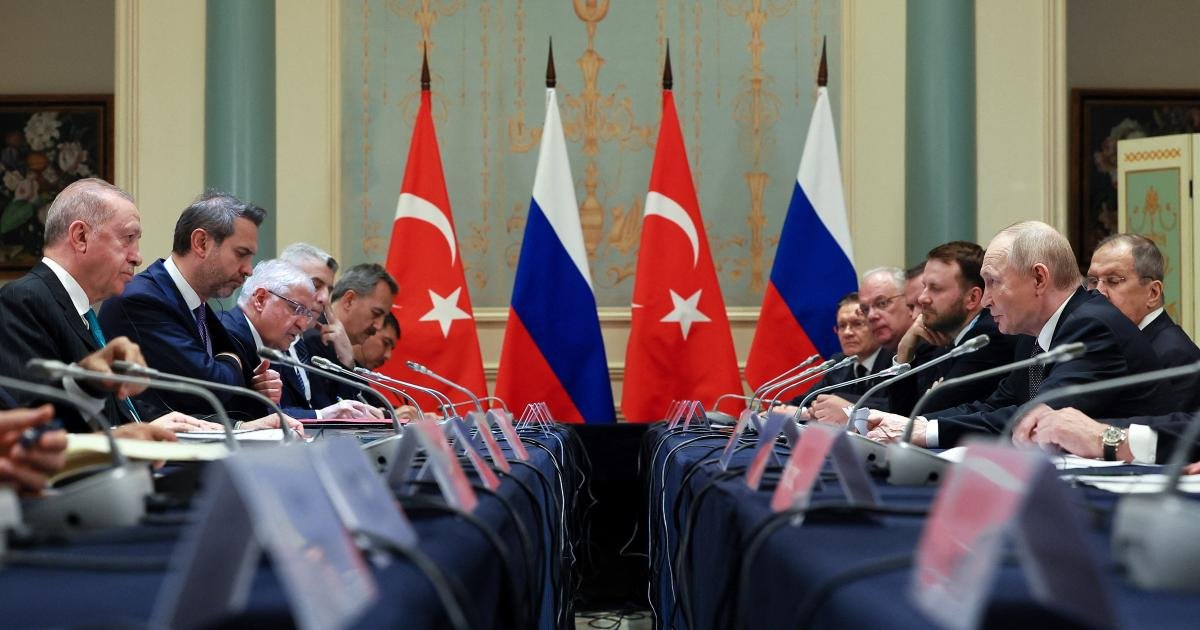
Ankara’s rapprochement with Moscow had its roots, paradoxically, in one of the most dangerous crises in modern Russian-Turkish relations. In November 2015, a few months after Russia intervened in the Syrian civil war to save its ally Bashar al-Assad from a rebellion backed by Ankara, Turkey shot down a Russian jet near the Syrian-Turkish border. Moscow soon imposed sweeping economic sanctions, and Ankara feared that military retaliation would follow. It urged its NATO allies to cancel a planned withdrawal of Patriot missile batteries deployed to Turkey, but the United States and Germany proceeded anyway. At the time, U.S.-Turkish relations were already strained over Washington’s decision to arm a Syrian Kurdish militia that Ankara considers a terrorist organization. The Patriot withdrawal thus reinforced Ankara’s perception that NATO would not stand by it in moments of acute vulnerability.
Disillusioned with NATO allies and anxious about potential Russian retaliation, Erdogan sought to repair ties with Russian President Vladimir Putin in early 2016, expressing regret over the downing of the jet. Then, after a failed coup attempt against Erdogan in July 2016, Putin was the first foreign leader to call and offer support. The comparatively slow response of Turkey’s NATO allies rankled Erdogan, who interpreted the incident as further proof that NATO was unreliable in a crisis whereas Russia was a partner that Turkey could work with. Just a month later, Turkey launched a military incursion into northern Syria with Russia’s tacit approval. The next year, Turkey purchased the Russian-made S-400 missile defense system. Not only is the S-400 incompatible with NATO systems, but allies also worried that its advanced radar could collect intelligence on NATO aircraft—particularly the F-35 fighter jet—and potentially expose sensitive operational data and capabilities to Moscow. Even as the United States imposed sanctions on Turkey and expelled the country from the F-35 program, Ankara maintained that it had the right to diversify its defense partnerships and reduce its dependence on its Western allies.
Domestic troubles compelled Ankara to rethink its foreign relations.
In some ways, Russia’s full-scale invasion of Ukraine in 2022 brought Russia and Turkey even closer. Ankara did not support the invasion; in fact, the Turkish government strongly condemned Russia’s actions, backed a UN resolution denouncing Russia, supplied drones and other arms to Ukraine, and closed the Bosporus and Dardanelles straits to warships, including Russia’s Black Sea Fleet, in fulfillment of the terms of the 1936 Montreux Convention. But Turkey also refused to join Western sanctions on Russia and increasingly became an economic lifeline for Moscow. Tens of thousands of Russians fleeing the war poured into Turkey, where they bought property, opened businesses, and injected much-needed cash into the battered economy. Bilateral trade nearly doubled in 2022 to more than $60 billion, making Turkey Russia’s second-largest trading partner after China.
Turkey’s ties to Russia deepened most notably in the energy sector. Within two years of the invasion, Turkey became the third-largest importer of Russian fossil fuels. Its imports of Russian oil in 2023 and 2024 were more than double 2021 levels. And Turkey and Russia pressed ahead with a deal, signed in 2010, for Russia’s state nuclear giant Rosatom to build, own, and operate the Akkuyu nuclear power plant on Turkey’s Mediterranean coast. Russia has poured billions of dollars into completing the project, and Ankara has helped Rosatom overcome sanctions-related obstacles to making the plant operational. Because the deal stipulates that Russia will retain majority ownership, it effectively grants Moscow access to critical infrastructure in a major NATO country for the plant’s expected 60-year operational lifespan and the subsequent decades-long process of decommissioning.
At this point, from the perspective of Turkey’s NATO allies, Ankara was further away than ever. Turkey had bought military equipment from Russia and cultivated close energy ties with Russia. Its enduring business dealings with Russia elicited warnings from European and U.S. officials that Turkish institutions could face secondary sanctions if they worked with sanctioned Russians. And Turkey even undermined NATO directly, using its veto power to press allies to make concessions in exchange for Ankara’s approval of Finland’s and Sweden’s applications to join the alliance. Ratification of the two countries’ membership was delayed for months. For many allies, it all looked like a win for Putin.
TIME FOR A RESET
But domestic troubles soon compelled Ankara to rethink its foreign relations. By the time of Turkey’s 2023 presidential and parliamentary elections, the country faced soaring inflation, a collapsing currency, and a widening balance-of-payments crisis. Years of economic mismanagement, institutional erosion, and Erdogan’s unorthodox monetary policies had badly damaged investor confidence, and years of pushing away its traditional Western partners had left Turkey without friends to fall back on. A devastating February 2023 earthquake, which killed more than 50,000 people and caused close to $100 billion in damage, compounded the country’s problems.
After winning the election in May 2023, Erdogan recognized that changing perceptions of Turkey had become an economic and strategic imperative. The country could not afford to continue alienating Europe, given that the EU was Ankara’s largest trading partner and source of investment. Turkey’s defense industry was central to Erdogan’s efforts to cultivate legitimacy at home and project influence abroad, but U.S. sanctions imposed over the Russian S-400s weighed on the sector. NATO’s removal of Turkey from the F-35 program effectively cost Turkish firms billions of dollars in contracts, and sanctions on Turkey’s defense procurement agency complicated production of arms that relied on U.S. components and stalled negotiation of new deals.
Turkey still wants to maximize its freedom of action.
As part of his course correction, Erdogan appointed Mehmet Simsek, who was widely respected by international investors after an earlier stint as Turkey’s finance minister, to lead the struggling economy. The new finance minister toured Western capitals to reassure investors that Turkey was returning to orthodox economic policies, and Fidan has signaled that Turkey would be moving into closer diplomatic alignment with its Western partners, working to stabilize relations with the United States and supporting efforts to revive Turkey’s European Union membership bid. In July 2023, Erdogan lifted his objections to Sweden’s NATO membership. Although Turkey did not join Western sanctions against Russia, it adjusted its policies to avoid secondary sanctions. Turkish exports to Russia fell sharply at the start of 2024, and Turkish banks began closing Russian corporate accounts, suspending payment processing, and severing ties with Russian counterparts. Ankara restricted exports of U.S.-origin goods such as microchips and remote control systems, which NATO allies worried could make their way to the Russian military.
Turkey also started taking steps to reduce its heavy dependence on Russian energy. In 2025, it held talks with Iran to increase the flow of gas from Turkmenistan and accelerated plans to boost imports of liquefied natural gas from the United States and other non-Russian suppliers. Ankara quietly shelved plans first proposed by Putin in 2022 to establish a Russian gas hub in Turkey, which Western governments had warned could allow Moscow to evade import restrictions by blending its gas with that of other supplies. Last year, Turkey extended expiring Russian gas contracts by only one year—but agreed to a 15-year deal to purchase roughly 1,500 LNG cargoes from the United States. Gas imports from Russia accounted for more than 50 percent of Turkey’s supply in 2018; by the end of 2025, this number had fallen below 40 percent. And after U.S. President Donald Trump urged Erdogan during a September 2025 White House meeting to reduce Turkey’s purchases of Russian energy, the country’s largest refineries started buying crude from Iraq, Kazakhstan, and other non-Russian producers, contributing to a more than 60 percent drop in Russian oil exports to Turkey in October.
Even the nuclear partnership has come under strain. The Akkuyu nuclear plant project, originally slated to begin operations in 2024, has faced repeated delays because of suppliers’ concerns about sanctions on Russia. Turkey is now working with the United States and South Korea on plans for a second nuclear plant in Sinop on the Black Sea coast, a project that had previously been expected to go to Rosatom.
SAFETY IN NUMBERS
Regional developments over the past year and a half have reinforced Turkey’s recalibration. Assad’s fall in late 2024 and the rise of a new government in Damascus that is closely aligned with Ankara stripped Russia of much of the influence it held in Syria since 2015—and made it largely unnecessary for Erdogan to curry favor with Putin in order to secure support for his own Syria policies. The political transition in Syria also paved the way for a U.S. military withdrawal from the country, removing a long-standing source of tension in U.S.-Turkish relations. This favorable diplomatic environment has helped Turkey strengthen the partnerships its military and defense industry have long relied on. Domestic defense production requires access to U.S. parts, and acquisitions from NATO allies, such as the purchase last year of several dozen Eurofighter Typhoon jets, are central to Turkey’s military modernization program. Ankara is also eager to participate in Europe’s efforts to build up its own defense industry—and thus tap into new funding opportunities. Turkey has decided, essentially, to recommit to NATO. And it has made that intention clear: in December 2025, after years of insisting Turkey would purchase a second batch of S-400s, Erdogan asked Putin to take back the missile defense system.
NATO’s response to the U.S.-led war against Iran that began on February 28 demonstrated to Ankara that it had made the right choice. When several Iranian missiles entered Turkish airspace, it was NATO-linked defense systems in the eastern Mediterranean that intercepted them. The alliance subsequently reinforced Turkey’s air and missile defenses, including by deploying Patriot batteries to the country’s southeast, where the radar system that supports NATO’s ballistic missile shield is located. Turkey’s highly expensive S-400s, by contrast, remained idle as the country came under direct missile threat.
Ankara is increasingly turning to NATO allies to help it close the gaps in its defenses that have been revealed by the war, particularly when it comes to fending off medium-range ballistic missiles, cruise missiles, and coordinated saturation attacks. It has pressed ahead on previously stalled negotiations with France and Italy to acquire and coproduce the SAMP/T missile defense system. Germany announced that it will deploy an additional Patriot air defense battery and 150 troops to Turkey at the end of June. Turkish officials recently revealed a NATO plan underway since 2023 to establish a multinational corps in Turkey; Ankara aims to complete the project by 2028. Turkey is also expanding its involvement in Black Sea security, launching a NATO-linked demining initiative alongside Bulgaria and Romania in January.
BACK TO REALITY
Turkey’s growing cooperation with NATO has clearly unsettled Moscow. Despite repeated invitations, Putin has not visited Turkey since 2020. Turkish targets have also come under Russian fire in Ukraine and the Black Sea in recent years. Russian forces fired warning shots at a Turkish-owned cargo ship in the Black Sea in 2023. In 2025, Russia struck a Turkish-flagged LNG tanker in the Ukrainian port city of Odessa and attacked a Turkish Bayraktar drone facility near Kyiv. Although Turkey continues to present itself as a mediator between Russia and Ukraine, it has grown frustrated with what officials see as Russia’s uncompromising demands and unwillingness to engage in the high-level talks that are necessary to reach a settlement. And, tellingly, it supports Ukraine’s aspirations to join NATO.
Even though Turkey is distancing itself from Russia and moving closer to NATO, that does not mean Ankara has entirely abandoned its pursuit of strategic autonomy. Turkey still wants to maximize its freedom of action and retain the option to engage simultaneously with competing actors, including NATO allies, China, Russia, and regional powers. But Ankara now understands that it is in a stronger position to pursue its interests abroad when it works with the United States and Europe. Turkey’s defense industry is central to its ability to project power and shape the outcome of conflicts in the region, and Ankara will continue to invest heavily in domestic capabilities. Yet advancements in those capabilities still rely on U.S. and European technology, components, financing, and defense partnerships.
Turkey’s economy and security remain firmly anchored to Europe and the United States, as has been true for decades. Erdogan sought to find an alternative by building a close relationship with Russia—but reality has now brought Turkey back.
Loading…
