

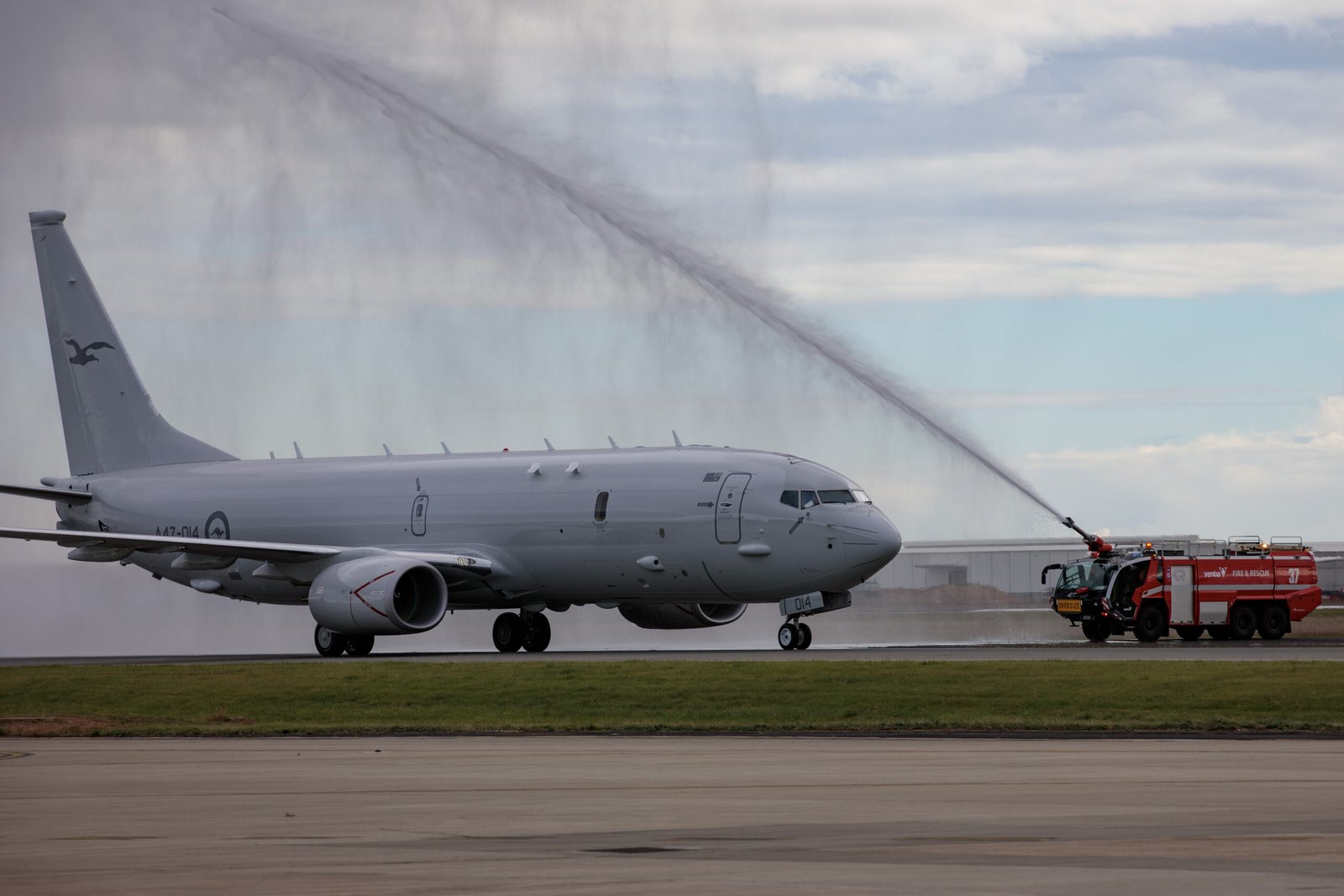
Australia’s 14th and final Boeing P-8A Poseidon arrived home on 26 May, bringing a decade of deliveries of the type to a close.
The P-8A with tail number ‘A47-014’ arrived at Royal Australian Air Force (RAAF) Base Edinburgh, following stopovers in Honolulu and in Nadi, Fiji.
“Completion of the 14‑aircraft fleet enables higher availability, increased resilience and the ability to deliver sustained operations in support of Australia’s security and regional stability,” said an Australian Department of Defence statement issued a day following the homecoming.
Under Project Air 7000 Phase 2B, eight P-8As, with an option for a further four, were ordered in 2014 to replace the RAAF’s ageing Lockheed AP-3C Orion aircraft.
In 2016, Australia ordered a further four aircraft as the first tranche of a planned two-stage acquisition that was intended to total seven aircraft. The plan was not fully realised, for in 2021 Australia converted only two of its three remaining options into firm orders, resulting in a final fleet of 14 aircraft.
The first RAAF P-8 was delivered in November 2016, and an initial operating capability was declared in early 2018. Deliveries continued over following years, with the 13th aircraft – the first of the latest pair ordered – arriving in Australia in October 2025.
The RAAF’s fleet of 14 Poseidons are based at Edinburgh and are operated by No. 11, 12 and 292 Squadrons, the latter serving as the operational conversion unit. No. 12 Squadron stood up in October 2025 as the second operational unit to accommodate the expanding fleet.
The Poseidons provide the RAAF’s anti‑submarine warfare, maritime strike, and intelligence, surveillance and reconnaissance (ISR) capabilities. The P-8 can operate alongside the RAAF’s Northrop Grumman MQ-4C Triton high-altitude, long-endurance unmanned aerial system, with the latter providing expanded maritime patrol and ISR capabilities.
Upgrades, under four-year Increment 3 Block 2 modifications, are also being rolled out to the RAAF’s P-8 fleet to further enhance its capabilities. As the first international customer to undergo the upgrade, Australian P-8s will receive new antennas, sensors and software to improve computer processing and communication systems.
The RAAF’s P-8 developments come as the fleet expands its activities across the Asia-Pacific region. In recent months, deployments of P-8s were made to Japan and the Philippines, for instance.
In the former, a pair of Poseidons deployed in May to Iwakuni Air Base, located about 30km southwest of Hiroshima, where they conducted bilateral training with the Japan Self-Defense Force, as well as trilateral exercises involving Japanese and US forces.
In the bilateral activity, RAAF P-8 crews engaged with their counterparts from the Japan Maritime Self-Defense Force (JMSDF) flying the ShinMaywa US-2 amphibious aircraft and P-3C Orion maritime patrol aircraft.
Training was also conducted with the Kawasaki RC-2 signals intelligence platform operated by the Japan Air Self-Defense Force’s Electronic Warfare Operations Group. During a flying activity, information was shared between an RAAF P-8 and RC-2 through a tactical battlefield network, simulating the transmission of an operational picture of the battlespace.
RAAF and US Navy P-8s also flew together with a JMSDF Kawasaki P-1 in a trilateral anti-submarine warfare exercise.

Over in the Philippines, an RAAF P-8, flown by No. 12 Squadron, deployed to Clark Air Base in March. It conducted maritime domain awareness missions over the South China Sea/West Philippine Sea, continuing a pattern of previous deployments.
The latest RAAF P-8 deployments follow numerous others over the years, including missions supporting the enforcement of United Nations Security Council sanctions against North Korea from Kadena Air Base in Japan, as well as maritime domain awareness missions conducted from Malaysia and Singapore.
by Roy Choo
