

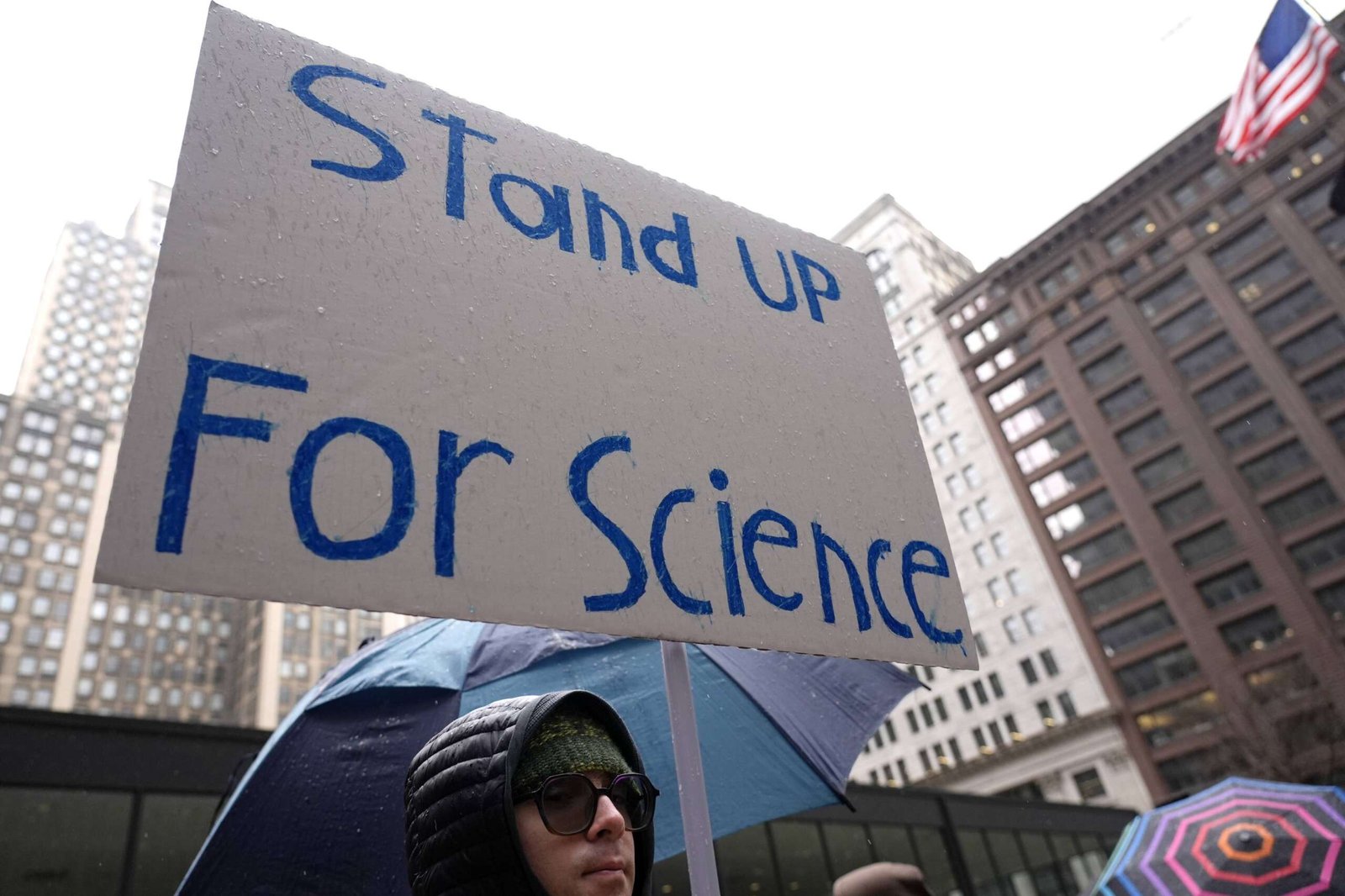
Amid the Trump administration’s workforce overhauls, some federal science agencies appear to be bearing the brunt of the changes, according to new research from the Partnership for Public Service.
Federal workforce reductions, cuts to resources, and plans to increase political influence in the grantmaking process are all leading to declines in scientific development and innovation, said Max Stier, the nonprofit’s president and CEO.
The effects, Stier said, will be felt for decades to come.
“We’re talking about a generational loss here,” Stier told reporters during a press call last week. “This is not something that can be turned on and off like a light switch. We’re seeing the destruction of something that was invested in over 50 years, and it’s disappearing in the space of, so far, 18 months.”
Currently, there are about 726,000 federal employees working at science-related agencies, according to the latest workforce numbers from the Office of Personnel Management. That’s after a decrease of close to 118,000 federal employees working in scientific fields between September 2024 and February 2026, the Partnership noted in a June 2 report.
While the federal workforce overall has shrunk by about 12% under the Trump administration, a large portion of those staffing losses, roughly 40%, came from science-related agencies, the report found.
For instance, the Forest Service and National Science Foundation have each faced a roughly 33% staffing loss. The National Park Service has seen a nearly 37% workforce decline. And the Substance Abuse and Mental Health Services Administration (SAMHSA) has experienced a headcount reduction of nearly 42%.
Thousands of federal employees working in areas including scientific research, public health, food safety and the environment left their jobs either voluntarily or by force. The Partnership said that has led to a loss of decades of scientific expertise across government.
“You also saw massive declines in resources that went out to critical science projects, and none of this in a planned and effective way,” Stier said.
The White House budget request showed steep cuts to proposed spending levels for research and development at civilian agencies, at $46.8 billion for fiscal 2026. That’s compared to $73 billion in enacted spending during fiscal 2025, the nonprofit’s report found.
Also during fiscal 2025, science agencies obligated $112.6 billion in spending toward project grants — a 24% decrease in grant funding from science agencies since 2024, USASpending data showed.
“We are seeing drops in project funding for everything from environmental research, to food safety, to mitigation efforts on public lands,” said Brandon Lardy, the Partnership’s data director.
The science agency overhauls appear to be causing ripple effects as well. The nonprofit pointed to a March 2025 poll conducted by Nature, a scientific journal, which found that 75% of scientists said they were considering leaving the U.S. because of recent disruptions to science.
At the same time, current and former federal science employees are warning of ongoing challenges particularly at the National Institutes of Health, as a result of workforce reductions, program cuts and policy changes over the last year.
27 UNIHTED, a grassroots organization that advocates for NIH employees and policies, issued a June 9 letter that raised sweeping concerns about the Trump administration’s management of the agency. The employees said it has led to an “unstable research environment,” the loss of workforce expertise and low employee morale.
The new letter, which was written and signed by dozens of current and former NIH employees, came one year after the 2025 Bethesda Declaration, which similarly warned of significant risks from staffing losses and program overhauls across the NIH.
Since then, NIH employees said their initial concerns “have only deepened,” following decreases in research funding, workforce shortages and delays in research awards.
“The chaos of 2025 has been replaced with coordinated, systematic, institutionalized destruction in 2026,” the letter said.
A Department of Health and Human Services spokesperson told Federal News Network that NIH remains committed to funding rigorous, reproducible science, advancing scientific discovery, and supporting scientific integrity and academic freedom.
“Director Bhattacharya is committed to transparency, open inquiry and constructive debate and remains open to continuing direct conversations with the authors of the Bethesda Declaration to discuss their concerns firsthand,” the spokesperson said in an email. “While disagreement is a healthy part of science, he believes the most productive path forward is through direct engagement and dialogue. The NIH remains committed to the mission of being the world’s leading institution for biomedical research.”
The Partnership also raised concerns about the Office of Management and Budget’s recent proposed regulations on federal grants, and warned that the planned changes would politicize the government’s grantmaking process.
The changes the Trump administration is proposing, according to OMB, would remove diversity, equity and inclusion (DEI) and other “woke” ideals from the federal grantmaking process. Grant terminations would become easier under OMB’s proposal, bringing the rules more in line with termination rules for federal contracts. And political appointees and other senior officials would get a larger role in the discretionary grant process.
“It will no longer be done by expert nonpartisan career scientists, but rather the political influence would be huge, and it would become less transparent,” Stier said. “It is contrary to the centuries-old understanding about the scientific method and evidence, and the need for choices to be made on a non-political, expert basis.”
Earlier this year, the Partnership published research showing that the government’s non-confirmed political appointee workforce is at its highest level in 40 years, while staffing in the career Senior Executive Service is down nearly 30%.
If you would like to contact this reporter about recent changes in the federal government, please email drew.friedman@federalnewsnetwork.com or reach out on Signal at drewfriedman.11
Copyright
© 2026 Federal News Network. All rights reserved. This website is not intended for users located within the European Economic Area.
