

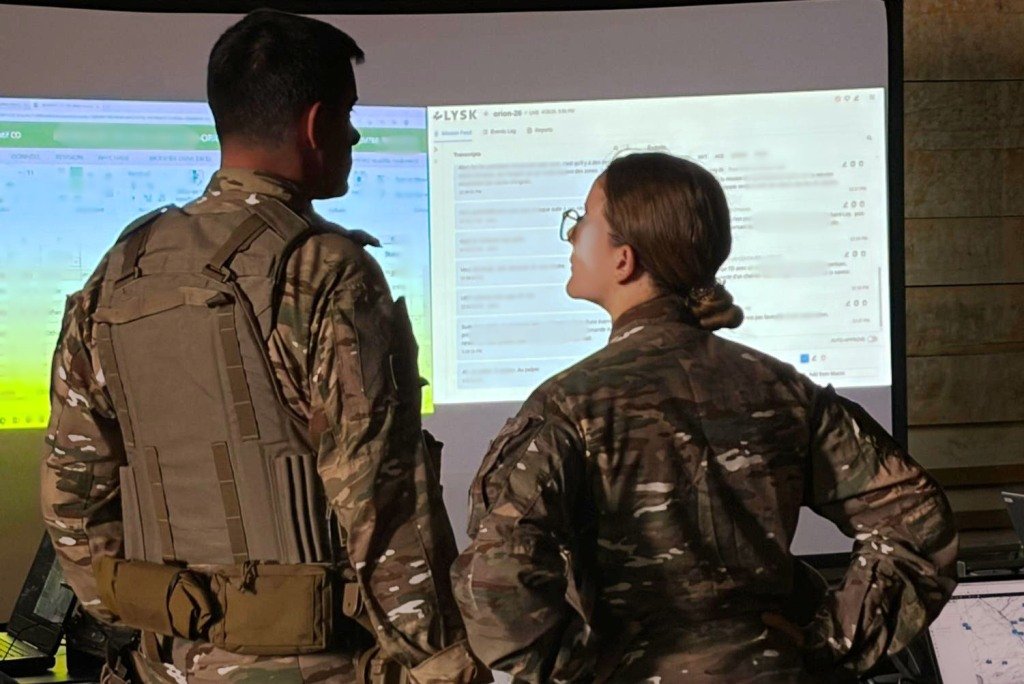
Keeping track of all communication and data that flow through a command post, improving reliability, and allowing to shorten the decision loop, this is the aim of Lore, the software developed and recently tested by Lysk, a startup with less than one-year existence
Lysk was created in 2025 by a French, a German, and a Polish, one with military and diplomatic background, the other two with business and technical experience. Since inception they aimed at concentrating on software only and finding areas that were mission-critical and that had not been dealt with by anybody else.
One of the first evidence was that many processes which in civilian life are fully automated, tend to be still done by humans in the military world. A critical element in the decision-making rooms is how to keep track of all what is said, all radio communications, all data exchanged. In the civilian world this is done automatically by evolved software that exploits the computing capacity of scores of high-performance CPUs supporting cloud-based services. In the military you have somebody, who often also has other tasks to perform, who takes notes manually, frequently working on 12-hour shifts; stress, noise, other tasks, makes the transcript inaccurate, and when the decision maker asks to review it, he is usually listening at multiple sources at the same time, then problems start. And when a real problem appears causing a crisis, things get even worst.
Once identified this problem, the Lysk team decided to solve it. Work started in September 2025. Obviously, a number of hurdles had to be overcome; in the military security of information is a priority, as well as sovereignty, so automatic transcript on an iPhone is something different from a tactical voice AI-based solution. Lysk co-founders also identified a cultural problem, a sort of “language barrier” between scientists and technicians and military operatives. Some requirements are totally unrealistic, typically asking software-based performances that are impossible to be obtained on the proposed hardware. Another difference was identified between peacetime and wartime constraints; in the Alliance all must be NATO compliant, but will this remain in wartime, when some constraints will become an obstacle to effective operations? Ukraine is proving that many pre-war constraints were abandoned in the name of efficiency.
Huge differences can be found between the United States and Europe in terms of software and hardware security standards; the US Department of War “Impact Level” framework does not exist in Europe, so software and hardware developers lack appropriate guidelines, the Old Continent lacking a regulatory framework.
Knowing well all those issues, Lysk started working on the transcript problem. Today the main screen is usually split in two, on one side the map showing the common operational picture provided by the Battle management system (BMS), and on the other the spreadsheet, the log, produced be the man-made script. To which we must add information coming by mail, instant messaging, and other means. In the end the log does not keep track of the information and is used only for compliance.
Being able to get all information at the same time, the same place and live, would allow to use them for situational awareness, for updating logistic data and for solving many other issues. Doing things by hand increases the risk of mistakes and needs manpower, Ukraine showing for that command posts are becoming smaller with less personnel to reduce risks, manpower becoming therefore an even greater issue.
To automate the process generating a useful tool needs a deep knowledge of how which are the key data, how forms such as call-for-fire or nine-liner are structured, which are radio procedures, and so on. Once all this has been structured, then artificial intelligence (AI) can be used to generate the end state product.
In late 2025 and early 2026 the Lysk team deployed several times on the field with the French Army to acquire all information needed to, overcoming initial scepticism towards a previously unknown company. This led to a first product demonstrator that was used in a Brigade level command post during Exercise Orion 2026, which allowed to assess the initial work done. The experiment proved positive, the new tool being considered useful by the military, Orion becoming the starting point for further developments. The system works on two levels, on one side all the rough materiel is transcribed, something key for compliance, on the other AI synthetizes data generating actionable information. It took one week for the Lysk team to get on top of all issues and make the system working smoothly, for example adding audio data coming from the PR4G tactical network, the product being then used profitably during the second week of Orion. Lysk also carried out experiments with other customers, and one of the key performance indicators is that the company software allowed to shorten the decision loop, something if great importance in war scenarios were anticipating the enemy has become something of paramount importance.
The software developed by Lysk is named Lore. It can be run potentially in any command post as he is BMS and Command-and-Control (C2) systems agnostic, the aim is having it capable to process data coming from any source, any type of radio, etc. Based on all information received and analysed, Lore can generate messages and send relevant ones to the BMS, these being tagged as automatically generated.
Of course, digesting all information and processing them requires considerable computing power, therefore Lysk plugged a high-performance server into the command post network, where Lore performed its tasks. Exercise Orion 2026 constituted a sort of validation for the initial product, which is now considered TRL 7. Lysk will unveil its product at Eurosatory next week.
Photos courtesy Lysk
