

The United States Army spent the last two decades optimizing sustainment for permissive environments defined by uncontested supply lines, contractor support, and static forward operating bases. As the National Defense Strategy shifts toward strategic competition and multidomain operations, however, this efficiency-driven model has become a liability. In large-scale combat operations, victory will depend less on which force fields the most advanced weapons and more on which can sustain combat power under persistent attack. A lethal maneuver force without a survivable logistical backbone is simply a stationary target waiting to culminate.
The Weight of History: Lessons in Logistical Overreach
History provides stark, recurring warnings against neglecting the sustainment tail in favor of the combat teeth. A prime example is found in Operation Barbarossa, the German invasion of the Soviet Union in 1941. German mechanized formations shattered Soviet defenses and advanced hundreds of miles within weeks. Yet they rapidly outran their logistics network.
The German high command had planned for a short, decisive campaign. It failed to account for the immense distances, the lack of paved roads, and the mismatch in railway gauges that prevented German trains from utilizing Soviet rail lines without extensive modification. Despite unprecedented initial battlefield successes, the campaign inevitably faltered. Fuel, ammunition, winter clothing, and replacement parts failed to keep pace with the advancing Panzer groups.
The famous halt before Moscow in the winter of 1941 was not primarily a tactical defeat inflicted by the Red Army; it was a systemic failure in sustainment. The Wehrmacht’s operational brilliance was entirely nullified by its lack of strategic endurance. The lesson here is clear: Operational reach is strictly dictated by logistical and sustainment capacity. Modern armies, fixated on the speed and lethality of their own mechanized and aviation assets, risk repeating this exact error if they assume that supply will keep pace with the maneuver force.
Furthermore, the Army must unlearn the logistical lessons from Operations Desert Storm and Iraqi Freedom. In 1991, the US military spent six months building massive “iron mountains” of supplies in Saudi Arabia, completely unhindered by Iraqi interdiction. In 2003, while supply lines were stretched, US forces still enjoyed absolute air supremacy and electromagnetic dominance. In a future peer conflict, the US Army will not be granted a six-month, uncontested build-up phase, nor will it operate under friendly skies.
The Crucible of Ukraine: The Transparent Battlefield
If history provides the theory, the ongoing war in Ukraine offers a brutal contemporary lesson: Modern armies collapse when they run out of logistics, not when they run out of weapons. Pervasive sensing, precision fires, and inexpensive drone systems have effectively eliminated the traditional rear area. Sustainment nodes, convoys, and distribution routes are now persistently exposed to detection and attack, making survivability and dispersion prerequisites for operational endurance.
During the opening phase of the invasion, the forty-mile-long Russian convoy that stalled north of Kyiv in February 2022 demonstrated how fuel shortages, maintenance failures, and interdicted movement corridors can immobilize operational maneuver. Ukrainian forces bypassed armored spearheads to strike vulnerable fuel and support convoys, exposing the mechanized formations’ dependence on uninterrupted sustainment. Multiple Russian formations stalled not because they were tactically defeated, but because their logistical support collapsed.
As the conflict evolved into a war of attrition, the vulnerability of centralized logistics became even more pronounced. Long-range precision fires, particularly HIMARS, enabled Ukraine to systematically target Russian ammunition depots and rail hubs deep behind the front. Russia’s subsequent displacement of logistical nodes farther from the battlefield degraded both the speed and volume of artillery resupply, demonstrating how attacks on sustainment architecture can directly reduce combat effectiveness at the point of contact.
Core Vulnerabilities: Moving Bulk Class III and Class V at Scale
To understand the scope of the problem, one must examine the staggering consumption rates inherent to large-scale combat operations. The two most critical vulnerabilities in the current US Army sustainment architecture are the diminished capacity to move bulk Class III (fuel) and Class V (ammunition) at scale, and the overreliance on centralized, easily targetable infrastructure.
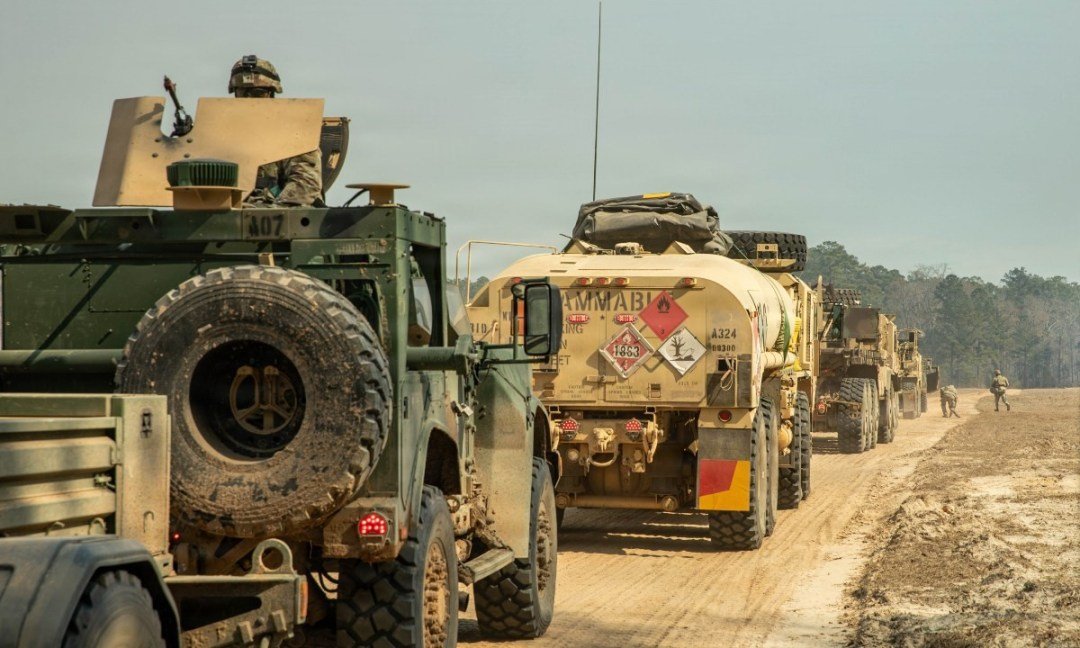
This is particularly apparent in the organic sustainment architecture of an armored brigade combat team, which consumes tens of thousands of gallons of fuel daily during high-intensity combat. Moving this volume of fuel from the division support area through the brigade support area and forward to the combat trains command post requires a massive fleet of heavy tactical vehicles. Current fuel distribution platforms remain large, lightly protected, and readily detectable by their thermal and electromagnetic signatures, while maintenance shortfalls and inconsistent operational readiness reduce available distribution capacity. The current distribution system lacks the physical resilience and protection needed to withstand the relentless deep-strike attacks expected from a peer adversary.
Similarly, the ammunition expenditure rates observed in Ukraine should alarm every Army planner. Wars between industrial powers are fundamentally contests of industrial capacity. Artillery, air defense interceptors, and precision-guided munitions are being consumed at rates not seen since World War II. The US military’s current stockpile depth, combined with the difficulty of transporting extremely heavy 155-millimeter artillery shells and guided multiple-launch rocket system pods across contested oceans and degraded theater road networks, poses a critical threat to combat endurance. Without the ability to continuously and securely resupply the front, even the most technologically advanced combat formations will rapidly culminate, rendering their tactical overmatch irrelevant.
Adapting the Architecture: From Static Nodes to Agile Networks
Large brigade support areas optimized for counterinsurgency-era efficiency have become liabilities in large-scale combat operations. Concentrated personnel, vehicles, and materiel create lucrative targets for adversaries equipped with persistent surveillance and long-range precision strike systems.
To survive in contested environments, the Army must transition from a centralized hub-and-spoke sustainment model to a decentralized network of smaller, dispersed, mobile, and signature-managed nodes. Sustainment elements must be capable of relocating with the same frequency as maneuver battalion tactical operations centers, while distributed caching of fuel, water, and ammunition across concealed locations should replace the current reliance on large, centralized supply dumps.
This transformation must be paired with deliberate investment in camouflage, concealment, and deception tailored to sustainment operations. Multispectral signature reduction, disciplined electromagnetic management, and strict emissions control are no longer optional enhancements but operational necessities. Sustainment forces must be trained to operate in GPS-denied environments where poor signature management invites rapid detection, targeting, and interdiction.
Arming the Sustainers: Survivability and Organic Protection
On a nonlinear battlefield, sustainment forces can no longer depend on maneuver units for protection and must possess organic defensive capabilities. Brigade support battalions and combat sustainment support battalions require embedded counter–unmanned aircraft systems and short-range air defense assets capable of defeating aerial threats at the point of attack.
Additionally, the Army must reinvest in up-armoring its logistical fleet. While adding armor reduces payload capacity and increases fuel consumption, violating the peacetime gospel of efficiency, it is a mandatory trade-off for survival. We must also accelerate the development and fielding of autonomous and semiautonomous resupply platforms. Unmanned ground vehicles and heavy-lift cargo drones can take over the most dangerous last mile resupply missions, moving critical Class III and V to the absolute edge of the forward line of troops without risking human lives in highly contested kill zones.
The Cultural Imperative: Elevating the Sustainment Enterprise
Ultimately, the failure to modernize the tactical sustainment enterprise is not just a procurement issue; it is a cultural failure within the Army. Army modernization culture continues to privilege investments in maneuver and fires over sustainment and resilience, prioritizing advanced firepower, next-generation combat vehicles, and deep-strike capabilities. In contrast, sustainment remains an institutional afterthought, often relegated to the background of operational planning and budget allocation.
The notion that amateurs talk tactics and professionals talk logistics is frequently discussed in military academies and war colleges, yet it is rarely reflected in the Army’s budget requests or modernization priorities. The outdated concept of the tooth-to-tail ratio, which implies the logistical tail is a bureaucratic waste that must be minimized to support the combat teeth, must be fundamentally reexamined. In modern warfare, the tail is the primary target. If the tail is severed, the teeth are rendered useless.
If the Army is serious about preparing for peer conflict, it must elevate sustainment to a primary warfighting function. This means granting it the same level of intellectual investment, protective prioritization, and institutional prestige as maneuver and fires. At combat training centers, rotational units must face significant logistical challenges. Umpires should regularly disable undefended base support areas and compel brigade commanders to operate without fuel or artillery ammunition. Such conditions would force commanders to innovate under contested sustainment conditions rather than operate with artificially uninterrupted supply lines.
The US Army cannot rely on software, predictive maintenance algorithms, or artificial intelligence to solve the brutal, physical challenges of industrial warfare. While data analytics can optimize a supply chain, they cannot armor a fuel truck, shoot down a loitering munition, or physically transport 155-millimeter shells through a barrage of precision fires.
The Army’s success in future conflict will not be determined by whose tanks have the thickest armor or whose missiles have the longest range. It will be determined by whose sustainment enterprise can survive, adapt, and function under persistent, brutal, and multidomain attack. Wars between massive industrial powers are fundamentally contests of endurance. Right now, the Army risks entering that contest with a logistical backbone built entirely for peacetime efficiency, not wartime survival. This is no longer just a modernization gap; it is a glaring strategic vulnerability that demands immediate, decisive, and well-funded action. The Army’s future success will not be determined solely by superior platforms or longer-range fires, but by whether its sustainment enterprise can endure under persistent attack. Without reorienting modernization toward survivability, dispersion, and endurance, the Army risks fielding a force optimized for tactical excellence yet vulnerable to operational culmination. In the next war, logistics will not merely enable victory; it will determine it. The Army risks fielding a force optimized for tactical excellence but not for sustained operational momentum.
Major Jonathan Buckland currently serves in the J33 on the Joint Staff. His previous assignments include serving as the executive officer of 5th Squadron, 7th Cavalry Regiment, 1st Armored Brigade Combat Team (ABCT), 3rd Infantry Division; operations officer for 3rd Battalion, 69th Armor Regiment, 1/3 ABCT; and future operations chief for 3rd Infantry Division. He has a bachelor’s degree in English from the Virginia Military Institute, a master’s degree in international studies from the University of Kansas, and a master’s in operational studies from the Army Command and General Staff College.
The views expressed are those of the author and do not reflect the official position of the United States Military Academy, Department of the Army, or Department of Defense.
Image credit: Spc. Rebeca Soria, US Army
