

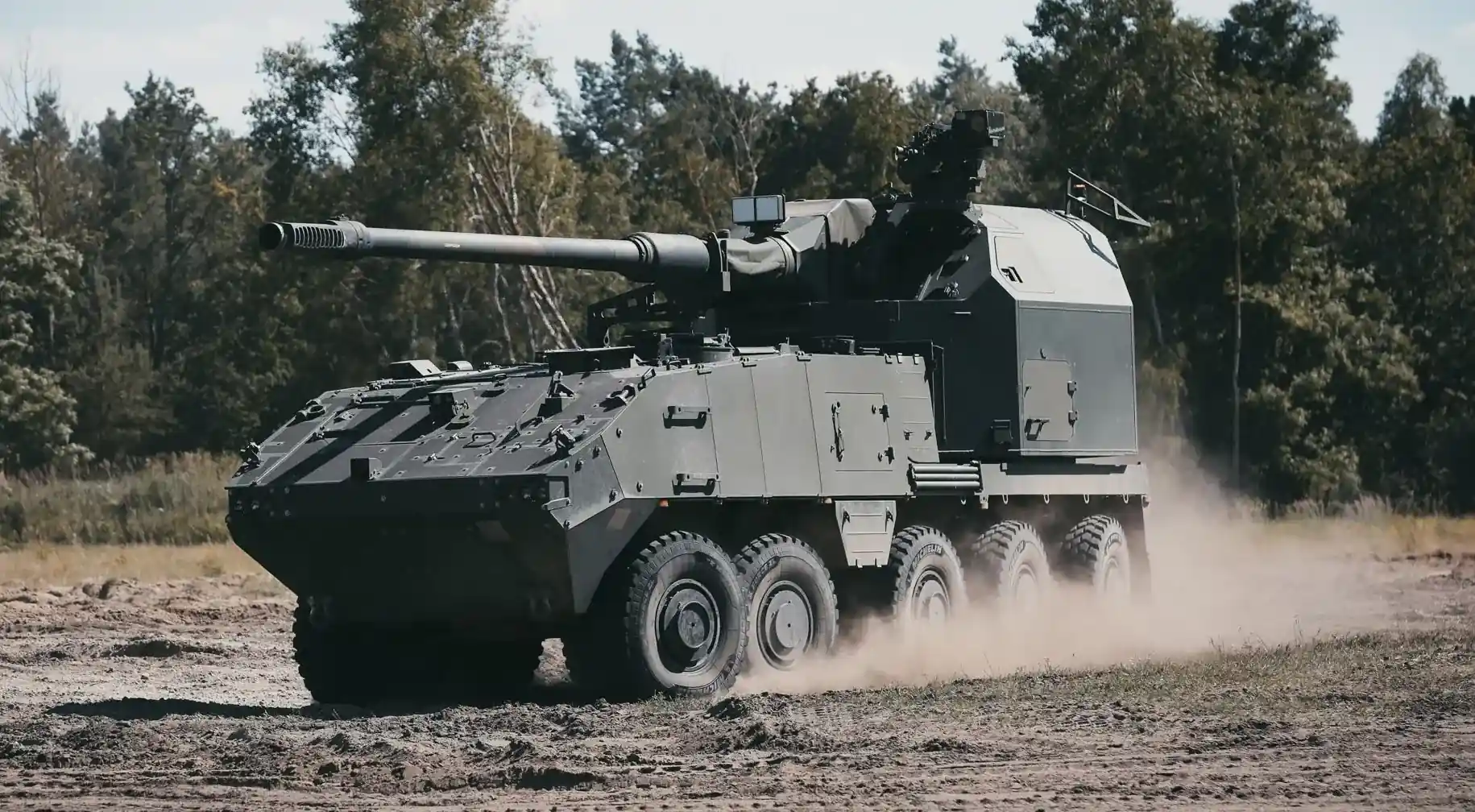
Defense Feeds – Madrid. The NATO Gains New Wheeled Howitzer With Piranha 10×10 Platform development highlights Europe’s ongoing push to strengthen long-range firepower as defense manufacturers race to deliver more mobile and survivable artillery systems for future battlefield operations.
Defense companies General Dynamics European Land Systems (GDELS) and KNDS have joined forces to integrate the AGM 155mm artillery module onto the Piranha Heavy Mission Carrier 10×10 platform, creating a new wheeled self-propelled howitzer designed to meet the evolving needs of NATO armed forces.
The system combines the firepower of advanced artillery with the mobility and flexibility of a modern armored vehicle, offering military planners a new option for long-range precision fires.
The unveiling comes at a time when artillery has once again become one of the most decisive weapons on the battlefield. The war in Ukraine has demonstrated the importance of rapid-fire capability, mobility and survivability, driving renewed investment in next-generation artillery systems across Europe and North America.
Military analysts believe the new platform could attract significant interest from NATO countries seeking to modernize aging artillery fleets while improving strategic mobility and deployment flexibility.
Piranha 10×10 and AGM Turret Create New Artillery Capability
At the heart of the new system is the combination of two proven technologies. The Piranha Heavy Mission Carrier 10×10 provides a highly mobile wheeled chassis capable of supporting heavy mission payloads, while the AGM artillery module delivers advanced 155mm firepower through an automated turret system.
The AGM, short for Artillery Gun Module, was developed by KNDS as a highly automated solution designed to reduce crew workload while maintaining high rates of fire. The turret can operate with a smaller crew compared to many traditional self-propelled artillery systems, improving operational efficiency and battlefield survivability.
By mounting the AGM on the Piranha platform, the partners aim to create a system capable of deploying rapidly across large operational areas while retaining the firepower expected from modern NATO artillery.
Wheeled artillery systems have become increasingly popular among military planners because they generally offer lower operating costs and greater road mobility than tracked alternatives. This makes them particularly attractive for rapid-reaction forces and expeditionary deployments where strategic transportability is a key requirement.
Defense experts note that modern artillery units must be able to shoot and relocate quickly to avoid detection by enemy drones, counterbattery radars and precision-guided munitions. The mobility provided by the Piranha chassis directly supports that operational requirement.

NATO Modernization Drives Demand for Mobile Firepower
The launch of the new artillery platform reflects broader trends shaping military procurement across NATO.
Since the outbreak of the war in Ukraine, alliance members have accelerated investments in artillery, ammunition production and long-range strike capabilities. Battlefield experience has demonstrated that artillery remains one of the most important tools for shaping combat operations, despite advances in drones and precision-guided weapons.
Countries throughout Europe are now seeking systems capable of delivering sustained fire support while remaining mobile enough to survive on increasingly transparent battlefields. Advanced surveillance drones and satellite imagery have made it more difficult for artillery units to remain hidden after firing.
As a result, mobility has become just as important as firepower.
The combination of the Piranha 10×10 and AGM turret appears designed specifically with these challenges in mind. The platform offers the ability to move rapidly between firing positions while maintaining compatibility with NATO-standard 155mm ammunition.
Military observers also note that the growing shift toward wheeled artillery reflects changing operational priorities. Compared with heavier tracked systems, wheeled platforms can often travel longer distances on roads without requiring extensive logistical support, making them attractive for both homeland defense and expeditionary operations.
The new howitzer may therefore appeal to NATO members seeking a balance between strategic mobility and battlefield effectiveness.
Future Artillery Systems Focus on Speed and Survivability
Modern artillery warfare is undergoing a major transformation driven by advances in reconnaissance, targeting and precision strike technologies.
The widespread use of drones in Ukraine has shown that artillery units face constant surveillance threats. Once a firing position is identified, counterbattery strikes can arrive within minutes or even seconds. This reality is forcing militaries to prioritize systems capable of rapid deployment, fast firing sequences and immediate relocation.
Automated artillery modules such as the AGM are increasingly viewed as a solution to these challenges. By reducing crew requirements and streamlining firing operations, they help improve responsiveness while lowering operational risk.
At the same time, NATO nations continue seeking greater interoperability across alliance forces. Platforms that use standardized ammunition and compatible logistics systems offer significant advantages during multinational operations.
The partnership between GDELS and KNDS reflects Europe’s broader effort to strengthen defense-industrial cooperation while delivering advanced capabilities tailored to alliance requirements.
As military modernization accelerates across the continent, the new Piranha 10×10-based howitzer demonstrates how mobility, automation and long-range firepower are becoming central pillars of future artillery doctrine. For NATO forces preparing for increasingly contested battlefields, such systems could play a critical role in maintaining operational advantage and battlefield effectiveness.
