

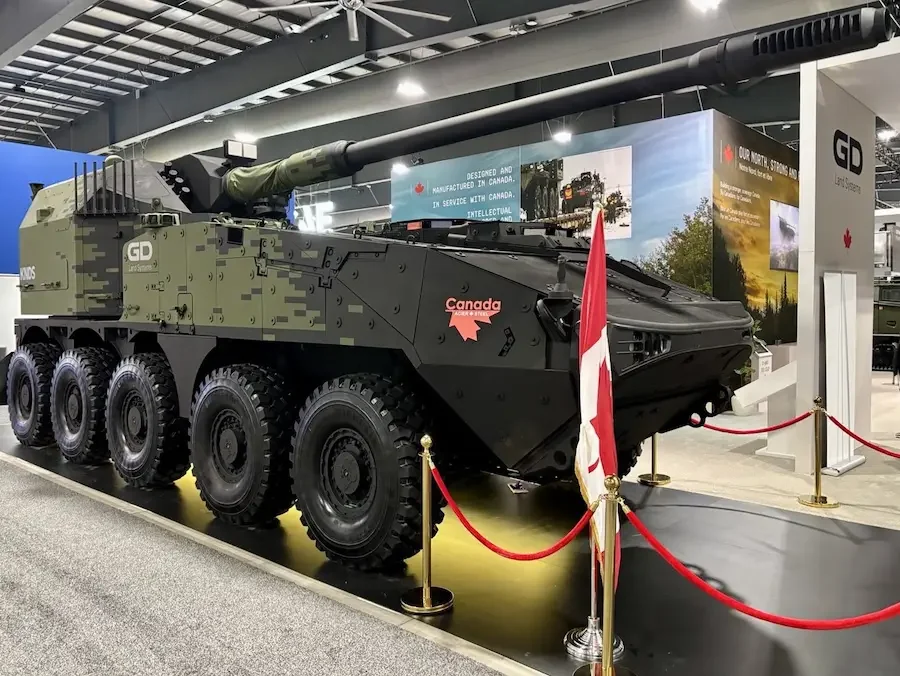
Defense Feeds – Ottawa. The Canada Unveils Grizzly 10×10 Self-Propelled Howitzer showcase at CANSEC 2026 highlights the growing demand for highly mobile artillery systems as militaries worldwide seek greater firepower, survivability and rapid deployment capability for future battlefield operations.
The Grizzly self-propelled howitzer combines a 155mm artillery system with a 10×10 wheeled armored platform, creating a modern artillery solution designed to meet the needs of contemporary military forces. Revealed during Canada’s largest defense and security exhibition, the platform reflects broader trends in military modernization where mobility and precision fire support are becoming increasingly important.
As conflicts such as the war in Ukraine continue reshaping military doctrine, armed forces are placing renewed emphasis on long-range artillery capable of delivering effective fire support while avoiding enemy detection. The Grizzly concept aims to address those requirements through a combination of advanced firepower, operational flexibility and enhanced battlefield mobility.
Defense analysts believe wheeled artillery platforms like the Grizzly are likely to attract growing interest as countries seek alternatives to heavier tracked systems that can be more expensive to operate and deploy.
Grizzly Combines Heavy Firepower With Strategic Mobility
At the center of the Grizzly platform is a NATO-standard 155mm artillery system mounted on a robust 10×10 wheeled chassis. The design seeks to balance firepower with mobility, allowing military units to reposition quickly after firing missions while maintaining the ability to support frontline operations.
Modern artillery units face increasing pressure to avoid detection from drones, satellites and counterbattery radar systems. As a result, the ability to rapidly relocate after engaging targets has become one of the most important characteristics of any new artillery platform.
The Grizzly’s wheeled configuration offers several advantages in this environment. Compared to traditional tracked self-propelled guns, wheeled vehicles generally provide higher road speeds, reduced maintenance requirements and improved strategic deployability.
Military planners increasingly favor systems capable of moving long distances without requiring specialized transport assets. This flexibility allows artillery formations to respond faster to changing operational conditions while reducing logistical burdens.
The platform was presented as a solution capable of supporting both national defense requirements and expeditionary operations. Such versatility is becoming increasingly important as NATO members prepare for a broader range of operational scenarios.
Industry observers also note that the growing popularity of wheeled artillery reflects wider changes in military doctrine emphasizing speed, flexibility and dispersed battlefield operations.

Modern Conflicts Reinforce Importance of Artillery
The resurgence of artillery as a decisive battlefield weapon has become one of the clearest lessons from recent conflicts.
In Ukraine, both sides have relied heavily on artillery to shape battlefield conditions, destroy defensive positions and support maneuver operations. The conflict has demonstrated that despite advances in drones and precision-guided weapons, artillery remains a cornerstone of modern warfare.
However, the nature of artillery employment is evolving rapidly. Systems must now operate in environments where surveillance drones continuously monitor the battlefield and where firing positions can be identified within minutes.
This reality has accelerated demand for self-propelled artillery systems capable of conducting rapid “shoot-and-scoot” operations. The concept involves firing missions followed by immediate movement to a new location before enemy forces can respond.
The Grizzly appears designed around this operational requirement. Its wheeled platform provides mobility while its artillery system delivers the firepower necessary to engage targets at significant distances.
Defense experts argue that future artillery systems must balance range, accuracy and survivability. Platforms unable to relocate quickly risk becoming vulnerable to counterbattery fire, loitering munitions and drone-directed attacks.
As a result, mobility is increasingly viewed as a form of protection alongside traditional armor and defensive systems.
NATO Militaries Seek Next-Generation Fire Support Platforms
The unveiling of the Grizzly at CANSEC 2026 comes amid a broader wave of artillery modernization across NATO countries.
Alliance members are investing heavily in long-range fires, ammunition production and advanced artillery technologies as they adapt to a more demanding security environment. Many armed forces are replacing aging Cold War-era systems with modern platforms capable of operating in highly contested battlespaces.
The emphasis on interoperability is also shaping procurement decisions. NATO-standard 155mm artillery systems remain particularly attractive because they simplify logistics and enable greater cooperation during multinational operations.
Canada’s defense industry continues positioning itself within this evolving market by developing solutions aligned with alliance requirements and emerging battlefield trends. The Grizzly represents part of that effort, offering a platform that combines mobility, firepower and operational flexibility.
Military analysts expect demand for wheeled self-propelled howitzers to remain strong throughout the coming decade as countries seek to improve readiness and strengthen deterrence capabilities.
For defense planners, systems like the Grizzly illustrate how artillery is adapting to the realities of modern warfare. Speed, mobility and survivability are becoming just as important as raw firepower, and future battlefield success will likely depend on the ability to combine all three effectively. The Grizzly’s debut at CANSEC 2026 demonstrates how manufacturers are responding to those evolving operational demands.
