

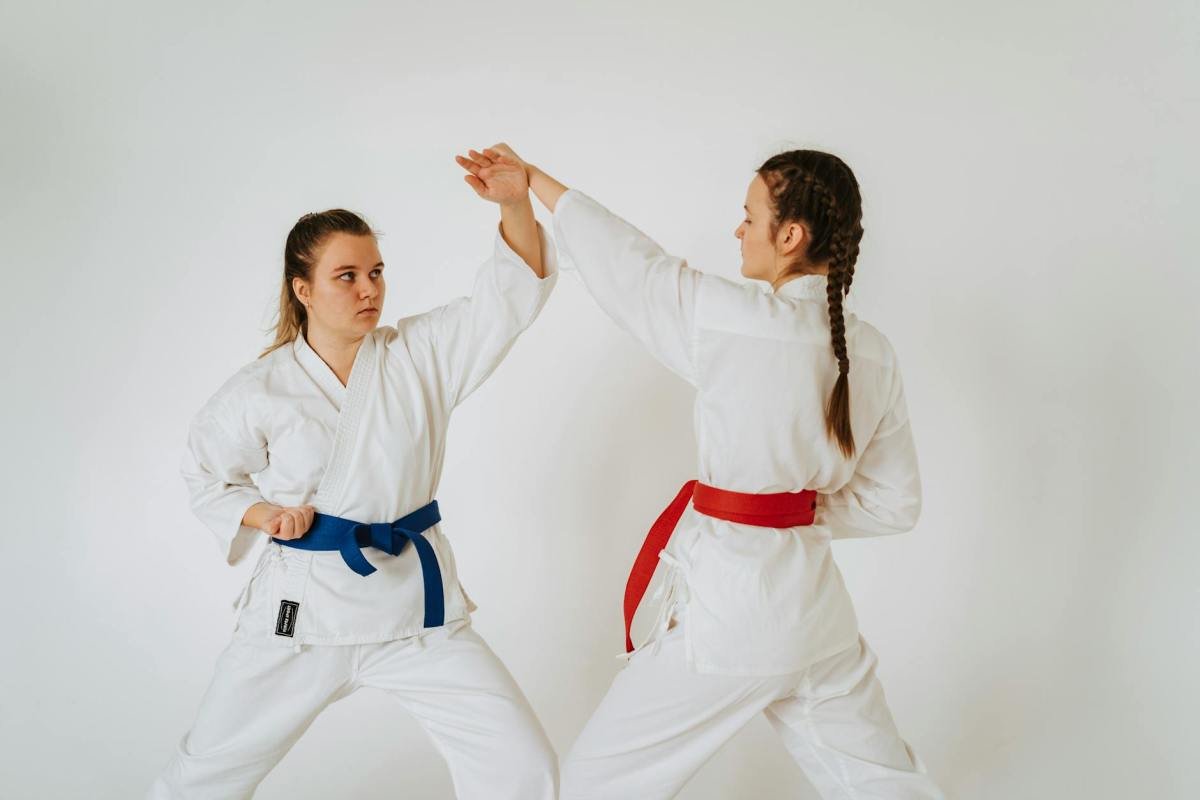
Karate kata are most often encountered as sequences to memorize, forms to perform, and milestones to pass on the way to higher rank. In many dojos, they are treated as objects: fixed arrangements of movement whose value lies in faithful reproduction, technical sharpness, or aesthetic precision. Students learn them as lists, instructors teach them as requirements, and practitioners often carry them as collections, each kata another item acquired along the path.
Yet this surface understanding fails to explain why kata have endured across generations, cultures, and stylistic divisions. It does not account for why forms with disputed origins, ambiguous applications, or apparently impractical movements continue to shape effective martial artists. Nor does it explain why practitioners from different styles, trained in different kata, often converge toward similar qualities of movement, presence, and adaptability at higher levels.
Beneath the choreography lies a deeper architecture. Kata are not primarily sequences to be remembered but developmental processes, living training instruments designed to act upon the practitioner over time. Their purpose is not the preservation of techniques but the deliberate shaping of the human body and nervous system, guiding the practitioner from rigid external form toward internalized, adaptive freedom.
Seen in this way, kata are not valued for their surface arrangements but for what they reliably produce through sustained practice. They build structure in the body, refine perception through relationship, and ultimately cultivate freedom of action. Rather than fixed objects to be collected, kata must be understood as processes that shape the practitioner over time.
This taxonomy organizes kata across major karate systems – Gōjū-ryū, Uechi-ryū, Shōrin-ryū, Shotokan, Isshin-ryū, and Kyokushin –according to the principles they cultivate, the secondary qualities they sharpen, and the strategic themes they embody at beginning, intermediate, and advanced stages. Rather than listing kata by style or historical lineage, it arranges them by what they teach the practitioner at each stage of growth.
Each system encodes the same developmental journey using different emphases, metaphors, and movement vocabularies. The purpose of this framework is not to collapse stylistic differences but to make their shared logic visible. By focusing on function rather than lineage, the taxonomy provides a way to recognize common developmental principles across karate systems without erasing their distinct identities.
This framework is offered not as a replacement for tradition, but as a lens through which it can be understood more clearly. It is intended for instructors seeking language to explain why kata matter beyond memorization, for practitioners looking to contextualize their training as a coherent developmental process, and for cross-style readers searching for common ground grounded in principle rather than appearance.
Viewed through this lens, the journey of karate becomes clear:
First learn the structure.
Then understand the principles within the structure.
Finally, let the structure dissolve so only principles remain.
What remains to be explained is how this progression is produced in practice: how kata act upon the practitioner to generate these transformations over time.
Kata persist not because they catalogue fighting techniques, but because they reliably produce transformation. Their effectiveness does not depend on whether a given movement corresponds neatly to a modern self-defense scenario. Instead, their value lies in how sustained practice reorganizes posture, coordination, breath, timing, and perception.
Kata operate primarily below conscious thought. They are not designed to teach the practitioner what to do but to change how the body behaves under stress. Through repetition within carefully constrained movement environments, kata progressively retrain how the nervous system responds to threat, reducing perceptual narrowing, stabilizing posture and breath, and allowing awareness to expand rather than fragment under pressure. Alignment, balance recovery, force transmission, and tension regulation are conditioned until they become reflexive rather than deliberate.
This is why kata remain meaningful even when surface interpretations vary. Different instructors may teach different applications, yet the deeper adaptations continue to occur. Kata work because they shape default responses rather than conscious decision-making.
Seen in this way, kata are not relics of the past but developmental technologies refined through generations to produce specific outcomes in the human organism.
Beginning Level
Ingest the Form. Establish Structure, Power, and Stability Before Function ·
At the beginning level, karate kata across all systems converge on a single task: to construct the physical architecture required for principles to later inhabit. Movements are deliberately simple and externally defined, not because combat is simple, but because the body and nervous system must first be organized before they can adapt.
A. Core Principles
- Structure & Line Work: Direct strikes, clean blocks, straight-line power, and foundational stances.
- Rooting & Center Stability: Lower-body anchoring, aligned spine, and pressure absorption.
- Simple Timing & Rhythm: One-count or two-count execution and consistency before complexity.
- Linear Power Generation: Hip–shoulder coordination, linear force, and foundational body mechanics.
- Directional Awareness: Turning mechanics, basic multi-directional readiness.
B. Secondary Qualities
- Patience, repetition tolerance
- External focus (follow exactly as taught)
- Clear posture, simple breathing
- Precision and deliberate movement
- Mental quieting: “just do the kata”
C. Strategic Themes
- Form before function
- Accuracy before interpretation
- Posture before speed
- Stability before adaptability
Thesis: Stand firm. Move clearly. Obey the form so the form can shape you.
Intermediate Level
Principles Begin to Reveal Themselves. Adapt Form Through Relationship
At the intermediate level, kata begin to show the opponent(s) embedded within the form. Movements become relational rather than isolated, and variation emerges not through invention but through insight. The practitioner no longer merely performs kata but begins to perceive timing, angle, and pressure within it.
A. Core Principles
- Dynamic Transfer & Body Shifting: Angled steps, weight drops, rising/falling motion, and evasive lines.
- Close-Range Mechanics: Trapping, tactile sensitivity, grappling pressure, and forearm engagement.
- Circularity & Redirection: Soft–hard interplay, circular mechanics, and kata intricacy.
- Complex Rhythm Changes: Stop–start, compress–release, and slow–fast patterns.
- Rotational Power & Angular Force: Applied torque, diagonal movement, and pivoting attacks/defenses.
B. Secondary Qualities
- Curiosity—investigative mindset
- Sensitivity to pressure, timing, and angle
- Internal guidance emerging; less dependence on teacher correction
- Multi-directional perception
- Emerging “shadow opponent” perception
- Adaptation and responsiveness under stress
C. Strategic Themes
- Application drills illuminate hidden principles and functions.
- Variations arise from insight, not creativity for its own sake.
- Movements become relational, not isolated.
- Kata begins to “respond” in the practitioner’s mind.
Thesis: Look through the form. Discover the principles. Perceive the opponent(s) inside the form.
Advanced Level
Embody principles. Move beyond dependence on form.
At the advanced level, kata complete their work by dissolving. Techniques are no longer consulted, rhythm becomes fluid and unpredictable, and distinctions between attack and defense collapse. Movement arises directly from embodied principles rather than from remembered sequences.
A. Core Principles
- Soft–Hard Integration at Will: Seamless switching of force types, controlled tension/relaxation cycles, and breath–power unity.
- Unpredictable Rhythm & Subtle Timing: Deceptive cadence, micro-hesitations, and non-linear flow.
- Internal Vectors: Spirals, Waves, & Coiling Force: Whole-body spiraling, internal redirection, and whip-like fluidity.
- Spatial Mastery: Multi-attacker logic, range fluidity, vertical and horizontal-plane control, and long-short range integration.
- Moment-to-Moment Adaptability: Strategy shifts without conscious thought, and form dissolves into responsiveness.
B. Secondary Qualities
- No-mind, seamless intent
- Fluid creativity grounded in principle
- Ability to create or modify form responsibly
- Deep sensitivity to force, line, and timing
- Calm under complexity and unpredictability
C. Strategic Themes
- Technique collapses into understanding.
- Form becomes optional yet honored.
- Principles express themselves spontaneously.
- No distinction between attack/defense.
- No conscious application: only expression.
- Kata is absorbed and becomes formless understanding.
- Ri becomes the unseen foundation for the next Shu.
Thesis: Move from understanding. Let the principles act through you. Form is now within.
From Form to Freedom: The Journey of Kata
Across the karate systems examined, Gōjū-ryū, Uechi-ryū, Shōrin-ryū, Shotokan, Isshin-ryū, and Kyokushin, kata reveal themselves not as stylistic artifacts but as expressions of a shared developmental logic. Beneath differences in tempo, posture, and emphasis, the same underlying process is at work. Kata shape the practitioner in stages, first constructing the physical architecture required for force and stability, then refining perception through relationship, and finally dissolving into a freedom of action no longer dependent on prescribed form.
At the beginning of practice, kata establish structure. Stances align the skeleton, coordinated movement teaches the body to transmit force, and rhythm trains consistency before interpretation. These early forms are necessarily rigid, not because combat is rigid, but because the nervous system must first be organized before it can adapt. Structure is not the goal, but it is the prerequisite. Without it, principles have no medium through which to operate.
As practice deepens, kata begin to function differently. Movements no longer exist in isolation; they reveal opponents, angles, and pressures embedded within the form. Perception sharpens as the practitioner learns to read timing, line, and contact. At this stage, kata become relational. The form is no longer obeyed blindly, nor is it freely altered without understanding. Instead, principles emerge through interaction, and variation arises from insight rather than invention. Kata begin to respond, and the practitioner begins to listen.
At the advanced level, kata complete their work by dissolving themselves. Techniques no longer require conscious recall, rhythm becomes unpredictable, and distinctions between attack and defense dissolve. What remains is freedom, movement arising directly from principles, shaped by the moment rather than by memory. Form is neither rejected nor clung to; it has been absorbed. The practitioner is no longer performing kata but expressing the laws of movement that kata were designed to cultivate.
Seen in this way, kata across all karate systems form a single developmental continuum rather than a collection of isolated traditions. Each style speaks a different dialect, emphasizing certain qualities over others, yet all point toward the same nervous-system outcomes. When the principles are fully embodied, the practitioner returns to the beginning with new eyes. Structure is rebuilt, perception is refined, and freedom deepens not as a linear ascent but as a continuous cycle of integration.
Kata, then, are not relics of the past nor puzzles to be decoded. They are living curricula that construct, reveal, and ultimately dissolve themselves within the practitioner. When approached through principles rather than choreography, they show karate to be what it has always been: one art, spoken in many dialects, shaping structure, perception, and freedom through a shared human logic. In the end, only the essential laws of movement remain: form serves principles, and principles serve freedom.
Author
Michael Martin has been involved with the martial arts for more than six decades, beginning with the Japanese/Okinawan martial arts for fifteen years and then, for the past fifty years, with the Burmese martial arts and Muay Thai.
