

Terry Gerton Mike, I want to start with you. We’re talking about glacier flooding in Alaska. That doesn’t seem like a Corps of Engineers project to me, but what’s changed on the ground there in Alaska that has made this particular issue something the federal government and the Army Corps of Engineers thought they needed to step in and address?
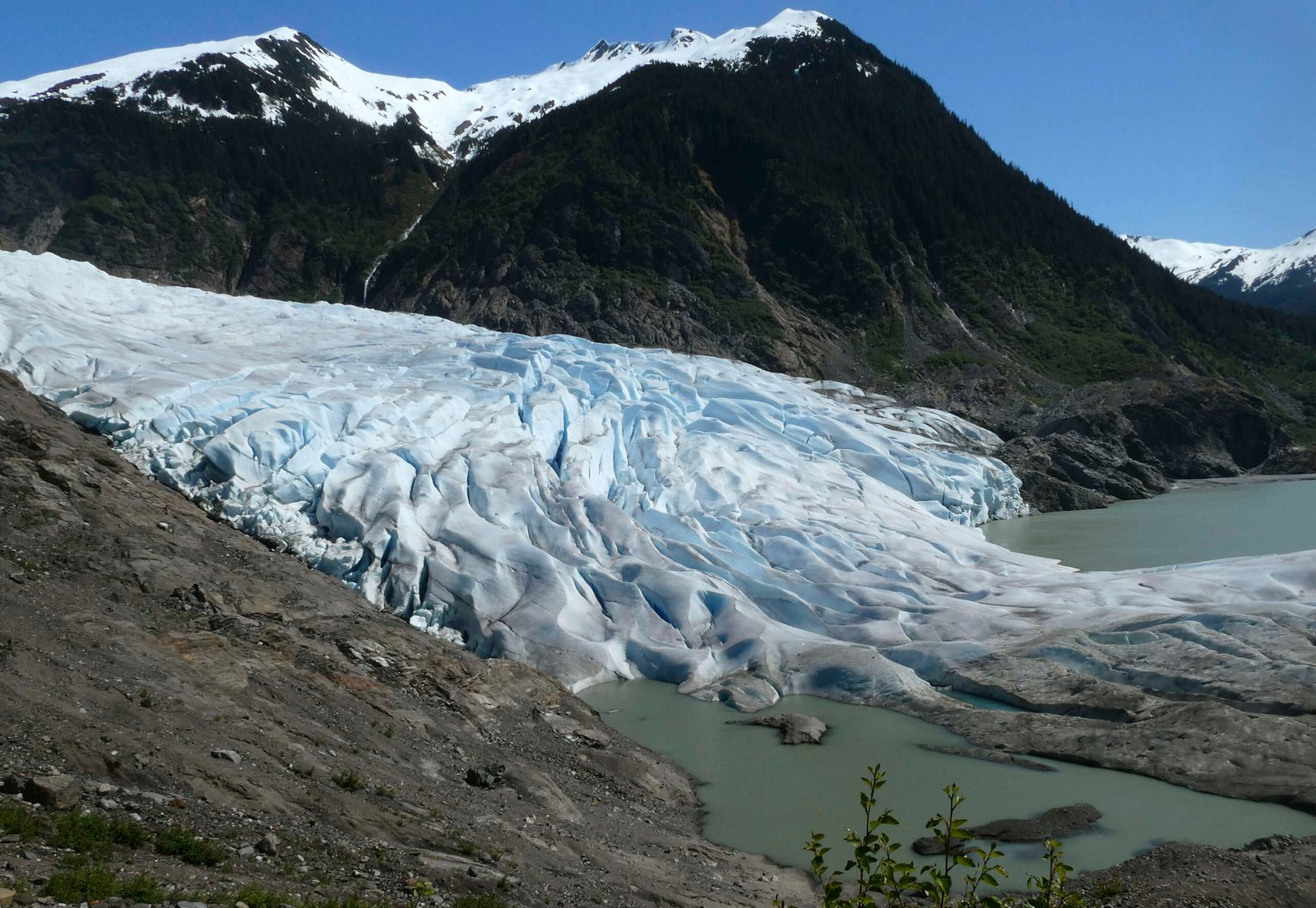
Mike Records Yeah, Terry, this is a really interesting, challenging and complex problem that is really something that the Army Corps is uniquely able to jump in and address. And I’ll just start by basically describing the problem here. So these are glacier-lake outburst floods, which we abbreviate as GLOF for short. And basically what’s going on here is the Mendenhall Glacier is changing, and it’s been changing since the end of the Little Ice Age. It’s been getting thinner and it has also been retreating. And as it’s been retreating, people have been building where it used to be. And I like to, you can think of a glacier, a glacier is a river. It’s a, it’s a river of ice, and much like a river or like a tree, it has branches. And these, as the glacier changes, these branches also change, these branches of ice that flow into the main stem into the trunk of the glacier. And so we have here is one of these tributary branch glaciers has actually retreated out of the valley that it was inhabited and it’s left behind this over deepened-basin that is now dammed by the main stem of the Mendenhall glacier. And that over-deepened basin fills with water and when it fills up completely, it then suddenly releases and produces a dramatic flood that looks a lot like a flash flood or a dam break flood in terms of its profile. It’s really sudden, rises really fast and retreats really fast. And it’s changing every year too because of the continued changes of the Mendenhall Glacier. And so just that, it’s just developed in the last 15 years. It’s gotten way more severe in the last few years. And we really, as an agency and with our partner agencies and the really unique skill set that we have in our centers of excellence and our ability to respond to emergencies. It’s a project that we’re really perfect for addressing in coordination with our sponsors and the other agencies here.
Terry Gerton Daryl, Mike just said that the glacier’s been changing since the [Little] Ice Age, although a little bit more dramatically recently. What is it about the current conditions today that make this kind of flooding even more dangerous than it’s been in the past?
Daryl Downing Well, yeah, thanks, Terry. So over the last few years, the water seems to be flowing out a lot quicker and there’s a lot more volume that’s coming out of the glacier, which is flowing down the river and coming out its banks. So under the Corps of Engineers Public Law 8499 program, we’re authorized to help prepare, respond and recover from specifically flood response or flooding issues that are impacting communities. So what we’ve been doing the last couple of years is kind of helping the City and Borough of Juneau prepare their flood response activities by providing a lot of flood fight materials. For example, temporary flood barriers, sandbags, super sacks, pumps. Over the course of the last year, the city in borough Juneau have been kind of ramping up efforts to protect a little bit more of the river upstream and downstream of key critical infrastructure and private properties. This year, the Corps was requested and is now implementing the construction of these temporary flood barriers to help mitigate these flooding impacts that have been getting worse over the last several years.
Terry Gerton Mike, Daryl is talking there about immediate flood response barriers and boundaries. When you think about the medium and long-term solutions to this, what do you see from a hydrological perspective?
Mike Records Yeah, I think it’s really important to highlight that what makes this situation kind of unique is, although flooding occurs all around our nation and the world, this sudden onset is unique here, sudden, severe, increasing onset. And that’s why it is important to have both this short term response and moving into more medium term and investigating long term responses. But so what we look at here for looking at long term is, we’re looking at other glacier-lake outburst flood systems in the region. And there are a couple other of these basins that have been having these outburst floods for decades. And so we see those as a possible analog to this newer system. And what those systems show is that there’s a lot of variability on the magnitude of the flooding. And so what we’re trying to do when we look at medium or long-term solutions is take that variability in flooding that we see in these analog glacier lake outburst systems and use that variability and magnitude of flooding to prepare for a medium-term solution that could be implemented before the 2027 season, and then potentially looking at a longer term solution that could be implemented over a longer period of years just because of the reality of constructing a large project like that.
Terry Gerton Mike Records is a hydraulic engineer with the U.S. Army Corps of Engineers in the Alaska District. Daryl Downing is the Mendenhall Project Manager with the U.S. Army Corps Of Engineers from the Seattle District. Daryl, let me come back to you. This glacier is in remote, difficult terrain. You’re up in Alaska. What are the biggest operational constraints you’re dealing with as you’re trying to provide both short and medium/long-term solutions here.
Daryl Downing So one of the biggest challenges that we’re facing is logistics, because currently the area that we are working in, all materials have to be either flown in or barged in. There’s no central roadway that brings us to the continental United States, so there’s a lot of additional planning requirements for both the corps and the City and Borough of Juneau to identify these materials that will be needed for implementation. Another factor that on the ground teams are dealing with is we’re working in people’s backyards. So this is something that is very disruptive to them. So we’re doing our best to construct something in somebody’s backyard with heavy equipment, lots of materials, and we’re doing our very best not to disrupt their lives any more than we have to because it’s only going to be more and more stressful as the annual flood comes to fruition. So, again, we do have people out there talking directly to landowners, to business owners, to make sure that they understand the importance of the work we’re doing. And then coordinating with the City and Borough of Juneau to make sure that the they are taking a holistic approach to what we are supplementing all their efforts with.
Mike Records Thanks, Terry. And I’ll also just add, even from a from a science perspective, the logistics are really challenging. Like you referenced, it’s in Alaska. It’s in the mountains of Alaska. It’s on a glacier in Alaska, and so a lot of the traditional techniques that scientists use for understanding and monitoring flood problems are particularly tricky here. To get up to this glacier outburst basin. You need a helicopter flight to get up there. The weather is really severe. It’s really challenging using traditional monitoring equipment there. The monitoring equipment struggles in severe weather. The glacier is really dynamic. The glacier’s changing. The icebergs that calve off the glacier into this basin actually break off the equipment every year. So that’s just another piece of the puzzle that makes it even more complicated is just quantifying and studying so that we know how this system could evolve or grow is very difficult in that remote, mountainous, glaciated terrain.
Terry Gerton Mike, you know, speaking from the science and engineering perspective, you just talked about the science challenges, but I’m wondering in terms of lessons learned from this, I mean, we are talking about glaciers in Alaska here, but are there flood control practices that you’re learning here that might be applicable in other regions, say inland flooding or coastal flooding from hurricanes or something like that?
Mike Records Absolutely, Terry. The thing that comes to mind for me right off the bat is how important it has been to work as a team with our other federal and state agencies here. We work every day with the U.S. Geological Survey, every day, with the National Weather Service, every day with University of Alaska, every day with our sponsors, the City and Borough of Juneau, and the tribal entity here, Tlingit and Haida. And that really brings together both the scientific components as well as this more like operations component of emergency preparedness, and that team has been so important leveraging everyone’s expertise and knowledge to have the most successful outcome we can.
Terry Gerton And Daryl, did you want to add on?
Daryl Downing Yes, I also just want to kind of highlight some of the planning support that we’ve been working with the United States Forest Service on. So as we get additional technical information, our emergency management team is postured to make quick turns to help mitigate these floodings. Forest Service partners have been critical with helping adjust alignments for where we’re putting these barriers. So, those kind of partnerships that we’ve been kind of working on over the last few years have been critical to kind of help, again, the corps pivot in a very rapid response to kind of protect the community as best we can.
Terry Gerton And Darryl, I want to wrap up with you. You mentioned earlier, you’re working in people’s backyards. You’re working with the local industry and community. From the community’s perspective, what are they expecting the Corps of Engineers to do here and how will they decide whether or not you’ve been successful?
Daryl Downing So I don’t necessarily want to speak for the entire community, but I do want to just kind of highlight some of the landowners that we have spoken with. We have generally received a very positive response to our activities. They’re extremely appreciative. In some cases, they’ll bring out coffee and cookies to our construction team and our quality control reps. But also, we have had instances where we have to work through some challenges because, again, these are people’s private backyards. So we are doing our best to adjust our construction methods to help fit within their confines of what they live and work in every single day. And, Mike, last word to you.
Mike Records Absolutely, I think that another thing that people here really appreciate is communication and understanding what we’re doing and an interview like this is a perfect opportunity to provide communication to the communities that we serve.
Terry Gerton I’ve been speaking with Mike Reckertz, he’s the hydraulic engineer from the U.S. Army Corps of Engineers, Alaska District. And Daryl Downing is the Mendenhall Project Manager with the Corps of Engineer, Seattle District. Thank you both for joining me today and thank you for what you’re doing up there.
Copyright
© 2026 Federal News Network. All rights reserved. This website is not intended for users located within the European Economic Area.
