

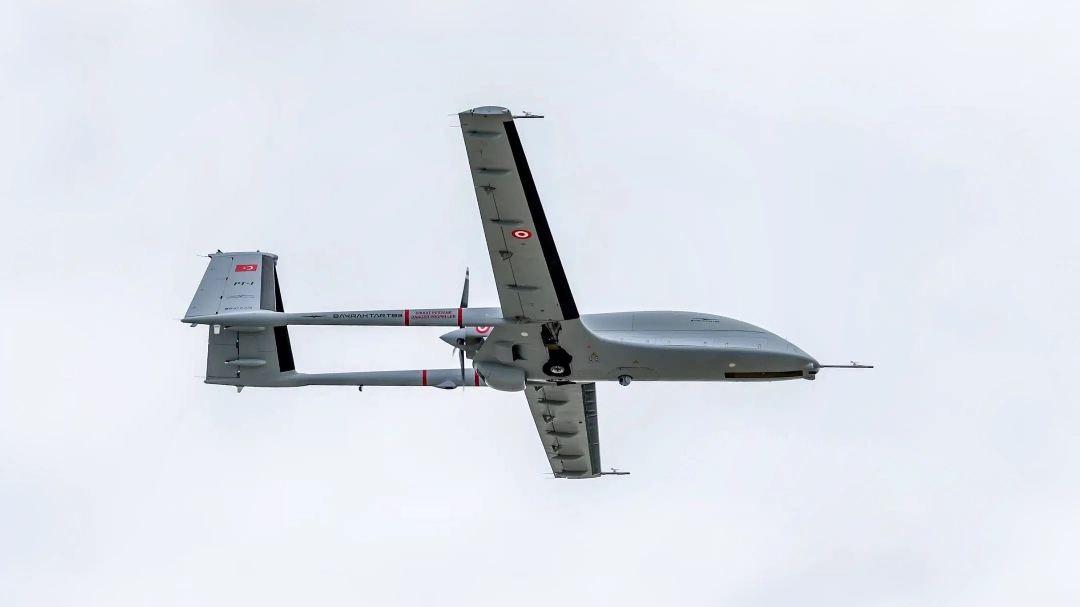
There’s a strange moment happening in modern warfare right now. Fighter jets that cost hundreds of millions of dollars are suddenly sharing the spotlight with aircraft that look, at first glance, almost too small, too lean, too quiet to matter.
And yet, the Bayraktar TB3 has military planners across Europe, the Middle East, and Asia paying very close attention.
Why? Because this isn’t just another drone.
The Baykar Bayraktar TB3 represents something bigger: the shift from traditional naval aviation toward a future where unmanned combat aircraft launch from short-deck ships, stay airborne for over a day, strike targets with precision munitions, then land autonomously while the sea rolls underneath them. No pilot onboard. No giant aircraft carrier required. Different game entirely.
Built by Turkish defense company Baykar, the Bayraktar TB3 drone was designed specifically for carrier-style operations aboard the Turkish amphibious assault ship TCG Anadolu. That alone makes it unusual. Most combat drones still rely on long runways and fixed land bases. The TB3 folds its wings, packs tighter than its predecessor, and operates in places where traditional UAVs simply can’t.
But here’s the interesting part people often miss: the TB3 isn’t trying to replace fighter jets outright. It’s doing something more subtle. It’s changing the economics of air power.
A country that cannot afford a fleet of stealth fighters may still field a swarm of long-endurance naval drones capable of reconnaissance, surveillance, and precision strikes hundreds of kilometers offshore. That shifts regional power balances fast, especially in contested seas.
And unlike many experimental military UAVs that remain stuck in testing limbo for years, the Bayraktar TB3 UCAV has already completed autonomous takeoff and landing tests aboard a ship at sea. That moved the conversation from “future concept” to “operational reality” almost overnight.
In many ways, the TB3 feels less like an upgraded drone and more like the first draft of a new naval doctrine.
What Is the Baykar Bayraktar TB3?
The Bayraktar TB3 is, technically speaking, a MALE UCAV, Medium Altitude Long Endurance Unmanned Combat Aerial Vehicle. But that label doesn’t quite capture why defense analysts keep circling back to it in conversations about the future of naval warfare.
This drone was built for a very specific problem.
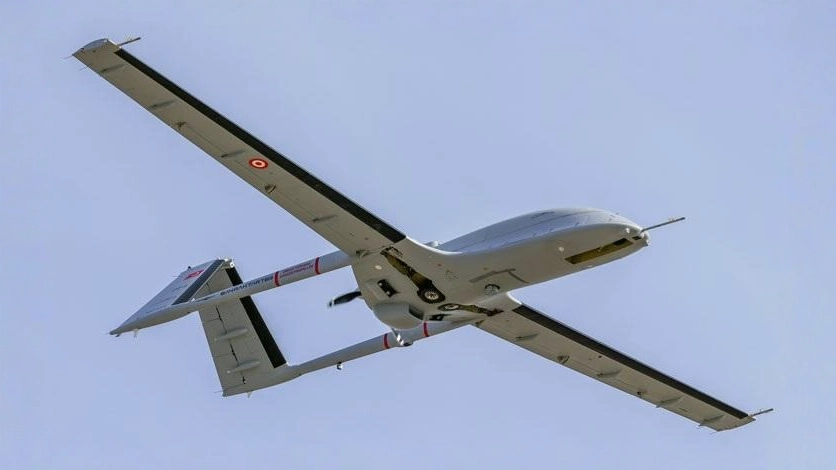
Turkey needed an aircraft capable of operating from short-runway assault ships after the country was removed from the Lockheed Martin F-35 Lightning II program.
Instead of shelving its naval aviation ambitions, Ankara pivoted hard toward unmanned systems. The result became the Baykar Bayraktar TB3, a carrier-capable combat drone with folding wings, satellite communication capability, and long endurance optimized for maritime missions.
At first glance, the TB3 resembles the widely known Baykar Bayraktar TB2. Same family DNA. Same lean fuselage. Same rear-mounted propeller arrangement. But under the skin, it’s a much more ambitious aircraft.
The folding wing system is probably its most distinctive engineering feature. On crowded naval decks, space is currency. Traditional UAVs occupy too much room, which limits deployment flexibility. The TB3 folds inward so multiple drones can be stored below deck aboard TCG Anadolu. Think less “air force drone,” more “floating air wing.”
Another major leap is beyond-line-of-sight communication through SATCOM integration. Unlike older tactical drones tied closely to ground stations, the Bayraktar TB3 drone can operate at far greater distances over open water. That matters enormously in the Aegean, Mediterranean, and Black Sea regions where maritime surveillance gaps can become strategic vulnerabilities.
Its first flight took place in October 2023, but the TB3’s rapid testing schedule surprised many observers. Autonomous deck landings, naval integration trials, and live-fire missile tests followed faster than expected. Usually, military aviation programs crawl through years of delays. This one moved with startup energy. Almost impatiently.
And that urgency says something important about where drone warfare is heading next.
Bayraktar TB3 Specifications
Numbers alone don’t tell the whole story of a military aircraft. Still, with the Bayraktar TB3, the specs reveal something important: this drone was engineered for endurance first, flexibility second, and intimidation somewhere quietly in the background.
Unlike flashy stealth fighters designed to win attention at air shows, the TB3 is built for persistence. Long hours. Long distances. Long pressure on enemy defenses.
Here’s a closer look at the core specifications of the Bayraktar TB3 UCAV:
| Specification | Bayraktar TB3 |
| Role | Naval Combat UAV |
| Manufacturer | Baykar |
| Length | 8.35 meters |
| Wingspan | 14 meters |
| Maximum Takeoff Weight | 1,450 kg |
| Payload Capacity | 280 kg |
| Engine | PD-170 turbodiesel |
| Maximum Altitude | 36,310 ft |
| Endurance | 24+ hours |
| Cruise Speed | ~125 knots |
| Communication | SATCOM / Beyond-Line-of-Sight |
One subtle but critical feature often overlooked is the PD-170 indigenous engine. Countries that depend heavily on imported military engines sometimes discover, too late, that export restrictions can cripple entire drone programs overnight. Turkey has clearly learned that lesson. The TB3’s engine strategy reflects a broader push toward defense independence.
Then there’s the wing design. Those folding wings aren’t just a cool engineering trick for promotional videos. They fundamentally change deployment possibilities. A drone that can launch from a ship without catapult systems or giant runways suddenly becomes useful in regions where fixed airbases are vulnerable or politically complicated.
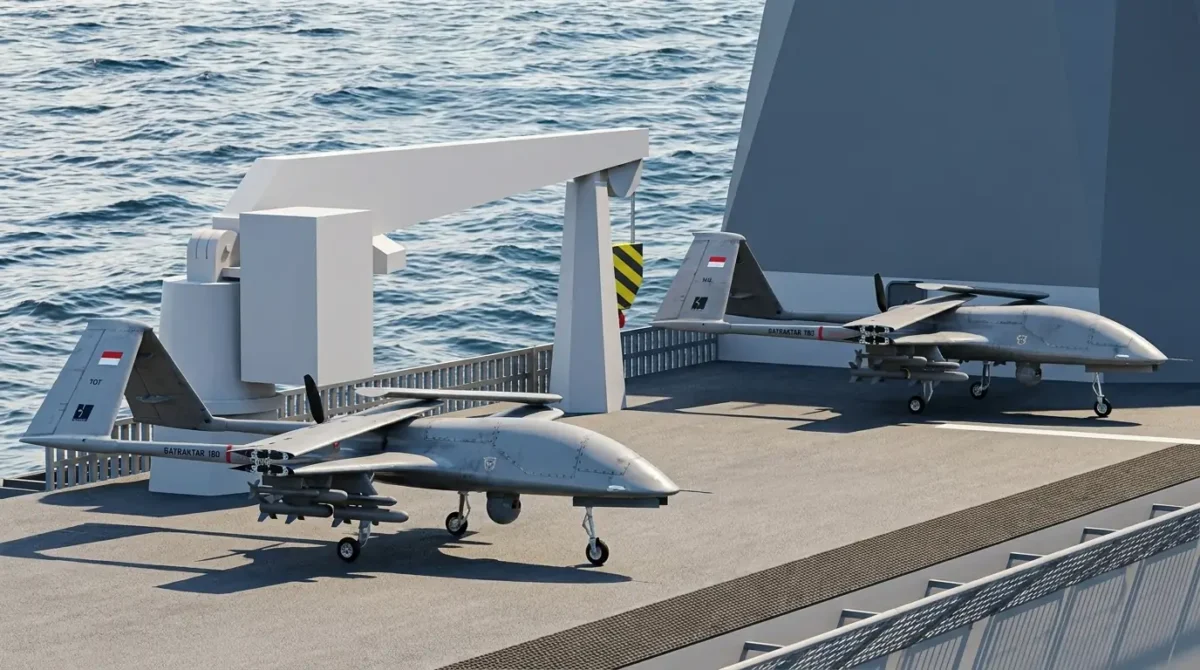
The Bayraktar TB3 drone also carries sophisticated autonomous flight systems. During testing, it completed takeoff and landing operations aboard TCG Anadolu with minimal human intervention. That’s not easy, by the way. Landing on a moving ship is difficult even for experienced fighter pilots. Sea winds shift unpredictably. Deck angles move constantly. Computers handling that workload in real time? Pretty remarkable.
And perhaps that’s the TB3’s biggest strength, not raw speed or stealth, but adaptability. It behaves less like a disposable drone and more like a scalable naval aviation platform.
Bayraktar TB3 Weapons and Combat Capabilities
A combat drone can stay airborne for 24 hours, fly across open water, and land on a ship autonomously, but if it can’t deliver meaningful firepower, militaries lose interest fast.
That’s where the Bayraktar TB3 becomes considerably more serious.
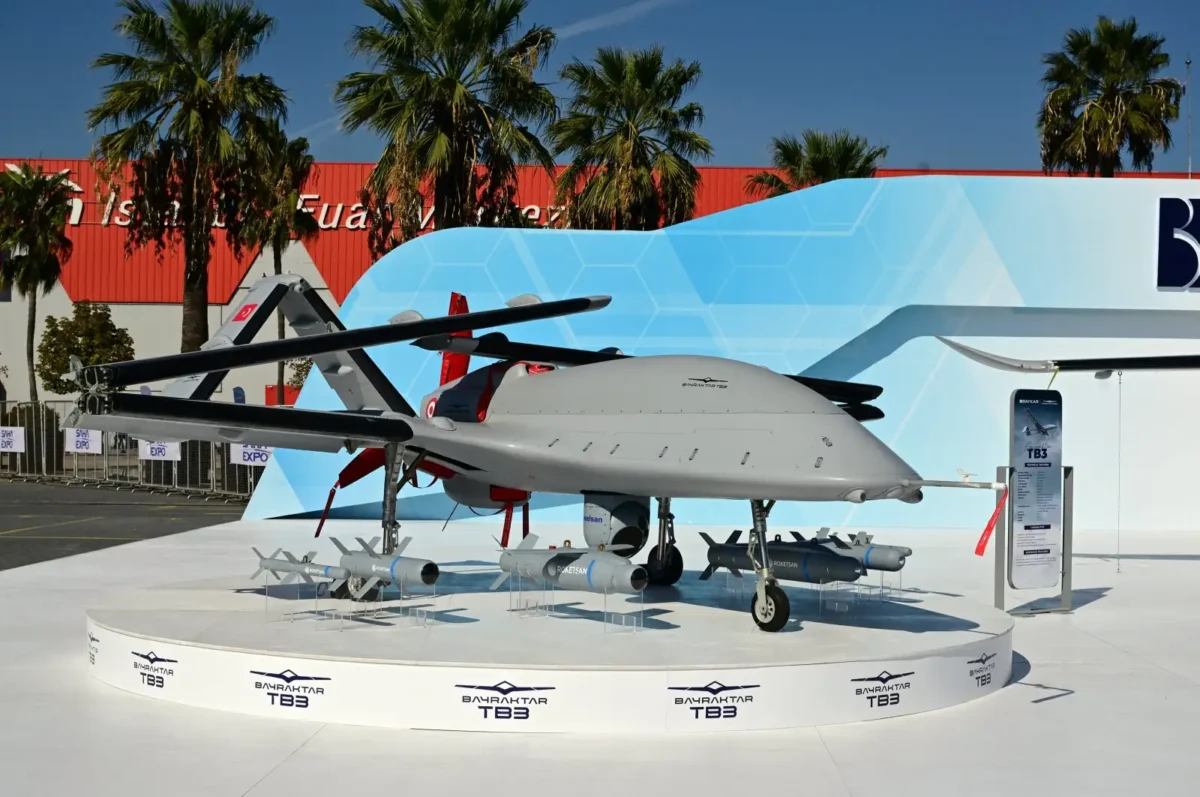
The aircraft was designed not merely as a surveillance platform, but as a fully operational strike drone capable of carrying precision-guided munitions against armored vehicles, naval targets, radar systems, and fortified positions. In practical terms, it gives smaller naval forces a kind of floating precision-strike capability that used to require advanced fighter aircraft.
The TB3 supports several Turkish-made smart munitions, including the widely used Roketsan MAM-L and heavier MAM-T systems. These weapons are compact, accurate, and particularly suited for drone warfare because they minimize weight while maintaining destructive capability.
Here’s a simplified breakdown:
| Weapon System | Purpose |
| MAM-L | Precision strikes against vehicles and structures |
| MAM-T | Extended-range smart munition |
| IHA-122 | Supersonic missile integration |
| Laser-Guided Bombs | Tactical battlefield strikes |
One test attracted unusual attention from defense analysts: the TB3 successfully fired the IHA-122 supersonic missile during live trials. That matters because drones are increasingly expected to hit faster-moving and better-defended targets, not just stationary pickup trucks in remote terrain.
The surveillance side is equally important. The Bayraktar TB3 drone carries advanced electro-optical targeting systems capable of maritime reconnaissance, target tracking, and real-time intelligence gathering. Combined with SATCOM connectivity, operators can monitor huge stretches of coastline or open sea far beyond visual range.
But the real shift here isn’t any single missile.
It’s the combination of persistence and precision.
Traditional fighter aircraft burn fuel quickly, require expensive maintenance, and need pilots rotated constantly. The TB3 can linger. Watch. Wait. Then strike at exactly the right moment. It turns patience into a weapon, which, honestly, may be one of the defining characteristics of 21st-century drone warfare.
And navies around the world are paying attention to that part very carefully.
Carrier Operations on TCG Anadolu
For decades, aircraft carriers represented an exclusive club. If a nation wanted true sea-based air power, it needed massive budgets, catapult systems, advanced fighter jets, and years of pilot training. Only a handful of countries could realistically pull it off.
The Bayraktar TB3 changes that equation in a surprisingly disruptive way.
Instead of building a giant nuclear-powered carrier like the USS Gerald R. Ford, Turkey adapted its strategy around drones operating from TCG Anadolu, a shorter-deck amphibious assault ship originally expected to support manned fighter aircraft.
Once Turkey lost access to the F-35 program, many assumed the ship’s aviation ambitions had collapsed. Instead, Baykar stepped into the gap with a very different idea.
Build a carrier air wing without pilots.
That’s essentially what the Bayraktar TB3 drone became.
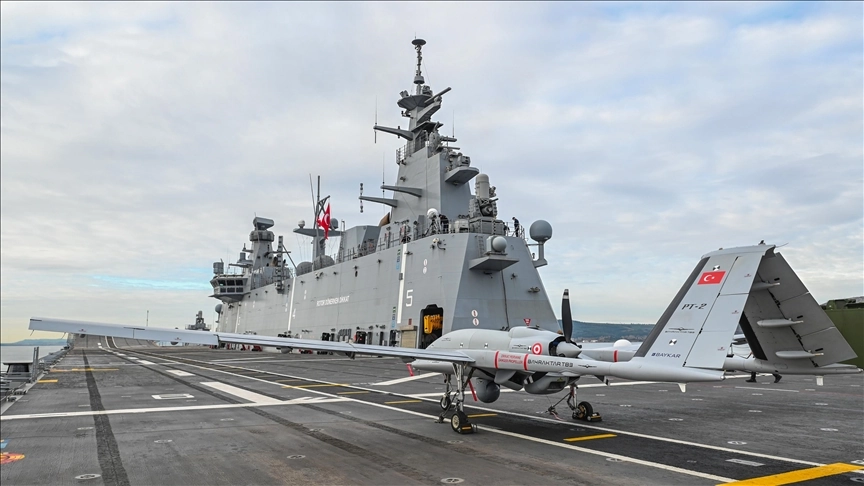
Unlike conventional UAVs that need long paved runways, the TB3 was engineered specifically for short-deck takeoffs and autonomous recoveries at sea
During testing, the aircraft completed fully autonomous takeoff and landing operations aboard TCG Anadolu while the vessel was moving across open water. That’s not just technically impressive, it’s strategically important.
Sea conditions are chaotic. Wind shifts. Deck motion changes constantly. Saltwater corrosion wrecks sensitive equipment over time. Naval aviation has always been brutal on aircraft.
The TB3 surviving this environment suggests Baykar designed it with operational durability in mind, not just demonstration flights for cameras.
The folding wings also become crucial aboard ship. Naval deck space disappears fast, especially during multi-drone operations. By reducing storage footprint, the Bayraktar TB3 UCAV allows more aircraft to be carried below deck without sacrificing mission readiness.
There’s another layer here people don’t always discuss.
Drone carriers create asymmetric advantages.
A mid-sized regional navy equipped with long-endurance combat drones suddenly gains reconnaissance and strike reach far beyond its coastline, without maintaining expensive fleets of manned naval fighters. That lowers the entry barrier for naval air power dramatically.
In many ways, TCG Anadolu may become remembered less as a traditional assault ship and more as the prototype for the drone carrier era.
Bayraktar TB3 vs Bayraktar TB2
At a glance, the Bayraktar TB3 and the older Baykar Bayraktar TB2 look like close relatives. Same narrow fuselage. Same inverted V-tail. Same unmistakable silhouette that’s become oddly recognizable in modern conflict footage.
But underneath, they were built for very different worlds.
The TB2 was designed primarily as a land-based tactical drone. It became famous because it delivered relatively cheap precision strike capability at a time when many countries couldn’t afford advanced combat aircraft. Ukraine, Libya, and Nagorno-Karabakh turned the TB2 into something larger than a UAV, it became a symbol of asymmetric warfare.
The Bayraktar TB3 drone, though, pushes beyond that role.
Here’s the clearest comparison:
| Feature | Bayraktar TB2 | Bayraktar TB3 |
| Operational Role | Tactical UCAV | Naval Carrier UCAV |
| Wing Design | Fixed Wings | Folding Wings |
| Carrier Operations | No | Yes |
| SATCOM Capability | Limited | Advanced BLOS SATCOM |
| Payload Capacity | Lower | Higher |
| Maritime Missions | Limited | Optimized |
| Shipboard Landing | No | Autonomous |
The folding wings alone completely change deployment strategy. A TB2 needs traditional runway infrastructure. The TB3 can operate from TCG Anadolu, giving naval commanders airborne reconnaissance and strike capability almost anywhere the ship can sail.
There’s also the matter of communication range. Earlier TB2 operations relied heavily on line-of-sight control systems, which naturally limited distance. The Baykar Bayraktar TB3 integrates beyond-line-of-sight SATCOM systems, allowing missions over much wider maritime areas. Open-sea operations practically demand that upgrade.
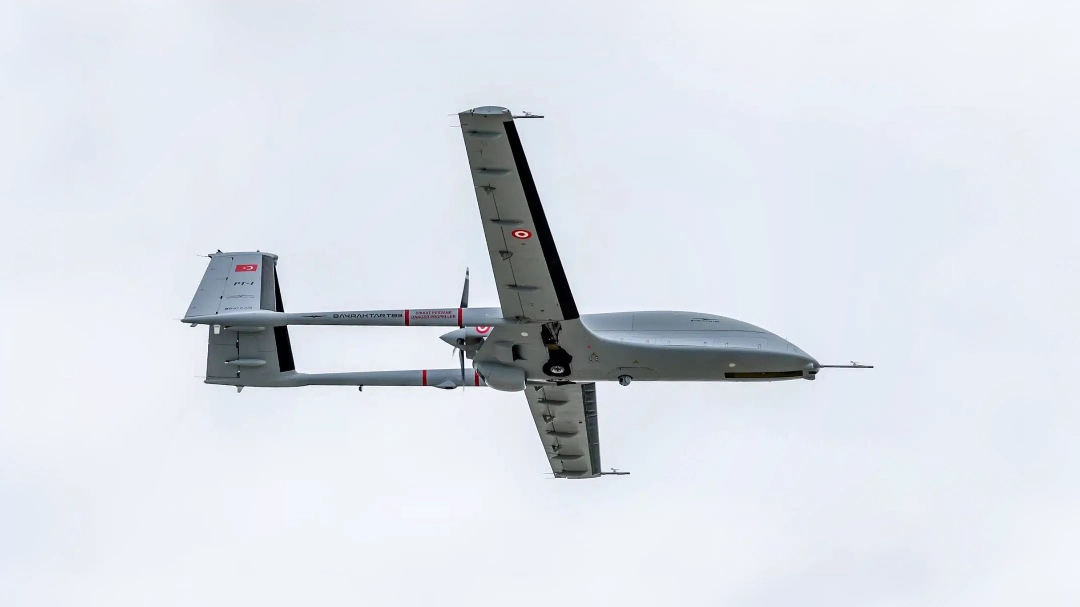
And then there’s survivability, not stealth exactly, but operational resilience. Naval drones encounter harsher environmental conditions: humidity, salt corrosion, unstable launch surfaces, unpredictable weather. Designing for that environment forced Baykar to rethink durability from the ground up.
The TB3 isn’t replacing the TB2 so much as evolving the concept into something more strategic.
If the TB2 proved drones could dominate battlefields cheaply, the TB3 is testing whether drones can reshape naval aviation itself. That’s a much bigger ambition.
Strategic Importance of the Bayraktar TB3
The Bayraktar TB3 matters for a reason that goes beyond drones, missiles, or flashy military demonstrations. It reflects a deeper shift in how countries think about power projection at sea, and who gets to participate in it.
For decades, naval aviation was essentially reserved for superpowers. Operating aircraft from ships required giant carriers, expensive fighter fleets, specialized pilots, and defense budgets large enough to make accountants sweat a little. Most nations simply couldn’t enter that club.
The Bayraktar TB3 drone changes the math.
By operating from TCG Anadolu, Turkey is experimenting with a lower-cost version of sea-based air power. Not a replacement for a full carrier strike group, no. But something more flexible. More attainable. A drone platform capable of reconnaissance, intelligence gathering, and precision strikes far from shore without relying on manned fighter aircraft.
That’s strategically significant because persistence often matters more than speed. A traditional fighter jet might remain over a target area for an hour or two before refueling becomes urgent. The Baykar Bayraktar TB3 can stay airborne for over 24 hours. It watches. Tracks. Waits. In modern conflict, that constant surveillance pressure can become psychologically exhausting for opponents.
The drone also strengthens Turkey’s broader defense-industry ambitions. Ankara has spent years reducing reliance on foreign military suppliers after repeated export restrictions from Western countries. Indigenous engines, locally produced smart munitions, and domestic UAV manufacturing all support that long-term strategy.
And globally, other navies are watching closely.
Because if carrier-capable drones become cheaper and easier to deploy, the future of naval warfare may belong less to giant carriers, and more to smart, persistent unmanned fleets scattered across the sea.
