

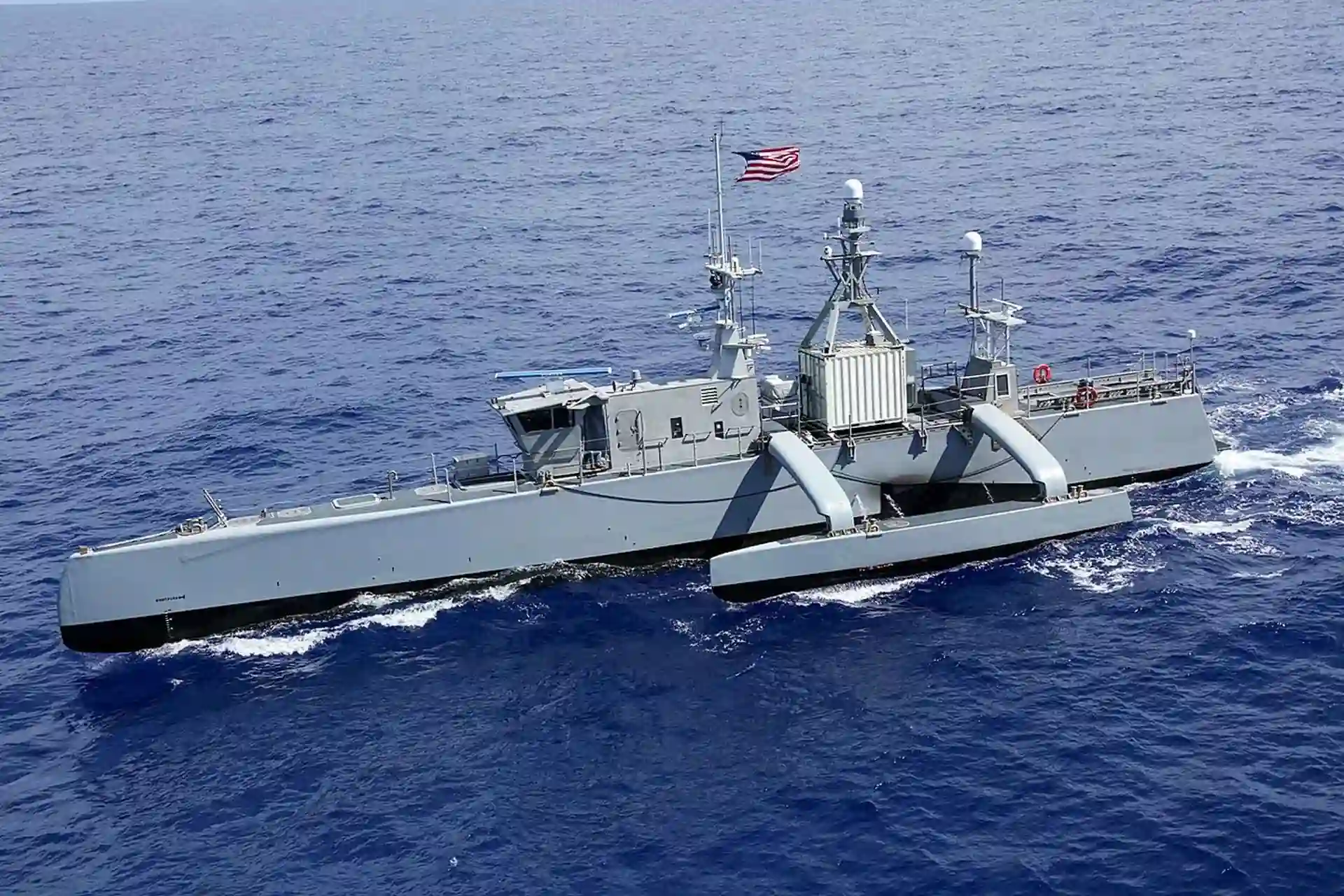
The US Navy Expands MUSV Drone Fleet to Counter China strategy is quickly becoming one of Washington’s most ambitious maritime modernization efforts in decades. Facing growing pressure from China’s rapidly expanding naval forces, the U.S. Navy now plans to acquire 47 Medium Unmanned Surface Vessels, or MUSVs, through 2031 as part of a broader push to reshape naval warfare in the Indo-Pacific.
The initiative appeared in the Navy’s latest long-term shipbuilding plan and reflects a major shift toward autonomous systems capable of operating in high-risk environments without onboard crews. Military planners increasingly see unmanned vessels as a critical tool for future operations near Taiwan, the South China Sea and other contested waters where Chinese military activity continues to expand.
Unlike traditional destroyers or cruisers, MUSVs are designed to perform missions such as surveillance, reconnaissance, electronic warfare and intelligence gathering while reducing risks to sailors. The vessels can also support distributed maritime operations, a strategy aimed at dispersing combat power across many platforms instead of concentrating forces into a smaller number of large warships.

Pentagon Pushes Autonomous Warfare in Indo-Pacific
The Navy’s growing investment in drone ships highlights how seriously the Pentagon views the long-term challenge posed by China’s naval modernization. Over the past decade, Beijing has rapidly expanded the size of the People’s Liberation Army Navy with new destroyers, aircraft carriers, submarines and anti-ship missile systems entering service at a pace unmatched by most global rivals.
American defense officials worry that traditional naval formations could face increasing risks during a potential conflict in the Western Pacific. Large warships remain powerful assets, but they are also expensive and increasingly vulnerable to long-range missiles, drones and advanced surveillance networks.
That is where MUSVs could change the equation.
The unmanned vessels are expected to operate as forward scouts, electronic warfare platforms or sensor nodes supporting larger fleet formations. Some analysts also believe future variants may eventually carry missile launch systems or anti-submarine warfare payloads, although the Navy has not officially confirmed future weapons configurations.
Another advantage is cost. Autonomous vessels are generally cheaper to produce and operate compared to manned surface combatants. This could allow the Navy to deploy larger numbers of platforms across the Indo-Pacific without dramatically increasing operational costs.
Recent conflicts have also influenced U.S. thinking. Ukraine’s use of maritime drones against Russian naval targets in the Black Sea demonstrated how relatively inexpensive unmanned systems can threaten larger conventional fleets. Pentagon planners appear to be studying those lessons closely as they prepare for future maritime competition with China.

MUSV Program Signals Major Navy Transformation
For years, unmanned surface vessels remained largely experimental within the U.S. Navy. That situation is changing quickly.
The inclusion of 47 MUSVs in the Navy’s procurement roadmap suggests the service now sees autonomous platforms as operational assets rather than limited technology demonstrations. Funding for the program is expected to increase steadily over the next several years as the Navy moves toward integrating drone ships into frontline fleet operations.
The MUSV fleet will likely work alongside other autonomous systems already under development, including unmanned submarines and drone swarms. Together, these technologies form part of a broader Pentagon strategy focused on artificial intelligence, distributed warfare and networked battlefield operations.
One of the key goals is improving survivability. By dispersing sensors and combat systems across numerous unmanned platforms, the Navy hopes to complicate Chinese targeting efforts during a conflict. Instead of focusing on a few major ships, an adversary would face a wider and more unpredictable operational network.
Military officials also believe MUSVs could help address long-standing fleet shortages. The Navy has struggled with maintenance delays, aging vessels and growing global deployment demands. Autonomous systems may help reduce pressure on existing manned fleets while expanding operational coverage across vast maritime regions.
Challenges Still Face the Navy’s Drone Ship Ambitions
Despite the growing momentum behind the program, several important challenges remain unresolved.
One major concern involves cybersecurity and communications resilience. Any future conflict involving China would likely include electronic warfare attacks, cyber disruptions and satellite interference designed to disrupt unmanned systems operating far from friendly bases.
Maintaining secure command links between operators and autonomous vessels could become extremely difficult in heavily contested environments. Defense experts have repeatedly warned that unmanned systems remain vulnerable to jamming, hacking or communications degradation during high-intensity warfare.
There are also legal and operational questions surrounding autonomous combat operations. While Navy officials continue to stress that humans will remain involved in major battlefield decisions, the increasing use of AI-assisted systems raises new debates about control, accountability and rules of engagement.
Even so, the broader direction appears clear. The United States is steadily moving toward a future naval force built around a mix of manned and unmanned platforms designed for operations across contested regions of the Indo-Pacific.
For China, that means facing a more distributed and technologically adaptive American naval presence. For the U.S. Navy, the MUSV expansion could mark the beginning of a major transformation in how maritime power is projected in the 21st century.
