

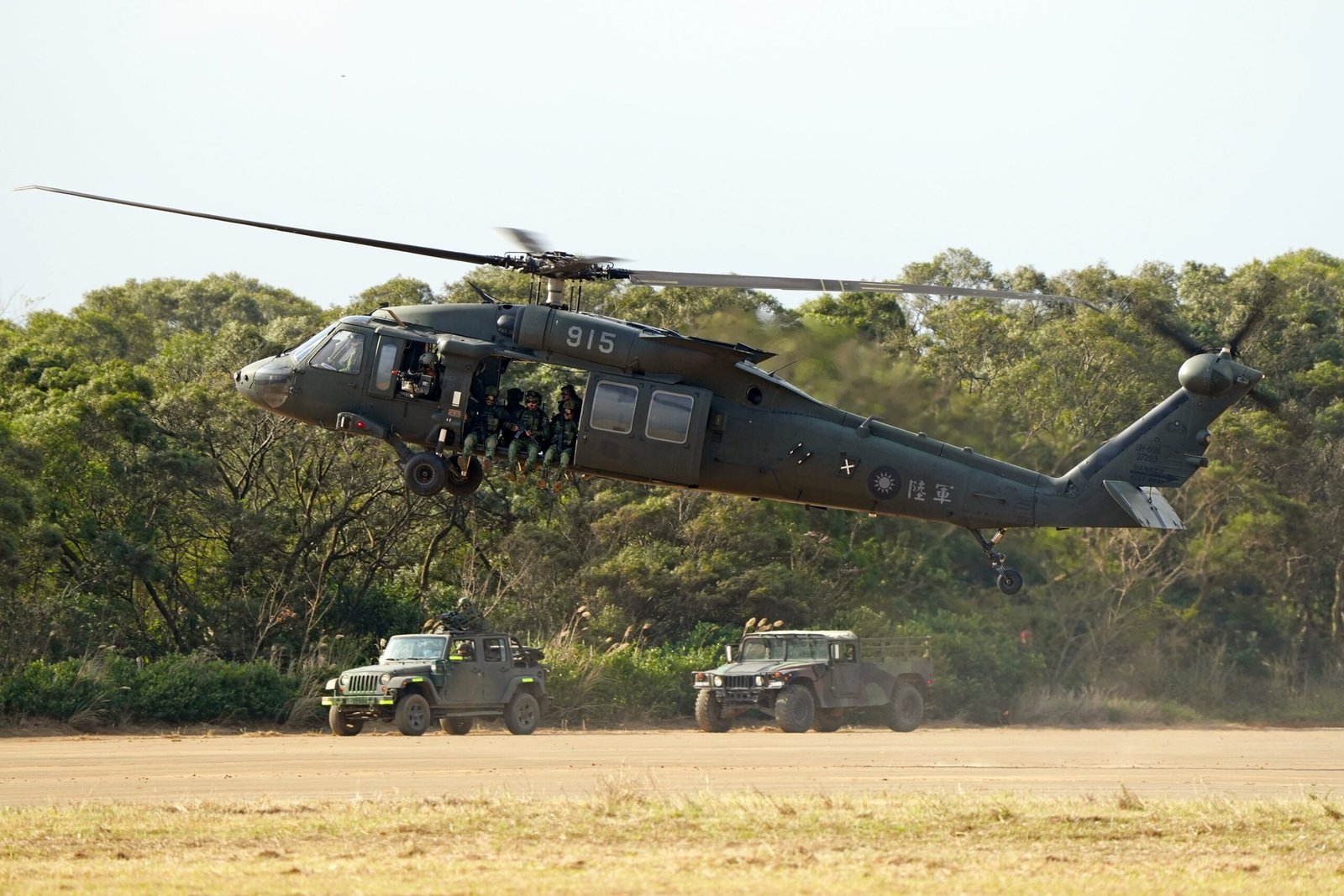
Taiwan hopes to significantly boost its defence spending, with the current administration committed to increasing military expenditure to 5% of GDP by 2030. The Army Aviation and Special Forces Command is hoping to cash in on extra funds to nullify a shortfall in utility transport helicopters.
For 2026, the defence budget is set to exceed the 3% threshold for the first time since 2009, even though Taiwan’s parliament reduced a NT$1.25 trillion (US$40 billion) proposed supplementary budget by a third on 8 May.
Under Project Tien Yuan, the island’s Ministry of National Defense (MND) acquired 60 Sikorsky UH-60M Black Hawk helicopters for the army under a US$3.1 billion deal in 2010.
However, even before deliveries began in 2014, 15 of the aircraft were reallocated to the National Airborne Service Corps under the Ministry of Interior. These were to be used in disaster relief and emergency operations.
Subsequently, a further 15 Black Hawks were transferred to the Republic of China Air Force’s Air Rescue Group for search-and-rescue assignments, as well as occasional VIP transport duties. Both services have since lost a helicopter each in separate accidents.
With its original requirement for Black Hawks effectively halved, Taiwan’s army had sought to have the shortfall in utility transport helicopters addressed through additional acquisitions.
Local reports in recent weeks, citing military sources, have indicated interest in procuring 30 additional UH-60Ms, potentially fitted with stub wings to enable carriage of weapons. This may include Hellfire missiles, 2.75-inch rocket pods and gun pods.
In addition, existing Black Hawk helicopters could be upgraded with similar modifications. The Armed Black Hawk – as the modular weapons kit is known – was revealed by Sikorsky at the Army Aviation Association of America conference in Nashville in mid-April.
News of the interest comes amid reports that Taiwan’s army aviation could phase out its Bell OH-58D Kiowa Warrior fleet slightly earlier than planned, within the next two years. Around three dozen aircraft remain in service, out of 39 acquired in the 1990s.

Taiwan had purchased about a decade’s worth of spare parts in 2018, a year after the US Army retired the type. However, the serviceability of the Kiowa Warrior’s Mast-Mounted Sight is believed to be problematic, while sustainment of the platform is expected to become increasingly difficult as global usage continues to decline.
The vulnerability of scout helicopters in modern, contested environments, coupled with the need to reallocate resources amid broader modernisation priorities, could also be factors behind the early retirement of the Kiowa Warriors.
The OH-58Ds work in concert with the Taiwan army’s roughly 60 Bell AH-1W Super Cobra attack helicopters, which were acquired around the same period. The OH-58Ds provide battlefield scouting and target designation for the AH-1Ws, and there is a possibility that the latter could also be gradually phased out or see a reduction in fleet size.
Should the Armed Black Hawk be procured, the platform could help offset the shortfall in firepower resulting from the phase-out of the OH-58Ds. The latter can also be armed with Hellfire missiles, rockets and gun pods.
To replace the reconnaissance role of the OH-58Ds, reports also state that Taiwan is evaluating AeroVironment’s Jump 20 vertical-take-off-and-landing unmanned aerial vehicle.
Taiwan’s army aviation also operates 29 Boeing AH-64E Apache Guardian attack helicopters, from a fleet of 30 delivered around a decade ago.
by Roy Choo, Sydney
