

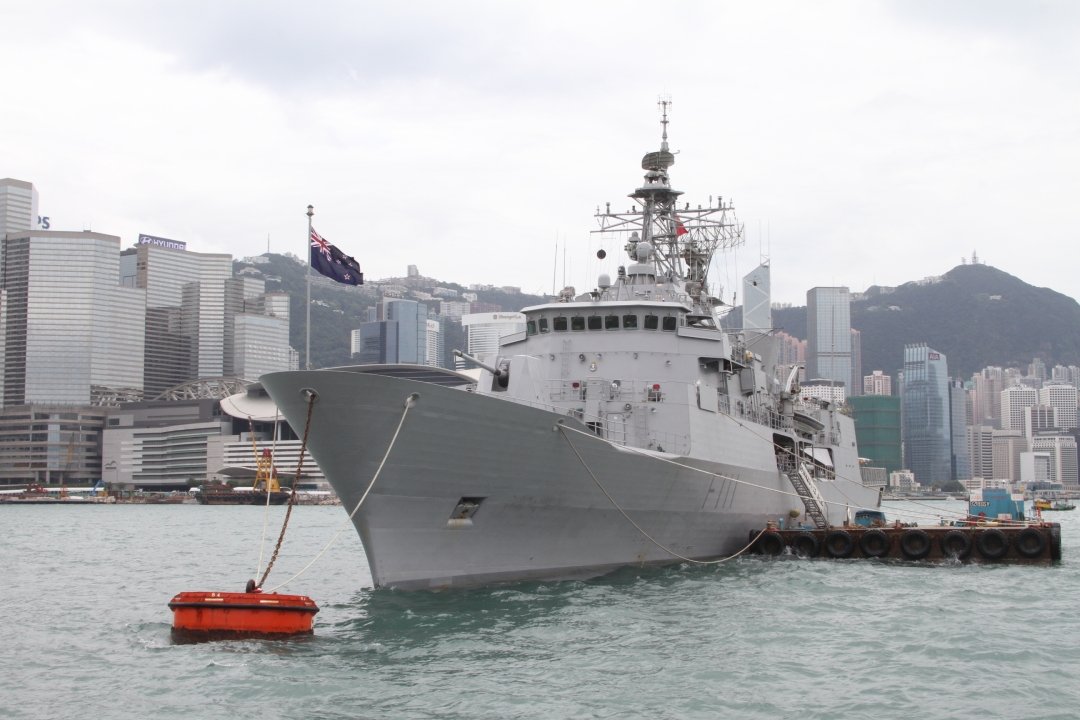
On 7 May, New Zealand’s new Defence Minister Chris Penk provided an update on progress to replace the Royal New Zealand Navy’s (RNZN) two Anzac-class frigates. The pool of contenders has been winnowed down to two.
One competing design is the Japanese 6,200-tonne Upgraded Mogami frigate, while the other is the British 5,700-tonne Type 31 frigate based on Babcock’s Arrowhead 140 hull design.
This frigate replacement programme is one part of the navy’s Maritime Fleet Renewal programme, which is assessing options for delivering a modern and combat capable fleet. The 2025 Defence Capability Plan released in April 2025 listed replacement of the Anzac frigates as an indicative investment for the 2029-39 period.
The minister’s statement revealed: “Defence has begun discussions with the Royal Australian Navy [RAN] and the United Kingdom’s Royal Navy to inform the next stage for potential frigate replacement and ongoing service arrangements.”
Penk added: “Our decision to prioritise discussions with our partners and focus on considering the Japanese Mogami-class frigate selected by Australia and the UK’s Type 31 frigates to inform the business case reflects our need to be interoperable and leverage efficiencies.”
In response, on 11 May, Japanese Chief Cabinet Secretary Minoru Kihara welcomed NZ’s decision to consider the 06FFM frigate. He said, “It could lead not only to improved interoperability among the three countries, including the Australian navy, but also greater mutual complementarity. From the perspective of strengthening deterrence in the Indo-Pacific region, this would be beneficial.”
Australia selected the same Upgraded Mogami, signing a production contract for the first three frigates on 18 April. The RAN will procure eleven of these general-purpose frigates, with eight planned to be constructed in Western Australia.
In the Japanese frigate’s favour is NZ’s expressed desire to buy equipment in common with Australia wherever possible. The Defence Capability Plan stated, “New Zealand will seek to procure the same assets and equipment as Australia where it makes sense to do so. This will help with interoperability.”
If NZ did buy two Upgraded Mogami frigates – likely constructed in Australia – this would create a combined Australian-Japanese-Kiwi class of 37 Mogami-class frigates.
However, NZ also maintains close military links to the UK. The Type 31 is supposed to enter Royal Navy service next year, while the Arrowhead 140 design has been selected for Indonesia and Poland too.
NZ is still collecting information, with a decision not due for some time yet. Penk explained, “…We are looking at mature combat-capable vessel programmes which are at a stage that allows adequate analysis against New Zealand requirements. A final decision has not yet been made, and advice is expected to be provided to Cabinet before the end of 2027.”
Penk also stated, “As a remote island nation, maritime security underpins New Zealand’s economic prosperity. Our safety, international connectivity and the vast majority of our trade is dependent on the sea.”
The minister noted that the country’s military must monitor activity in national waters, undertake combat, patrol and interception operations, transport people and equipment by sea, and support search and rescue efforts.
“These activities rely on a resilient navy, yet most ships in the current fleet are expected to reach the end of their design life by the mid-2030s, including the Anzac-class frigates. Without replacement, this would have a significant impact on New Zealand’s ability to protect its maritime interests in the Pacific and beyond.”
The RNZN continues to upgrade its two incumbent frigates, HMNZS Te Kaha and Te Mana, commissioned in 1997 and 1999 respectively. Penk shared, “In the interim, we are continuing to ensure the current frigates remain operational. We know this will be a significant decision for New Zealand, and we are determined to work with our partners, focus on what is in our best interests and get it right.”
by Gordon Arthur, Kuala Lumpur
