

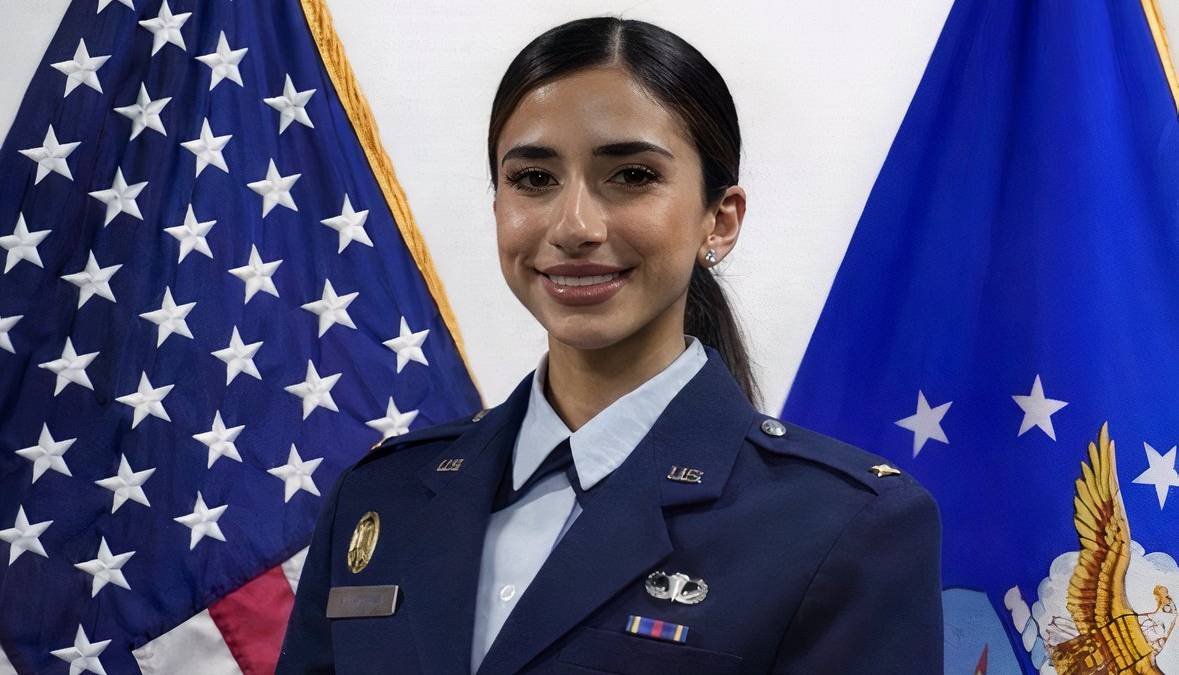
Mareem Al-Mosawi has had no easy path toward her dreams.
The daughter of Iraqi immigrants who fled to the U.S., and as the eldest sibling in her family, she was tasked to care for her visually impaired mother, who speaks only Arabic, while trying to keep her Middle Eastern identity intact and pursue her goal of serving the nation she’s called home since birth.
It’s been a lot to juggle.
But Al-Mosawi has risen above it all with an effervescent smile and air of determination that led to a bachelor of science degree in physics from Arizona State University (ASU), along with four years of Air Force ROTC training and being one of only 624 cadets accepted to the elite Undergraduate Pilot Training Program at Vance Air Force Base in Oklahoma.
At ASU, Al-Mosawi served as cadet wing commander for a ROTC detachment of 250 cadets. She found out about being chosen for the Air Force pilot training program in April, much to the delight of her fellow ROTC cadets.
Besides working part-time, succeeding both in and out of the classroom, and caring for her mom, Al-Mosawi earned a civilian student pilot license, logging more than 22 hours in the sky.
She feels she’s ready for the rigors of Air Force pilot training.
“It’s a lot more competitive to get a pilot slot out of ROTC than the (Air Force) Academy, because you already compete to get to the academy, so it’s like they get a lot of the slots,” Al-Mosawi told Military.com.
Al-Mosawi was selected for the exclusive training course in 2025 after completing a rigid evaluation process that scrutinizes aptitude, academics, leadership and performance. Al-Mosawi plans to become a full-fledged Air Force pilot in hopes of pursuing a goal she’s had since middle school – becoming an astronaut.
“It’s those little kid dreams, you know, like I wanted to be an astronaut. I did my research. I pulled up my tablet and typed in, ‘How do you become an astronaut?’ I looked through the NASA web page, and there were so many options, most of them involved doing about 12 years of school and training, earning a PhD and then another 30 years working in a science field, and I was like, Whoa, that’s a lot, and I don’t think I could do that,” Al-Mosawi said. “But then one option was being a military pilot, and I thought, Wow, that seems really cool. I started looking into the military a little bit more and just gained interest through that, researching it and seeing how it sets you up for life, all the options you get from the military and you pretty much have a guaranteed job after college. It’s super hands-on, and you’re serving a purpose.”
A Chance to Give Back
Al-Mosawi also felt the urge to join the military to give back to a nation that has given her promise and potential.
Born in Glendale, Ariz., Al-Mosawi was raised primarily by her disabled mother, an Iraqi refugee. Childhood wasn’t easy, as her family had to scrape by to pay bills, relying on government assistance.
“I grew up under the welfare system, so we had government-assisted housing, food stamps, and healthcare was all paid through the government. My mom is blind, and I just live with her,” Al-Mosawi said. “So, America has helped me out so much, and I was just so grateful for our nation. That kind led me into the military path.”
Before she came to ASU, Al-Mosawi’s main goal was to serve, and less about flying. But as the application deadline for the cadet training course was nearing, she knew she wanted to be a pilot.
“A lot of it is a fear of failure,” Al-Mosawi said, “because it’s so competitive. You come into the program, and all the pilot guys are like, ‘I’ve been wanting to do this since I was born, my dad’s a pilot,’ and I didn’t really fit in with that crew. But I took all the required tests and submitted my application, and I did good, and I was like, Dude, I’m super competent for this. I would absolutely love to do it. I think I could do it.’”
After she finishes pilot training, which lasts for more than a year, Al-Mosawi will be assigned to an aircraft.
Al-Mosawi was granted a Commander’s Scholarship that paid for her undergraduate degree, along with help from the U.S. Air Force Academy’s Freefall Program and $7,000 in flight scholarships. She’s taken advantage of study abroad opportunities in Jordan and Morocco and completed an internship at the Johns Hopkins Applied Physics Laboratory.

Family Fled War for a Better Life
From the perils of the Iran-Iraq War through much of the 1980s, to the Gulf War in the early 1990s, Al-Mosawi’s parents spent most of their youth surrounded by bloodshed and destruction. Being led by Saddam Hussein also didn’t help the Iraqi people’s hope for peace and freedom in an unstable region.
Al-Mosawi’s father spent four years as a prisoner of war in Saudi Arabia before being freed and allowed to immigrate to either Australia, Great Britain, the U.S. or Canada through a United Nations refugee program. He was chosen to relocate to the U.S., bringing Al-Mosawi’s mother stateside in 2000.
Four years later, Al-Mosawi was born, and the couple could breathe easier knowing their daughter, and eventually two younger siblings, would be raised free, not affected by invasions, war and dictatorships.
While the family was grateful for opportunities in the U.S., their experience wasn’t void of challenges.
“It’s just hard to step foot into a country where you don’t know the language, you don’t know the culture, you don’t know the people, and then raise a family there,” Al-Mosawi said. “I did grow up with my mom the entirety of my life. She is visually impaired, so she can’t drive, she can’t work, and she, unfortunately, never had the ability or the opportunity to really learn the language here, so ever since I was really young, all the responsibility was on me as the oldest to fill out all the applications for Section 8 (housing), for Social Security, take her to doctor’s appointments, figure all that out.”
One caring adult can make a lasting impact on a child’s life. Fortunately, Al-Mosawi had a strong network of support growing up, relying on guidance counselors and social workers to steer her in the right direction. She was determined to be the first in her family to attend college and took it upon herself to learn about programs and scholarships.
“There are so many people willing to help, in my experience at least, and so it’s been very helpful, but I have no military background, so I had to do it on my own,” Al-Mosawi said. “Fortunately, there are so many resources to tap into, so it hasn’t been too difficult, but it’s taught me how to be more resilient and face adversity.”

Culture Shock
Al-Mosawi said that while her mom is proud of her daughter’s accomplishments, it’s difficult for her and family members still in Iraq to comprehend how a woman can become an Air Force fighter pilot.
“Women in Iraq don’t really go to college, and none of my female cousins have been to college. And I have half-siblings over there, too, who, unfortunately, can’t move to America. My little half-sister won’t ever be able to have the same opportunities as I and go through college. We have free education here, and it’s an amazing education system,” she said. “So, it’s a culture shock for my mom a little bit, because she’s like, ‘Whoa, never really seen a girl do this in my whole life. It’s kind of like something out of the movies,’ and that’s how I felt for the longest time, like ‘Whoa, my life is literally a movie.’ I’m the first college graduate in my family, and I get to have a real person job, and I can help support my mom through my career.”
Since the odds of becoming an astronaut are five times harder than being accepted to Harvard Medical School, Al-Mosawi has adjusted her life’s goal somewhat, not totally abandoning voyages into space, but hoping to become a foreign area officer in the Air Force.
“You would get to be an ambassador or attache of the country of the language you pick, and since I know Arabic, I’m hoping to be sent to an Arabic-speaking country,” Al-Mosawi said. “I can help with the communication gap. I understand the culture, I’m not just translating, I can interpret the language and I think that helps close the communication gap, because there are a lot of things that can go on and they can either go wrong or go right. I want to be part of that process to help build connections with those nations because I could understand it a little bit better because of my background.”
No matter what path she takes years from now, Al-Mosawi knows she will turn heads as a female Iraqi American pilot. And she’s fine with that.
“It’s that representation of showing young girls, it doesn’t matter what your background is, you can absolutely become an Air Force pilot,” she said. “It’s a pretty cool gig, and so anybody who wants it can absolutely get to it.”
