

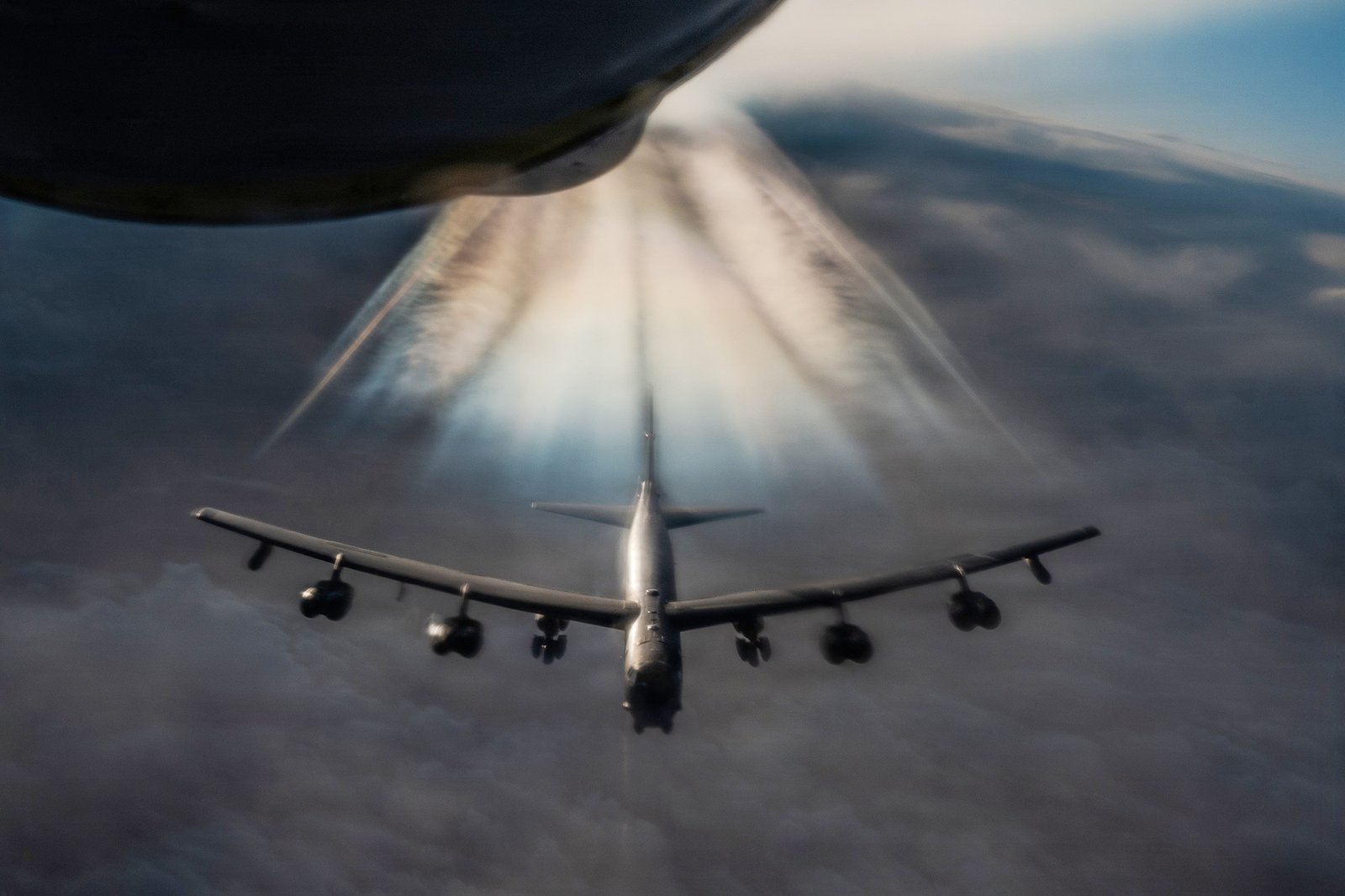
The Air Force is about to start considering alternatives for eventually replacing the B-52 Stratofortress, even as it prepares to upgrade the decades-old aircraft to a J-model featuring new engines, landing gear, avionics, and radar.
Documents released with the fiscal 2027 budget request outline plans for a “Heavy Bomber Analysis of Alternatives” to consider what long-range strike capabilities the Air Force might want in the future. Options include new requirements for the ageless B-52, a whole new aircraft, or both, the document said. First up: developing key performance parameters needed and the attributes needed.
The Air Force spent $3.9 million in 2025 to conduct a classified proof-of-concept demonstration on the B-52, and is seeking $1 million to begin the new analysis of alternatives in 2027.
The first of 76 B-52Hs will begin the overhaul process this year, gaining new Rolls-Royce engines to improve reliability and efficiency, a new glass cockpit with new controls, new landing gear, improved radar, and other major modifications. The work, to be done by Boeing in San Antonio, is supposed to keep the B-52s flying into the 2050s.
Air Force bomber plans call for adding at least 100 B-21 bombers and retaining the B-52Js, while retiring its B-1B Lancer and B-2A Spirit bombers in the 2030s.
Mark Gunzinger, a former deputy undersecretary of defense, retired Air Force colonel and bomber expert who flew the B-52, expects the Air Force to consider a wide range of possibilities for its future bomber fleet. The alternatives to be considered, he said, will likely include a new standoff bomber, additional modifications for the Stratofortress, a new aircraft designed to carry a large number of cruise missiles, as well as the option to build dozens more B-21 Raiders.
“While the [B-52] aircraft is old, the airframe is still relatively young in terms of flight hours and the stresses it’s absorbed over the years,” Gunzinger said. “So it’s a perfectly viable airframe.”
Gunzinger said that this analysis is about more than just a potential B-52 replacement.
“I think it might be better characterized as saying, they’re taking a look at the standoff strike mission area itself, and what’s the best solution for the distant future?” Gunzinger said.
One attribute that might be needed: stealth, in order to get a heavy strike jet closer to targets. But stand-off weapons could mitigate against that requirement. Another is speed and how important that might be in achieving desired results. The Air Force study will consider weapons, effects, size, and the need for electronic warfare and self-defense capabilities, he said.
The planned retirement of the B-1, which can carry the 75,000 pounds worth of conventional weapons, is a key factor. Not only can the B-1 carry a greater payload than any other bomber, but it’s also the fastest, able to top 900 miles per hour, or Mach 1.2. The B-52 can carry up to 70,000 pounds, but its top speed is 650 miles per hour.
Gunzinger suggested the Air Force will always want a combination of stand-off and penetrating strike aircraft to better tailor its strike packages and that settling on an all B-21 bomber force could be limiting.
Stand-off attack means aircraft remain outside of an enemy’s airspace, releasing weapons that penetrate contested airspace; the B-21 is designed to evade radar and penetrate deep into adversaries’ airspace to strike well-protected targets such as hardened or deeply buried installations.
“Both are needed,” Gunzinger said. “It really gets down to, what’s the ultimate mix you want?”
Gunzinger said the B-21’s modular, open-systems architecture will enable the Air Force to easily upgrade the aircraft as future technology comes online. With the Air Force committed to buying at least 100 B-21s, a larger fleet is very much in the discussion; U.S. Indo-Pacific Command boss Admiral. Samuel Paparo told lawmakers in April he favors a B-21 fleet of 200 bombers.
Exact specifications for the B-21 are not yet known, but Gunzinger said visual observations suggest it will have a smaller payload capacity than the B-52. When flying into contested areas, the B-52 is limited to carrying missiles.
