

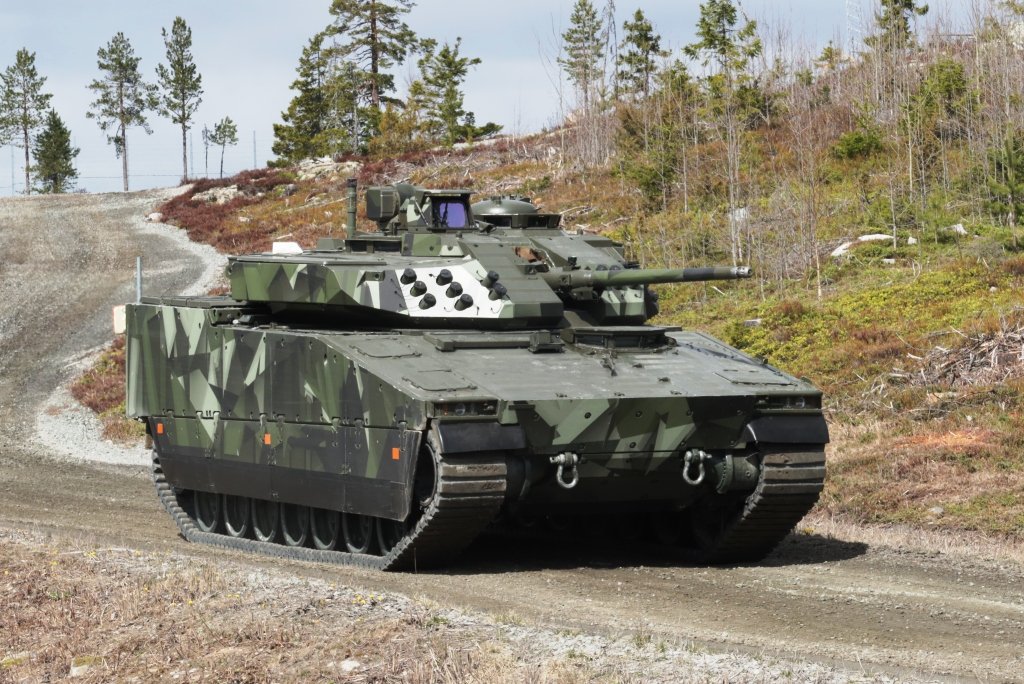
Since February 2022 most countries, in Europe and not only, modified their defence stance which led to an increase in defence budgets. Notwithstanding initial criticisms, armoured vehicles reman key in land warfare, which led the Swedish company based in Örnsköldsvik to invest in new production space, new machines, new procedures and especially an increasing workforce
Part of BAE systems since 2004, BAE Systems Hägglunds is based in Örnsköldsvik, some 450 km north of Stockholm, on the eastern coast of the Gulf of Botnia. Started in 1899 by Johan Hägglund as a furniture joinery, he was succeeded by his sons, the business seeing many transformations ending up in busses and railway products. The first contacts with the defence world date back to the 1950s, when the company started manufacturing turrets for a combat vehicle. Today it is one of the key players in the infantry fighting vehicle and in the all-terrain vehicle businesses.
In a world that sees tension constantly increasing, the company is increasing its capacity, however, there has been dark moments from 1996 on, when the so-called “dividend of peace” brought to a reduction of defence budgets. “The defence business has been very volatile,” Tommy Gustafsson-Rask, who leads BAE Systems Hägglunds since 2012, explained, “with revenues falling from 400 million US$ to 200-250 US$. It was tough, we restructured the business, we had to do a redundancy notice of more that one third of the company to allow us to survive, maintain competence and know-how.”
Today the situation has reversed. “In 2025 we made 1.1 billion revenues, but the key factor is that export accounts for 70 to 90 per cent, depending on the year. The Swedish customer does not allow us to survive, although it is an extremely important reference customer,” the company CEO stated.
In 2020 revenues were around 200 million US$ and the workforce was down to 750; today BAE Systems Hägglunds has 2,600 employees, most of them working in Örnsköldsvik but part of them, mostly design offices, are spread throughout Sweden. This is the result of a first round of investments worth 300 million US$ over the last five years that were focused on expanding production capacity, test and verification facility, engineering and manufacturing skills, and supply chain resilience. “We have extended by 30 per cent the floor space,” Tommy Gustafsson-Rask said, “adding a new welding hall to the existing one.” The main facility used to have three main halls, A for assembly, B for logistics and C for hull production and prototype production, where welding is performed; a new D hall has been added doubling the welding capacity, which should be up and running by Q3/Q4 2026. It is to note that the company has outsourced the welding of the BVs10 cabins, to free space for CV90s. While new welding machines will be installed in D hall, EDR On-Line understood that the machines currently used to cut armoured steel to obtain elements that form the hull will remain the same, as they have sufficient growth margin, waterjet technology being used for cutting high thickness steel, up to 120 mm, while laser cutting is used for thicknesses up to 30-40 mm. The company is already planning to go from two to three shifts if this will be needed. The assembly hall hosts three lines, one with 15 stations for the BvS10 all-terrain vehicle and two parallel lines each with seven stations for the CV90, the latter production being of around four hulls per week.
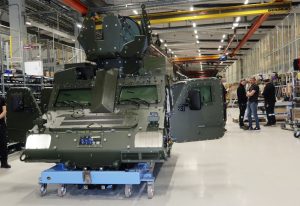
While turret production is carried out locally by most of the export customers, Kvaener and CHSnor in Noray, Patria in Finland, Van Halteren in the Netherlands, Hydrema in Denmark, Koval in Slovakia, RUAG in Switzerland and VOP in the Czech Republic, hulls have been mostly assembled in Sweden until recently. Ritek AS of Norway started producing the hulls for two new variants for Sweden, Hydrema in Denmark is also ready to start, while MSM in Slovakia and Excalibur in the Czech Republic are currently producing the first items for the contracts that will deliver respectively 152 and 246 vehicles to the land forces of the two nations. All together the CV90 production capacity was increased by 400%. Several upgrade programmes are performed in country by customers, programmes already running in Finland and the Netherlands while that for Switzerland is currently being finalised.
Ten nations are deploying or will deploy the CV90, the order book being just short of 600 vehicles, which will keep production lines busy until 2030, the CEO explained. “We are currently in negotiation for a joint procurement which sees Sweden in the lead, and involves Finland, Norway, Netherlands, Lithuania. The requirement is for around 800 vehicles, and we hope we will close the deal in Q3 2026, which will keep production lines open until 2032.” Estonia was also part of the programme but opted out due to the political decision to shift funding towards C-UAS and UAS systems, however this should not be a major issue as the number of vehicles destined to Tallin were relatively low, the country planning to upgrade its in-service CV90s.
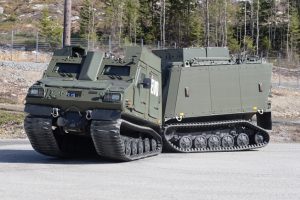
The investments done in the last few years affected not only the main production site but also the Test and Verification Centre located a few kilometres from Örnsköldsvik. A second main hall was built to host quality assurance, final painting, and customer handover. Not only this frees space in the main site for production, but it also streamlines the delivery process; previously BVs10 were moved to the test centre, were tested for around 100 km, and then were going back to the production site for delivery, while now they will be moved only once.
“People, production capacity, tools and processes,” these were the four pillars that allowed BAE Systems Hägglunds to undergo the surge in production needed to answer current requests from the market, Tommy Gustafsson-Rask said. One issue that had to be solved was linked to the supply chain. EDR On-Line understood that main issues did not come from A components, such as Scania for the engine, Allison for transmission, Northrop Grumman for guns, but rather from B components, such as brackets, cables, electric boxes, electronics, produced by subcontractors under the OEM design. This was a bottleneck, but things are improving; “procurement and supply chain is the department that has grown the most,” the CEO stated.
Investments are not finished; additional 150 million US$ have been committed for the 2026-2028 timeframe and will allow building a new logistics centre, which will free up further manufacturing capacity in existing workshops, as well as an integration and inspection facility near the test track, a third building that will add to the original and the newly built one.
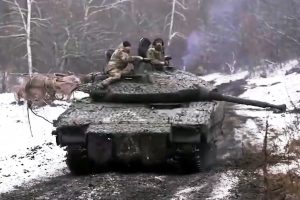
Asked about performances of the CV90 in Ukraine, the vehicles donated to Kiev were particularly appreciated by Ukrainian Army crews, who were used to BMP-1 and BMP-2 IFVs of Soviet origin, which did not provide much protection. According to information acquired, “the one CV90 that was seen in Moscow was lost due to the fact that once it took enemy fire the crew,” something due to the lack of faith based on experiences with the Cold War era vehicles previously in use, therefore that vehicle was capture still fully operational. Ukraine received the very first CV90s acquired by Sweden, which were armed with the Bofors 40 mm gun, were fitted with steel tracks, most vehicles are now fitted with rubber tracks, as initially the tracked platform main mission was to fight against attack helicopters, which makes it well suited also to cope with the current UAV threat. The 50 CV9040C (Mk 0) vehicles operating in Ukraine were up armoured and fitted with mounts for camouflage netting notably Saab Barracuda, before being delivered, however they remain less protected compared to the MkIIIC and Mk IV versions now in production. “When operations reverted from manoeuvre warfare to a more static use, Ukrainian units found how to use the firepower in a different way. One of these is indirect fire, using HE explosive shells and guiding fire with a drone,” the CEO explained. Awaiting a batch of new and more protected CV90s offered by Sweden and Denmark, the Ukrainian appreciation for the Swedish-made IFV is obvious given that the flag of the 21st Mechanized Brigade stands out at the entrance to the Örnsköldsvik production plant, with a dedication to the company’s staff. “If we compare the CV90s activity in Ukraine to the mileage done by Sweden in a normal training year, they do the same mileage in three weeks, the use of the vehicle is in a wholly different dimension, and this is another lesson learned from the front,” Tommy Gustafsson-Rask said.
With a backlog of 8 billion US$ and forecasted revenues of around 2 billion US$ in 2026, BAE Systems Hägglunds is looking at new opportunities in Europe, as well as to new business models, one being production under license as in the case of the BvS10 programme for India, where local Larsen & Toubro is the selected partner.
Customer support is obviously a key element, the CV90 Users Club having two groups, a Logistic and Support Working Group, which deals with support issues, and the Technical Working Group, where nations discuss possible upgrades and share operational experiences. On of the latest additions to the support effort is the development of the Microfactory, a deployable asset capable to produce qualified spares downrange, should the supply of spare be interrupted. The first Microfactory has recently been delivered to the Swedish Army which is undergoing thorough tests.
Photos by P. Valpolini and Ukrainian MoD
