

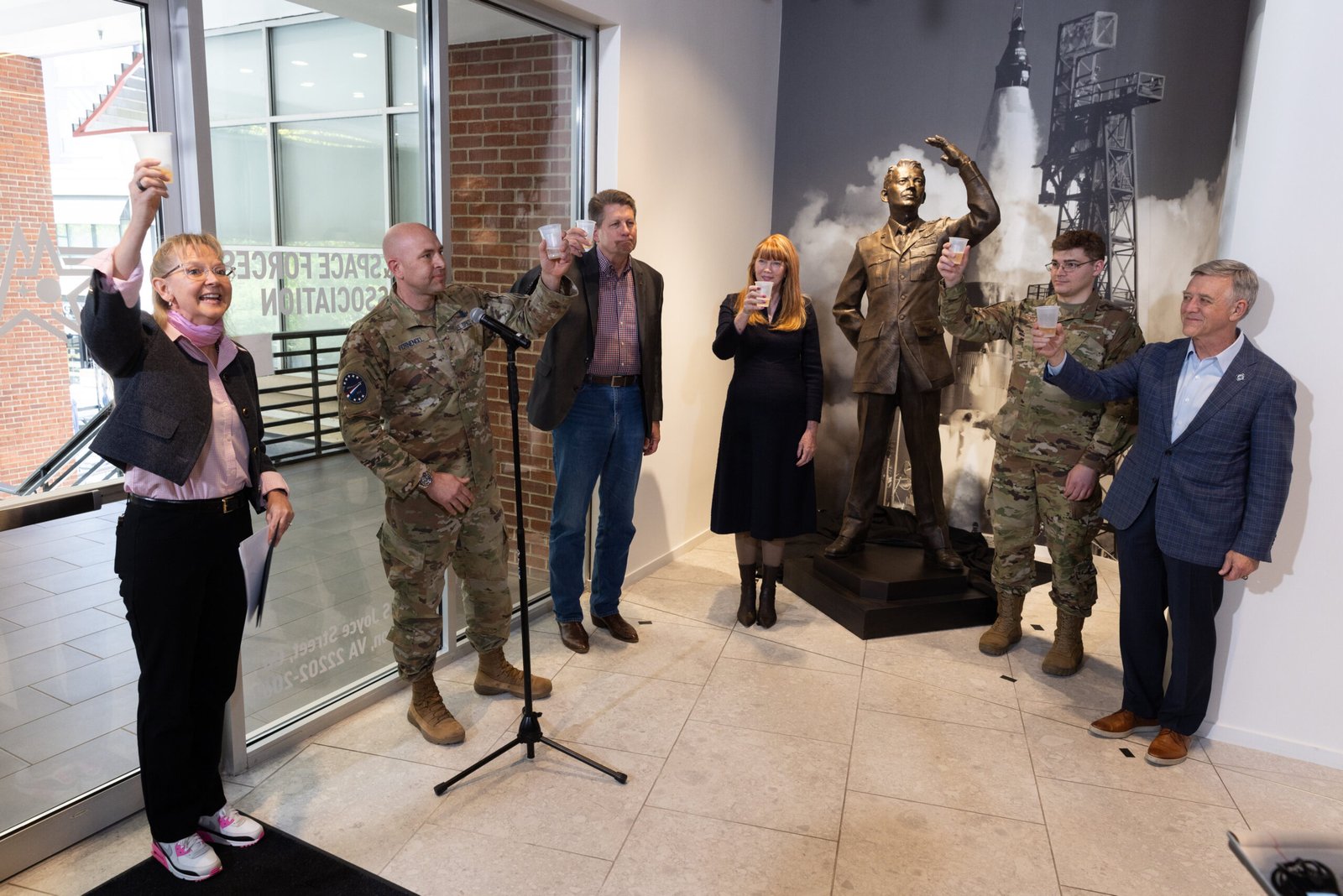
The long-standing legacy of a man who first envisioned the need for the United States to achieve space superiority echoed through the decades at the unveiling of his bronze statue during the Air & Space Forces Association’s inaugural “Salute to Space” celebration on May 1.
The bronze figure of Air Force Gen. Bernard A. “Bennie” Schriever, his left hand reaching skyward, shielding his eyes as he looks to the heavens, now stands watch at the association’s Arlington headquarters entrance; behind the statue, a floor-to-ceiling image of an Atlas rocket rumbles skyward, carrying astronaut John Glenn into orbit.
It was thanks to Schriever’s herculean efforts to advance rocket and space technology in the 1950s that the U.S. developed the technologies, concepts, and personnel who could eclipse the Soviet Union in the race to the moon.
“There are moments in history when a single individual changes not just the trajectory of a service but the trajectory of a nation,” said retired Lt. Gen. David Deptula, dean of AFA’s Mitchell Institute for Aerospace Studies. “General Schriever was one of those individuals. He didn’t just imagine the future, he delivered it.”
The chief architect of Air Force ballistic missile and space programs, Schriever began his military career as a U.S. Army Air Corps pilot in 1933. He flew combat missions in B-17 bombers in World War II and later worked in jet and rocket technology development. But it was when he was sent to lead the Western Development Division, a secret organization intended to develop an intercontinental ballistic missile, that Schriever made history.
Retired Air Force Lt. Gen. Burt Field, AFA president and CEO, noted that Schriever and his team not only enabled America’s Intercontinental Ballistic Missiles, but helped create the U.S. industrial expertise that lifted America into the space age. “What they did in that timeframe makes it almost magic, in my opinion,” Field said.
The event was timed to coincide with National Space Day, an official designation initiated in 1997 by Lockheed Martin and expanded in 2001 to be International Space Day by Glenn, by then a U.S. senator.
Space Force Linkage
Schriever’s work makes him what some call the “spiritual father of the U.S. Space Force.” Though an independent branch for space would not materialize until 2019, senior Space Force officials today see that as an inevitable trajectory that begins with Schriever’s vision.
The Cold War space race that Schriever helped fuel also has direct parallel’s to today’s modern-day space race, said Space Force Brig. Gen. Christopher Fernengel, director of plans and programs. Both have aspects of uncertainty: Whether the Soviet Union in the the 1960s or China today, in neither case can the U.S. be sure how far its rival might go to contest the domain, Fernengel said. Both eras also share elements of urgency, requiring rapid technological development.
“If there’s one lesson we can take from Gen. Schriever, it’s this: The future does not belong to those who wait,” Deptula said. “It belongs to those who build.”
Schriever’s great-grandson, Air Force Reserve Master Sgt. Brett Schriever addressed the audience of dignitaries representing both the U.S. and foreign militaries, the aerospace industry, and more, made the point that space is increasingly contested: “Space is no longer a benign environment,” he said. “It is a rapidly developing warfighting domain.”
As a space systems operator in his civilian role, which currently has him working at the National Reconnaissance Office, he is a rare fourth-generation space operator. Not only was his great grandfather the figurative father of military space, but his grandfather served as a “Star Catcher,” a navigator in the flight crews that snagged film capsules released by Corona spy satellites, which dropped through the atmosphere after reentry and had to be caught before the canisters plunged into the sea. His father, Lt. Col. Michael Schriever, is a Space Force officer.
Gen. Bernard Schriever’s approach to his work offers clear lessons for the Space Force, said retired Gen. David D. Thompson, who was the first vice chief of space operations and now teaches at the Air Force Academy.
“He was famous for maintaining momentum, especially by forcing decisions to keep moving forward,” Thompson said. Schriever’s push for momentum inspired the Space Force’s first leadership team as they raced to make the decisions needed to fully standup their new military service.
A Toast to History
Schriever’s statue was sculpted by Eugene Daub, who was commissioned to sculpt a 9-foot statue of Schriever that now stands outside Space Systems Command at Los Angeles Air Force Base, Calif. The commission came from AFA’s Schriever Chapter 147, said retired Air Force Maj. Gen. Thomas Taverny.

Daub studied dozens of photographs of Schriever and listened to recordings of his speeches, Taverney said, because he wasn’t satisfied to make an image, but wanted the statue to evoke the man. “He saw Schriever as a visionary, a man with great imagination,” Taverney said.
That statue was the basis for the new statue at AFA Headquarters, modeled this time as a lifesize companion to the lifesize statue of Gen. Jimmy Doolittle that stands on the other side of AFA’s entryway.
Daub’s work figures also into the AFA Schriever Chapter’s annual awards. The annual winner receives an 18-inch bronze scale model of Daub’s Schriever statue. When it came time to memorialize his time as Chief of Space Operations, Raymond wondered with Thompson what elements belonged in his official Pentagon portrait. Together, they settled on his Schriever Award, so that the portrait includes a visual reference to “the spiritual father of the Space Force,” Thompson said.
The final event of the evening was the unveiling, which took place before a toast dubbed by AFA “the Schriever Charge.” With the crowd sipping from collector pint mugs and the ceremonial party toasting with with plastic cups, an ode to the first official toast to the Space Force with an $11 bottle of champagne and a few plastic cups that were available. “That was the first toast of the Space Force the night it was created,” Thompson said.
AFA plans its annual Space Day event to conclude each year with the “Schriever Charge,” this year led by Fernengel: “To honor the past, challenge assumptions, and build the future.”
